

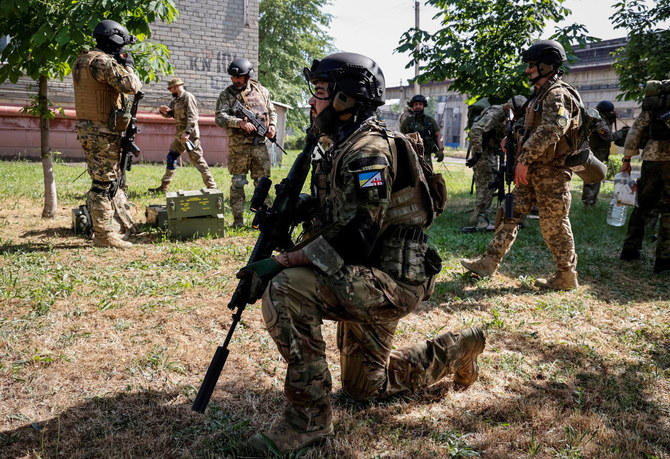

SIEVIERODONETSK, Ukraine: Ukraine said it clawed back a chunk of the industrial center of Sievierodonetsk in combat that appeared on Saturday to be stymieing a Russian drive to capture the ruined city, the focus of Moscow’s offensive to take the eastern Donbas region.
Sergiy Gaidai, governor of Luhansk province, told national television that Ukrainian troops had retaken 20 percent of the territory they had lost in Sievierodonetsk.
It was “not realistic” the city would fall in the next two weeks even though Russian reinforcements were being deployed, he said on Friday.
“As soon as we have enough Western long-range weapons, we will push their artillery away from our positions. And then, believe me, the Russian infantry, they will just run,” said Gaidai. Reuters could not immediately verify his claim of Ukrainian advances.
The war that Western governments believed Russian planned to win within a few hours of its February invasion entered its 100th day on Friday. Thousands have died, millions have been uprooted from their homes and the global economy disrupted since Moscow’s forces were driven back from Kyiv in the first months of the conflict.
Russian President Vladimir Putin denied on Friday that Moscow was preventing Ukrainian ports from exporting grains, blaming rising global food prices on the West.
“We are now seeing attempts to shift the responsibility for what is happening on the world food market, the emerging problems in this market onto Russia,” he said on national television.
He said the best solution would be for Western sanctions on Russia’s ally Belarus to be lifted and for Ukraine to export grain through that country.
Ukrainian officials are counting on advanced missile systems that the United States and Britain recently pledged to swing the war in their favor, and Ukrainian troops have already begun training on them.
While Ukraine’s resistance has forced Putin to narrow his immediate goal to conquering the entire Donbas region, Ukrainian officials said he remains intent on subduing the whole country. “Putin’s main goal is the destruction of Ukraine. He is not backing down from his goals, despite the fact that Ukraine won the first stage of this full-scale war,” Ukrainian Deputy Defense Minister Hanna Malyar told national television on Friday.
Moscow has poured troops and materiel into the battle for Sievierodonetsk, which Russia must overrun to take all of Luhansk, one of two provinces that comprise the eastern Donbas region that the Kremlin has stated it intends to capture.
Reuters reached Sievierodonetsk on Thursday and was able to verify that Ukrainians still held part of the city.
Separately, two Reuters journalists were injured and a driver killed on Friday after their vehicle came under fire as they tried to reach Sievierodonetsk from an area controlled by Russian-backed separatists.
Russian soldiers attempted to advance toward Lysychansk, across the Siverskyi Donetsk River from Sievierodonetsk but were stopped, Ukraine’s military general staff said.
In neighboring Donetsk province, Russian troops were just 15 km (9 miles) outside the city of Sloviansk, regional governor Pavlo Kyrylenko told Reuters.
Donetsk will not fall quickly, but needs more weapons to keep the attackers at bay, Kyrylenko said.
Moscow says undeterred by Western arms
Moscow says the Western weapons will pour “fuel on the fire,” but will not change the course of what it calls a “special military operation” to disarm Ukraine and rid it of dangerous nationalists.
Russia still controls around a fifth of the country, about half seized in 2014 and half captured since launching its invasion on Feb. 24.
For both sides, the massive Russian assault in the east in recent weeks has been one of the deadliest phases of the war, with Ukraine saying it is losing 60-100 soldiers every day.
Moscow has made slow but steady progress, squeezing Ukrainian forces inside a pocket in Luhansk and Donetsk provinces, but failing to encircle them.
Kyiv, meanwhile, hopes the Russian advance will drain Moscow’s forces enough for Ukraine to recapture territory in months to come.
The war has had a devastating impact on the global economy, especially for poor food-importing countries. Ukraine is one of the world’s leading sources of grain and cooking oil, but those supplies were cut off by the closure of its Black Sea ports, with more than 20 million tons of grain stuck in silos.
UN aid chief Martin Griffiths on Friday ended two days of “frank and constructive discussions” with Russian officials in Moscow on facilitating exports of Ukraine grain from Black Sea ports, a UN spokesman said.
The talks came as UN Secretary-General Antonio Guterres tries to broker what he calls a “package deal” to resume both Ukrainian food exports and Russian food and fertilizer exports.
Kyiv and its allies blame Moscow for blockading the ports, which Ukraine has mined to prevent a Russian amphibious assault. Putin blamed Western sanctions.


