Iran must release journalist: Press rights group

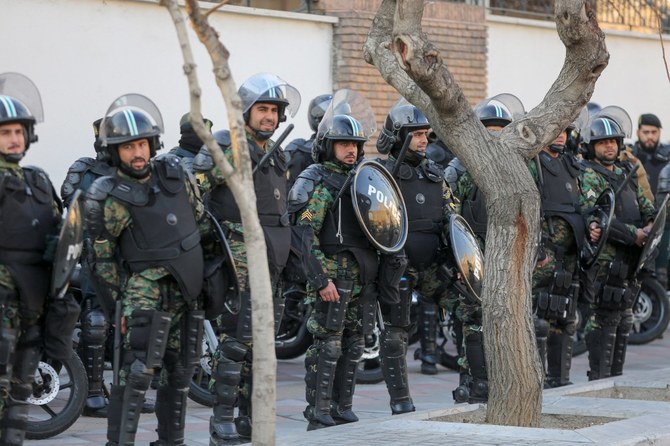
Iranian security forces stand guard in front of the British embassy in the capital Tehran. (File/AFP)
Short Url
Updated 01 June 2022
Follow

Iran must release journalist: Press rights group

  • Arash Ghaleh-Golab was at a mourning ceremony in Khuzestan province when he was arrested

  • Committee to Protect Journalists: ‘The authorities must cease arbitrarily locking up members of the press’

LONDON: The Committee to Protect Journalists on Wednesday urged Iranian authorities to release a freelance reporter who was detained by state security forces.

Sources in Iran told the CPJ that Arash Ghaleh-Golab was at a mourning ceremony on May 26 near the Metropol building — which recently collapsed, killing 31 in Abadan city in the southwestern Khuzestan province — when he was arrested. 

A source familiar with the case told the CPJ that during the arrest, officers hit Ghaleh-Golab and kicked him.

The CPJ said he is still detained without charge at an undisclosed location, and has not been allowed to contact his family. 

It is unclear if Ghaleh-Golab attended the mourning ceremony as a private citizen or in his capacity as a journalist.

“Iranian authorities must understand that they can’t hide the country’s difficult realities and problems by silencing and jailing journalists,” said Justin Shilad, the CPJ’s Middle East and North Africa senior researcher.

“The authorities must free journalist Arash Ghaleh-Golab immediately and unconditionally and cease the practice of arbitrarily locking up members of the press.” 

Ghaleh-Golab writes political commentary and opinion pieces, according to the CPJ’s anonymous source, and has recently contributed to state-run media. He was reportedly arrested in 2016 following his critical commentary of state policies.

His arrest comes amid a political atmosphere in Abadan that was tense even before the building collapse.

Communities in Khuzestan have been blighted by extreme food and water shortages that have affected much of Iran.

This tension boiled over after the Metropol collapsed, sparking fresh waves of anti-regime demonstrations, with security forces responding violently.

The CPJ emailed the Iranian mission to the UN in New York but did not receive a response.


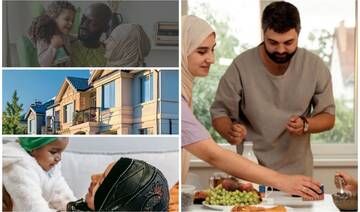
Study finds nearly half of UK news stories on Muslims show signs of bias

Updated 09 March 2026
Follow

Study finds nearly half of UK news stories on Muslims show signs of bias

  • Centre for Media Monitoring finds 20,000 out of 40,913 articles from 30 major news outlets contain bias and 70% link Muslims to negative behaviors or themes
  • Findings reveal ‘deeply concerning evidence of structural bias’ in portrayal of Muslims by UK press and point to ‘systemic problem’ within the media, says center’s director

LONDON: Nearly half of news articles published in the UK in 2025 that referenced Muslims or Islam contained some degree of bias, according to a report issued on Monday by the Centre for Media Monitoring. It also found that about 70 percent of stories linked Muslims to negative behaviors or themes.

The nonprofit organization, which tracks the ways in which Muslims and Islam are portrayed in the media, examined 40,913 articles from 30 major news outlets and found that about 20,000 showed some form of bias.

The study looked at “structural patterns” in coverage that “shape public narratives” about Muslims amid rising hostility toward the community.

“As the largest study of its kind ever conducted in the UK, this report presents deeply concerning evidence of structural bias in how Muslims are portrayed in the UK press,” said Rizwana Hamid, the director of the organization.

It found that 70 percent of the articles it reviewed highlighted negative aspects related to Muslims, though not all of the stories were biased in themselves. The wider patterns were also troubling: 44 percent of the coverage omitted key context, 17 percent relied on generalizations, and 13 percent included outright misrepresentation.

Taken together, the monitoring center said, the findings amounted to evidence of an “information integrity crisis” that distorts public understanding, and “a deeply concerning trend” in reporting on Muslims.

The research points to a “systemic problem within our media ecosystem,” Hamid said.

“When entire communities are repeatedly framed through lenses of suspicion or threat, it inevitably shapes public attitudes, political debate and the everyday lives of British Muslims,” she added.

News brands targeting right-wing audiences were more likely to produce biased coverage, the report found.

The Spectator magazine and GB News were identified as having the highest proportion of “very biased” articles, and as the “worst across all five bias categories”: negative framing, generalizations, misrepresentation, lack of context, and problematic headlines.

Other outlets highlighted for displaying high levels of biased content about Muslims included The Telegraph, The Jewish Chronicle, Daily Express, The Sun, Daily Mail and The Times.

In contrast, the BBC, other broadcasters and left-leaning outlets recorded the lowest rates of bias in the study.

The research comes as British Muslims report rising levels of discrimination. Official figures published in October revealed that religious hate crimes against Muslims rose by 19 percent in the year to March 2025 compared with the previous 12 months.