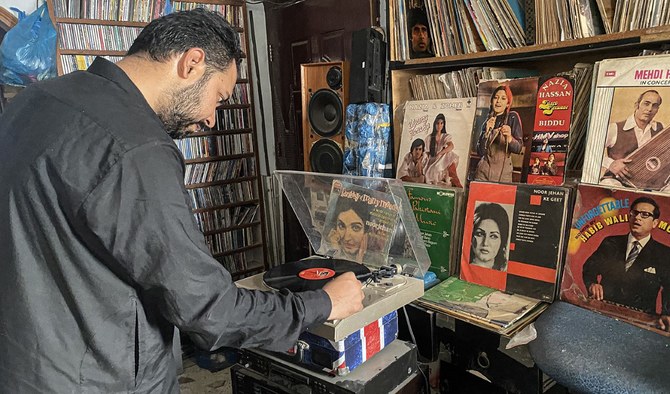

KARACHI: To get to Muhammad Hussain’s vinyl library in Karachi, visitors must make their way through a congested neighbourhood teeming with motorbikes and rickshaws until they reach a nondescript off white building on the edge of Violet Street.
Once there, they climb up a staircase to the fourth floor and walk right down the end of a dusty hallway to a door that bears no sign that beyond it lie 25,000 vinyl discs — likely the largest private collection of such records in Pakistan.
Records of legendary Pakistani and Indian singers seen at Muhammad Hussain's collection of vinyl records in Karachi, Pakistan, on May 25, 2022. (AN photo)
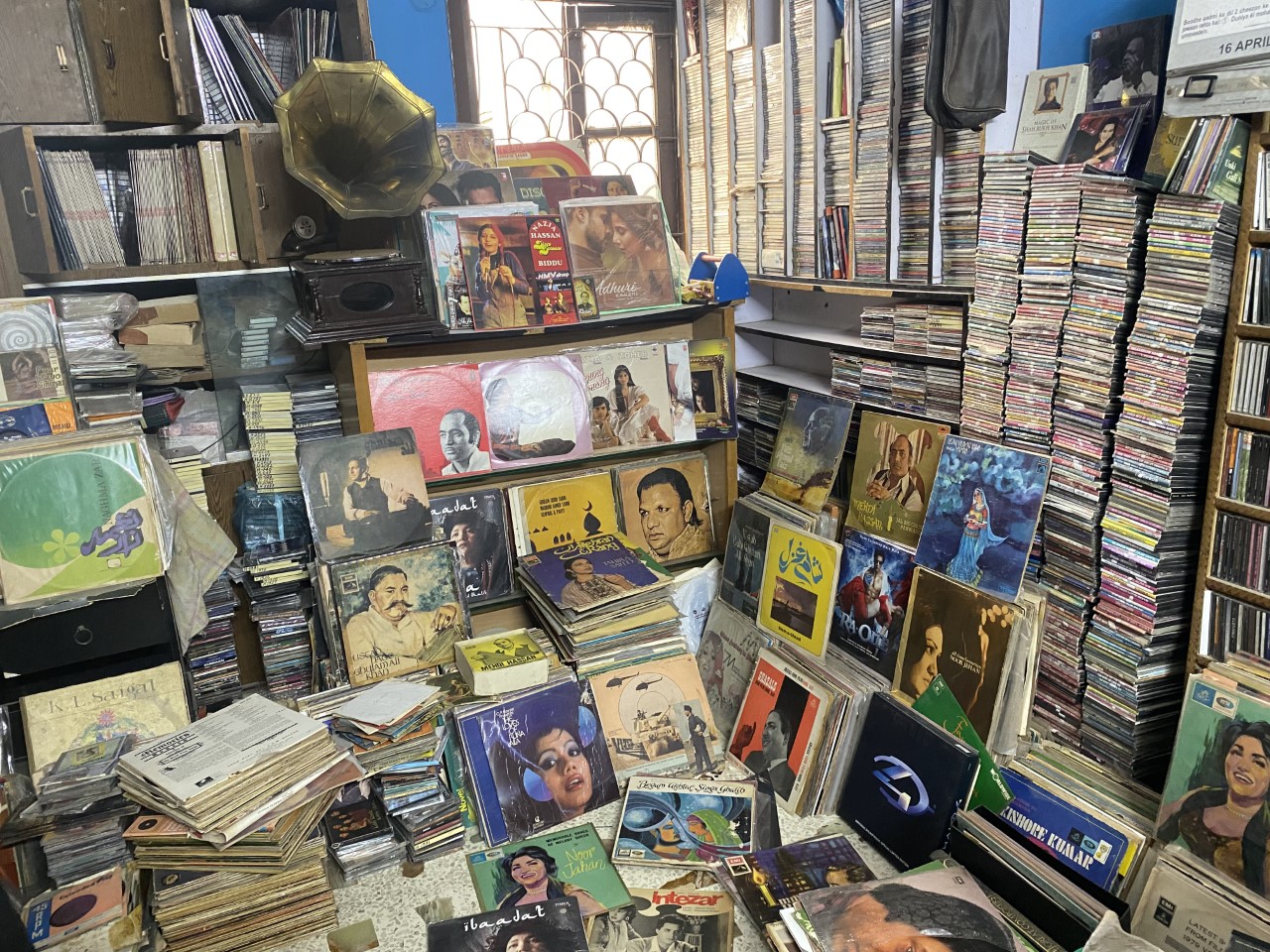
The three bedroom apartment-turned-library is full of wooden shelves lined with albums, some still in plastic wrapping, some labeled with Post-it notes marking them as rare. Wooden crates and cardboard cartons overflow with soundtracks and "Best of" collections, and antique radios and gramophones in different shapes and sizes sit atop tall piles of records. And the music is always playing: the hugely popular ghazal and folk singer Malika Pukhraj’s famous rendition of ‘Abhi tou mein jawan hoon’ hung in the afternoon air last week.
“I came to know how rare and precious these things [records] are, how important their existence and maintenance is,” Hussain told Arab News at the music library as he thumbed through some sleeves to find a record. “This is an asset of Pakistan.”
The music library once used to be the warehouse for Rhythm House, a record store run by Hussain’s father on Karachi’s famous Tariq Road, forced to shut down in 2006 after music’s digital revolution sounded the death knell for audio tapes, discs and records.

An old gramophone stands among thousands of vinyl records in Muhammad Hussain's collection of vinyl records in Karachi, Pakistan, on May 25, 2022. (AN photo)
Six years later, aged 20, Hussain, who regularly listened to old Pakistani vinyl records while growing up, decided to explore the remaining collection of family tapes and records. Cleaning records at the warehouse and browsing titles on the internet, he realized soon enough that he had a treasure-trove on his hands.
What began as a quest to arrange thousands of records, cassettes and CDs left behind from Rhythm House led Hussain to what is now his life’s work and passion: vinyl records.

CDs displayed on shelves of Muhammad Hussain's music library in Karachi, Pakistan, on May 25, 2022. (AN photo)
Today Hussain's library of 25,000 records boasts 4,000 LPs and around 10,000 singles of qawwali and ghazal masters, major pop names from the 1970s and 1980s, and some rare releases from the 1950s.
“I started listening to music from Nazia Hassan’s (records),” he said, referring to a Pakistani singing sensation from the 1980s who has been called the queen of South Asian pop. “Then, gradually, I moved on to Noor Jehan, Mehdi Hasan, Iqbal Bano and Farida Khanum," he added, listing grand masters of the ghazal form.
Hussain is well known among the community of record collectors and often gets calls from people wanting to buy and sell records.
“When I find records in other parts of Karachi, it takes a whole day to travel there,” Hussain said. “To go there, go back, sort out the records, bring them back and clean them and do the whole processing, it takes me 2-3 days just for a few records.”
And orders to buy and exchange records come from across Pakistan as well as other countries.
“I have received a lot of messages and calls from all over the world, many other countries [people] saying we want these records,” Hussain said. “When I have extra copies, I give them away and help people complete their collections.”
He said he refused to fix a value to his “precious collection” but said records could go for as low as Rs2,000 ($10) to as high as Rs50,000 ($250).
But his collection is not about making money for Hussain. It is about being a part of a community of vinyl devotees: “We have kept this [business] alive for passionate people. It is our passion to collect these items and get them to those who care about them.”
Many connoisseurs visit the library, some looking for a particular record, a rare find, and others just wanting to browse and listen to music for hours - a guilty pleasure.
“When he saw my library, believe me, his six hours here passed like he had spent just 10 minutes,” Hussain said, recalling a recent visitor from Lahore. “While leaving, he said, ‘I have been searching for these things for the last 15 years.’”
Hussain understands the enthusiasm.
“This is a passion which won’t let you sleep when you come to know that there are some records,” he said. “It is devotion, a passion and craze.”
What makes records so significantly different from other storage formats is their audio quality, which for Hussain does not compare to anything that modern, widely available technology can offer.
“The sound quality you have in original records cannot be found on YouTube or any other digital format,” he said.
“The sound quality of the record is such that when you listen to it, it will feel as if the musician is singing right in front of you and its clarity is so beautiful that you will be lost in it while listening and before you know it, the whole record has ended.”
When asked how he felt about owning possibly one of the largest collections of vinyl records in Pakistan, Hussain smiled. Behind him, a record player began to spin a blue disk: Best of Noor Jehan Vol. 1.
“Music is like a huge ocean, this a passion that can never be fulfilled, no matter how passionate a person is,” he said. “There is such a huge library just in Pakistan that no one person has a complete collection.”