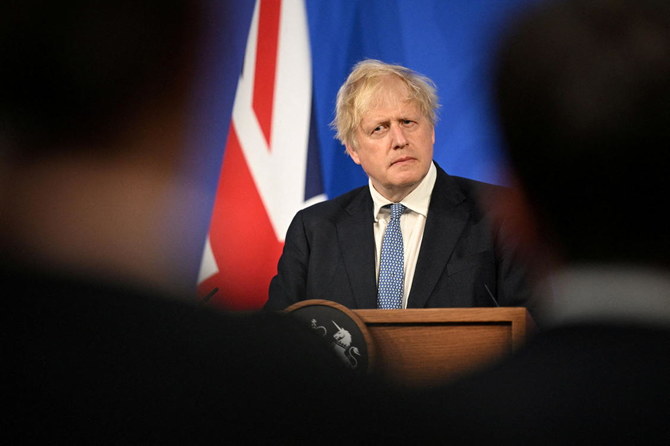
LONDON: Prime Minister Boris Johnson on Tuesday denied breaching the UK government’s ministerial code of conduct, as he bids to head off a growing Conservative revolt over the “Partygate” scandal.
Former Conservative leader William Hague said Johnson could face a no-confidence vote among his own MPs as soon as next week, following numerous lockdown-breaching parties held in Downing Street.
Johnson became the first serving UK prime minister found to have broken the law while in office when he was fined by police for attending a birthday party in June 2020.
Although he has apologized, he has repeatedly refused to resign, and doubled down on his defense in a letter to his independent adviser on ministerial interests, Christopher Geidt.
Lord Geidt issued an annual report laying out the need for Johnson to explain why he had not breached the ministerial code, in light of the police fine.
Under previous governments, violations of the code were considered a resigning offense, but Johnson has already stood by others in his ministerial team found to have been in breach.
Responding to Geidt, Johnson said “I did not breach the code.”
There was “no intent to break the law,” he said, insisting he had been “fully accountable” to parliament “and rightly apologized for the mistake.”
However, dozens of Tory MPs have now publicly criticized their embattled leader over the parties under his watch, which happened when the government was ordering the public to respect Covid lockdowns.
If 54 of them write a letter of no confidence in Johnson to a powerful backbench committee of Tory MPs, that will trigger a vote of all 359 Conservatives lawmakers on whether he should continue as leader and thereby prime minister.
Nearly 30 MPs are publicly known to have submitted such a letter but the process is shrouded in secrecy and the real tally is impossible to gauge.
Parliament is not sitting this week and with four days of celebrations for Queen Elizabeth II’s Platinum Jubilee beginning on Thursday, any announcement about a possible vote would not come until next week at the earliest.
The latest heavyweight Tories to express doubts about Johnson include former attorney general Jeremy Wright, who on Monday urged him to resign, and ex-cabinet minister Andrea Leadsom.
Hague said the intervention of Leadsom — a prominent “Brexiteer” who campaigned alongside Johnson in Britain’s 2016 EU referendum — had lit a “slow fuse” on a no-confidence vote.
“The fuse is getting closer to the dynamite here and it’s speeding up,” Hague told Times Radio, adding it was “just another indication the Conservative Party is moving faster toward a vote.”
Support for Johnson among Conservatives has ebbed further away following last week’s publication of an internal inquiry.
The probe by senior civil servant Sue Gray found that he presided over a culture of parties that ran late into the night and even featured a drunken fight among staff.
Johnson secured an 80-seat majority at the last general election in December 2019, on a promise to take the UK out of the European Union.
But despite that, an increasing number of Tory MPs have come forward to say they do not believe the party can win the next election, which is due by 2024, under his leadership.
Opinion polls have shown deep public disapproval over the scandal, with large majorities of people saying Johnson knowingly lied about “Partygate” and that he should resign.
The Tories have suffered several electoral setbacks during his tenure, including losing traditionally safe seats to the Liberal Democrats in by-elections and hundreds of councillors in local elections in early May.
The party is also predicted to lose two more by-elections in June, in southwest and northern England.


![]()

UK’s PM launches new ‘Partygate’ defense as rebels mobilize
Short Url
https://arab.news/5ccpk
UK’s PM launches new ‘Partygate’ defense as rebels mobilize
- Former Conservative leader William Hague said Johnson could face a no-confidence vote among his own MPs as soon as next week
- Although he has apologised, the PM has repeatedly refused to resign


Latest updates


Recommended


© 2026 SAUDI RESEARCH & PUBLISHING COMPANY, All Rights Reserved And subject to Terms of Use Agreement.