

Pakistan increases power tariff by Rs3.99 per unit amid rising inflation

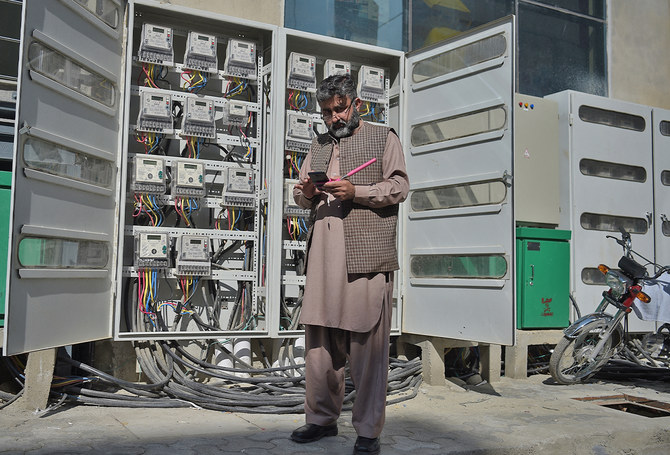
A Pakistani employee of the state-run Islamabad Electric Supply Company (IESCO), takes a meter reading with his smartphone at a commercial building in Islamabad, Pakistan, on November 7, 2018.(AFP/File)
Short Url
Updated 31 May 2022
Follow

Pakistan increases power tariff by Rs3.99 per unit amid rising inflation

  • The increase on account of fuel cost adjustment will be charged in electricity bills of June
  • Pakistan faces worsening balance-of-payment crisis, with inflation expected to hit 14.3 percent in May

ISLAMABAD: Amid rising inflation, Pakistan’s National Electric Power Regulatory Authority (NEPRA) on Tuesday jacked up the power tariff by Rs3.99 per unit on account of fuel cost adjustment (FCA) for the month of April, the regulator said. 

The development comes as Pakistani and International Monetary Fund (IMF) officials remained engaged for the revival of $6 billion loan program Islamabad availed in 2019, which will see the disbursement of around $1 billion tranche to the South Asian nation. On May 26, the government raised petroleum prices by Rs30 per liter after IMF officials expressed concern about the fiscal and current account situation arising from $2 billion energy subsidies and other slippages. 

Pakistan has been struggling with a worsening balance-of-payment crisis in the face of declining foreign exchange reserves, with inflation in the South Asian nation expected to reach 14.3 percent in May and the recent energy price hikes further impacting the economic indicators in the month of June. 

On Tuesday, NEPRA Chairman Tauseef H Farooqi held an open hearing on power distribution companies’ claims for FCA for the month of April. 

“The CPPA-G (Central Power Purchasing Agency [Guarantee]) had submitted a request for an increase in tariff by Rs4.5 per unit,” NEPRA said in a statement. 

“However, according to the preliminary examination of the data, it [FCA] was Rs3.99.” 

The FCA for the month of April will be charged in electricity bills for June, according to the power regulator. However, it will not be applicable to lifeline consumers. 

Pakistani cities and rural areas have been facing hours-long power outages as the country’s power shortfall has reached 7,000 megawatts, local media reported on Tuesday. 

Government officials say several power plants in the country were closed due to a lack of fuel and other technical issues, which have resulted in the shortfall and outages. 

Prime Minister Shehbaz Sharif’s government blames former administration of Imran Khan for the crisis, saying it neither procured fuel nor undertook proper maintenance and repair of power plants. Khan’s Pakistan Tehreek-e-Insaf (PTI) party denies the allegations. 


Pakistani president arrives in Iraq to deepen trade, energy cooperation

Updated 20 December 2025
Follow

Pakistani president arrives in Iraq to deepen trade, energy cooperation

  • Visit follows recent high-level contacts as Islamabad seeks to expand limited commercial ties with Baghdad
  • Talks are expected to cover investment, manpower and facilitation of Pakistani pilgrims visiting holy sites in Iraq

ISLAMABAD: President Asif Ali Zardari arrived in Iraq on Saturday on an official visit aimed at expanding cooperation in trade, energy and investment, as Pakistan seeks to deepen ties with Baghdad after years of limited engagement.

Pakistan and Iraq established diplomatic relations in 1947 and have traditionally maintained cordial ties, though commercial links remain modest, with officials and business groups identifying scope for cooperation in construction services, pharmaceuticals, manpower and agricultural exports.

“President Asif Ali Zardari arrived in Baghdad on a four-day official visit to Iraq,” his office said in a post on X. “He was received by Culture Minister Dr. Ahmed Fakkak Al-Badrani. During the visit, meetings with senior Iraqi leadership are expected to advance cooperation and further strengthen Pakistan-Iraq relations.”

Zardari’s visit follows a series of recent high-level contacts between the two countries, reflecting efforts to broaden bilateral engagement beyond traditional diplomatic ties and explore collaboration across economic, political and people-to-people domains.

According to Pakistan’s foreign office, the president is expected to hold meetings with Iraq’s senior leadership to discuss cooperation in various areas such as trade and investment, energy, technology, education and manpower.

He is also expected to discuss regional and international issues with Iraqi officials.

Earlier this month, Pakistan’s Interior Minister Mohsin Naqvi met his Iraqi counterpart, Abdul Ameer Al-Shammari, on the sidelines of meetings in Brussels, where both sides agreed to enhance cooperation on security and facilitate travel for Pakistani Shia pilgrims to Najaf and Karbala.

The two officials discussed measures to ensure the smoother movement of these pilgrims and their compliance with visa regulations.