

Pakistan jumps six places on World Economic Forum’s global tourism index

A general view of Naran valley is pictured in Mansehra District of Khyber Pakhtunkhwa province on June 28, 2021. (AFP/File)
Short Url
Updated 21 September 2025
Follow

Pakistan jumps six places on World Economic Forum’s global tourism index

  • The index measures factors and policies for sustainable development of tourism
  • Pakistan ranks 83rd among 117 economies, with record improvement since 2019 

ISLAMABAD: Pakistan has jumped six spots on the International Travel and Tourism Development Index (TTDI), the World Economic Forum (WEF) said in its latest report, with the South Asian nation making a significant improvement in the sector. 

The index measures the set of factors and policies that enable sustainable and resilient development of travel and tourism sector, which in turn contributes to the development of a country. 

The WEF covered 117 economies for its 2021 report, with Pakistan ranking among the lower-middle-income countries improving the most since 2019. 
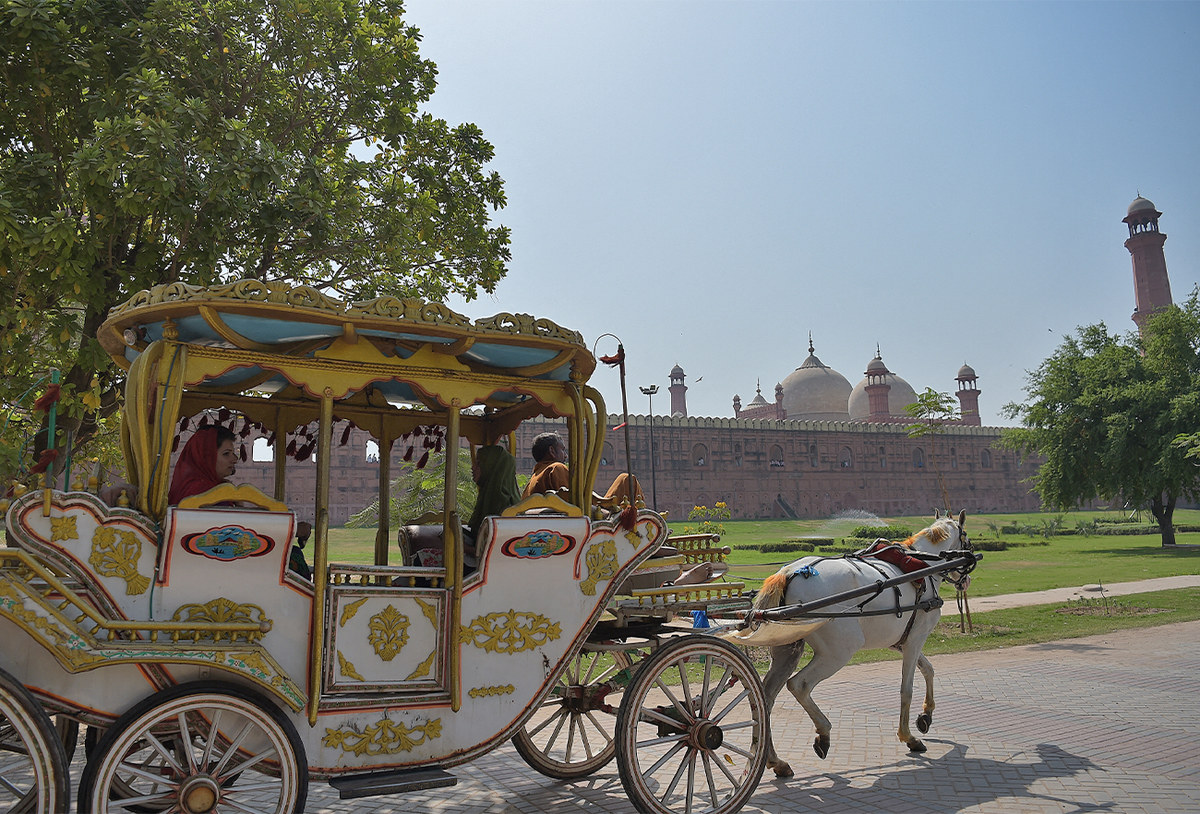


In this photograph taken on October 7, 2017, tourists ride on a horse buggy as they look at the historic Badshahi Mosque in Lahore, Pakistan. (AFP/File)

“As mentioned, Japan is the top performer in both the APAC region and globally, with Australia (7th) and Singapore (9th) ranking in the global top 10,” the WEF report read. 

“However, it is lower-middle-income economies such as Viet Nam (+4.7 percent, 60th to 52nd), Indonesia (+3.4 percent, 44th to 32nd) and Pakistan (+2.9 percent, 89th to 83rd) that have improved their TTDI scores the most since 2019.” 

China, which ranks 12th on the TTDI, has the region’s largest travel and tourism economy, while the Philippines, which depended the most on tourism for its GDP in 2020, ranks 75th, according to the report. India is the top scorer in South Asia on 54th position globally. 

In 2019, tourism accounted for a tenth of global GDP and jobs but the coronavirus pandemic decimated the $9.6 trillion industry, halving its output value and leaving 62 million people jobless. 

The global travel and tourism sector is projected to return to pre-pandemic levels in 2023 and grow at a rate that will outpace global gross domestic product (GDP) growth, the World Travel and Tourism Council (WTTC) said in April. 

The industry is expected to post an annual average growth rate of 5.8 percent from 2022 to 2032 versus the 2.7 percent increase in global GDP, and create 126 million new jobs. 


Pakistan’s deputy PM says country will not send forces to Gaza to disarm Hamas

Updated 9 sec ago
Follow

Pakistan’s deputy PM says country will not send forces to Gaza to disarm Hamas

  • Ishaq Dar says Pakistan open to peacekeeping but Gaza’s internal security is Palestinian responsibility
  • Pakistan’s top religious clerics from different schools have warned against sending forces to Palestine

ISLAMABAD: Deputy Prime Minister Ishaq Dar said on Saturday Pakistan was willing to contribute to an international peacekeeping force in Gaza, though it would not deploy troops to disarm or de-weaponize Hamas.

The statement follows media reports saying Washington views Pakistan as a potentially significant contributor given its battle-hardened military and wants it to be part of International Stabilization Force (ISF), which is part of United States President Donald Trump’s 20-point framework for a Gaza peace plan.

The plan announced by Trump at the White House on September 29 was formally adopted at the Sharm El-Sheikh Peace Summit in October. Co-chaired by Trump and Egyptian President Abdel Fattah El-Sisi, the summit brought together leaders from 27 countries to sign the “Trump Declaration for Enduring Peace and Prosperity.”

Deployment of troops from Muslim-majority countries during a transitional stabilization phase is a key part of the plan before the war-ravaged Palestinian territory moves toward reconstruction and a longer-term political settlement.

“If they say that we should go and start fighting, disarm Hamas, de-weaponize them, and go and destroy the tunnels that Hamas has built until now, that is not our job,” Dar, who is also the country’s foreign minister, told reporters during a year-end briefing in Islamabad.

He emphasized there was clarity between Pakistan’s civil and military leadership over the matter.

“We have a very complete understanding on this matter that we cannot do that kind of work,” he added.

The deputy prime minister said Pakistan had been using the term “peacekeeping” and had never used the phrase “peace enforcement” while discussing the force.

“I have been very clear: Pakistan will be happy to join if the mandate is not peace enforcement and disarming and de-weaponizing Hamas.”

The government’s stance comes amid growing domestic pressure over the issue.

On Monday, a group of Pakistan’s top religious leaders, chaired by prominent scholar Mufti Taqi Usmani, warned the government against yielding to what they described as international pressure to send forces to Gaza.

In a joint statement from Karachi, the clerics — representing Deobandi, Barelvi, Ahl-e-Hadees and Shia schools of thought — said that Washington wanted Muslim countries to send their forces to Gaza to disarm Hamas.

“Several Muslim governments have already refused this, and pressure is being increased on Pakistan,” it added.

Addressing such concerns, Dar said Pakistan would not land its forces in Palestine to “fight Muslims.”

Israel has repeatedly called for the disarmament of Hamas as a precondition for any long-term settlement, and the United Nations Security Council has also endorsed the ISF framework in November.

However, Dar maintained during the media briefing the internal security of Gaza was the Palestinian responsibility.

“The Palestinian Authority, their government, it is their job, it is the job of their law enforcement agency,” he said

The deputy prime minister also highlighted Pakistan’s involvement in the “Arab Islamic Group of Eight,” including Saudi Arabia, Jordan, Egypt, the United Arab Emirates, Qatar, Turkiye and Indonesia, which has been coordinating on the crisis.

He said the efforts of these countries had brought some peace to Palestine and reduced bloodshed.

“Our declared policy is that there should be an independent two-state solution,” he continued while calling for pre-1967 borders.