

Angry Iranians confront cleric at Abadan tower collapse that killed 32

1 / 2
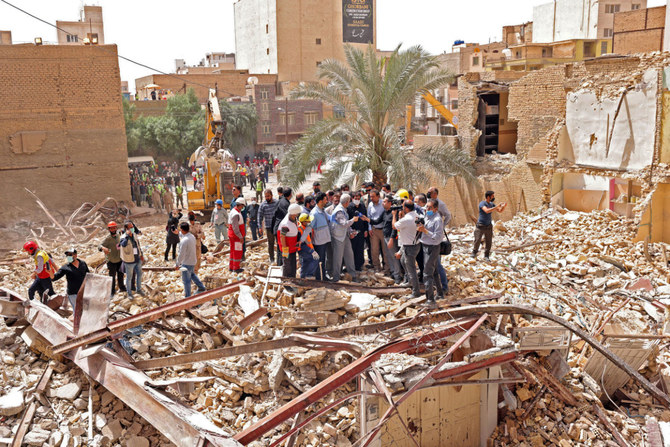
Iranian vice president Mohammad Mokhber (C) visits the site where a 10-storey building collapsed in the southwestern city of Abadan on May 27, 2022. (Iran presidency handout via AFP)
2 / 2
Rescue crews work at the site of a collapsed building in Abadan, Iran, on May 23, 2022. (West Asia News Agency via REUTERS)
Short Url
Updated 31 May 2022
Follow

Angry Iranians confront cleric at Abadan tower collapse that killed 32

  • Ayatollah tried to address upset mourners near the site of the collapsed Metropol Building but was instead booed and shouted down by a crowd
  • Video later showed officers confronting and clubbing demonstrators amid a cloud of tear gas in an attempt to disperse them

DUBAI: Protesters angry over a building collapse in southwestern Iran that killed at least 32 people shouted down an emissary sent by Supreme Leader Ayatollah Ali Khamenei, sparking a crackdown that saw riot police club demonstrators and fire tear gas, according to online videos analyzed on Monday.
The demonstration directly challenged the Iranian government’s response to the disaster a week ago as pressure rises in the country over rising food prices and other economic woes amid the unraveling of its nuclear deal with world powers.
While the protests so far still appear to be leaderless, even Arab tribes in the region seemed to join them Sunday, raising the risk of the unrest intensifying. Already, tensions between Tehran and the West have spiked after Iran’s paramilitary Revolutionary Guard on Friday seized two Greek oil tankers seized at sea.
Ayatollah Mohsen Heidari AleKasir tried to address upset mourners near the site of the 10-story Metropol Building but hundreds gathered Sunday night instead booed and shouted.
Surrounded by bodyguards, the ayatollah, in his 60s, tried to continue but couldn’t.
“What’s happening?” the cleric stage-whispered to a bodyguard, who then leaned in to tell him something.


The cleric then tried to address the crowd again: “My dears, please keep calm, as a sign of respect to Abadan, its martyrs and the dear (victims) the whole Iranian nation is mourning tonight.”
The crowd responded by shouting: “Shameless!”
A live broadcast on state television of the event then cut out. Demonstrators later chanted: “I will kill; I will kill the one who killed my brother!”
The Tehran-based daily newspaper Hamshahri and the semiofficial Fars news agency said the protesters attacked the platform where state TV had set up its camera, cutting off its broadcast.
Police ordered the crowd not to chant slogans against the mullah regime and then ordered them to leave, calling their rally illegal. Video later showed officers confronting and clubbing demonstrators as clouds of tear gas rose. At least one officer fired what appeared to be a shotgun, though it wasn’t clear if it was live fire or so-called “beanbag” rounds designed to stun.
It wasn’t immediately clear if anyone was injured or if police made any arrests.
The details in the videos corresponded to known features of Abadan, located some 660 kilometers (410 miles) southwest of the capital, Tehran. Foreign-based Farsi-language television channels described tear gas and other shots being fired.
Independent newsgathering remains extremely difficult in Iran. During unrest, Iran has disrupted Internet and telephone communications to affected areas, while also limiting the movement of journalists inside of the country. Reporters Without Borders describes the Islamic Republic as the third-worst country in the world to be a journalist — behind only North Korea and Eritrea.

Following the tower collapse in Abadan last Monday, authorities have acknowledged the building’s owner and corrupt government officials had allowed construction to continue at the Metropol Building despite concerns over its shoddy workmanship. Authorities have arrested 13 people as part of a broad investigation into the disaster, including the city’s mayor.
Rescue teams pulled three more bodies from the rubble on Monday, bringing the death toll in the collapse to 32, according to the state-run IRNA news agency. Authorities fear more people could be trapped under the debris.
The deadly collapse has raised questions about the safety of similar buildings in the country and underscored an ongoing crisis in Iranian construction projects. The collapse reminded many of the 2017 fire and collapse of the iconic Plasco building in Tehran that killed 26 people.
In Tehran, the city’s emergency department warned that 129 high-rise buildings in the capital remained “unsafe,” based on a survey in 2017. The country’s prosecutor-general, Mohammad Javad Motazeri, has promised to address the issue immediately.
Abadan has also seen disasters in the past. In 1978, an intentionally set fire at Cinema Rex — just a few blocks away from the collapsed building in modern Abadan — killed hundreds. Anger over the blaze triggered unrest across Iran’s oil-rich regions and helped lead to the Islamic Revolution that toppled Shah Mohammad Reza Pahlavi.

Abadan, in Iran’s oil-rich Khuzestan province, is home to Iran’s Arab minority, who long have complained about being treated as second-class citizens in the Persian nation. Arab separatists in the region have launched attacks on pipelines and security forces in the past. Videos and the newspaper Hamshahri noted that two tribes had come into the city to support the protests.
Meanwhile, one of the two Greek tankers seized by Iran on Friday turned on its tracking devices for the first time since the incident. The oil tanker Prudent Warrior gave a satellite position Monday off Bandar Abbas, a major Iranian port, according to data from MarineTraffic.com analyzed by The Associated Press.
Five armed guards were on the Prudent Warrior on Monday, though Iranian authorities were allowing the crew to use their mobile phones, said George Vakirtzis, the chief financial officer of the ship’s manager Polembros Shipping.
“The whole thing is political and in the hands of the Greek Foreign Office and the Iranian government,” Vakirtzis told the AP.
Monday night, Iranian state TV aired footage of the raid on the Prudent Warrior. The video showed masked Guard troops land a helicopter on the ship, then storm the civilian ship’s bridge armed with assault rifles.
It remains unclear where the second ship, the Delta Poseidon, is.


Gaza ceasefire enters phase two despite unresolved issues

Updated 16 January 2026
Follow

Gaza ceasefire enters phase two despite unresolved issues

  • Under the second phase, Gaza is to be administered by a 15-member Palestinian technocratic committee operating under the supervision of a so-called “Board of Peace,” to be chaired by Trump

JERUSALEM: A US-backed plan to end the war in Gaza has entered its second phase despite unresolved disputes between Israel and Hamas over alleged ceasefire violations and issues unaddressed in the first stage.
The most contentious questions remain Hamas’s refusal to publicly commit to full disarmament, a non-negotiable demand from Israel, and Israel’s lack of clarity over whether it will fully withdraw its forces from Gaza.
The creation of a Palestinian technocratic committee, announced on Wednesday, is intended to manage day-to-day governance in post-war Gaza, but it leaves unresolved broader political and security questions.
Below is a breakdown of developments from phase one to the newly launched second stage.

Gains and gaps in phase one

The first phase of the plan, part of a 20-point proposal unveiled by US President Donald Trump, began on October 10 and aimed primarily to stop the fighting in the Gaza Strip, allow in aid and secure the return of all remaining living and deceased hostages held by Hamas and allied Palestinian militant groups.
All hostages have since been returned, except for the remains of one Israeli, Ran Gvili.
Israel has accused Hamas of delaying the handover of Gvili’s body, while Hamas has said widespread destruction in Gaza made locating the remains difficult.
Gvili’s family had urged mediators to delay the transition to phase two.
“Moving on breaks my heart. Have we given up? Ran did not give up on anyone,” his sister, Shira Gvili, said after mediators announced the move.
Israeli Prime Minister Benjamin Netanyahu said efforts to recover Gvili’s remains would continue but has not publicly commented on the launch of phase two.
Hamas has accused Israel of repeated ceasefire violations, including air strikes, firing on civilians and advancing the so-called “Yellow Line,” an informal boundary separating areas under Israeli military control from those under Hamas authority.
Gaza’s Hamas-run health ministry said Israeli forces had killed 451 people since the ceasefire took effect.
Israel’s military said it had targeted suspected militants who crossed into restricted zones near the Yellow Line, adding that three Israeli soldiers were also killed by militants during the same period.
Aid agencies say Israel has not allowed the volume of humanitarian assistance envisaged under phase one, a claim Israel rejects.
Gaza, whose borders and access points remain under Israeli control, continues to face severe shortages of food, clean water, medicine and fuel.
Israel and the United Nations have repeatedly disputed figures on the number of aid trucks permitted to enter the Palestinian territory.

Disarmament, governance in phase two

Under the second phase, Gaza is to be administered by a 15-member Palestinian technocratic committee operating under the supervision of a so-called “Board of Peace,” to be chaired by Trump.
“The ball is now in the court of the mediators, the American guarantor and the international community to empower the committee,” Bassem Naim, a senior Hamas leader, said in a statement on Thursday.
Trump on Thursday announced the board of peace had been formed and its members would be announced “shortly.”
Mediators Egypt, Turkiye and Qatar said Ali Shaath, a former deputy minister in the Ramallah-based Palestinian Authority, had been appointed to lead the committee.
Later on Thursday, Egyptian state television reported that all members of the committee had “arrived in Egypt and begun their meetings in preparation for entering the territory.”
Al-Qahera News, which is close to Egypt’s state intelligence services, said the members’ arrival followed US Middle East envoy Steve Witkoff’s announcement on Wednesday “of the start of the second phase and what was agreed upon at the meeting of Palestinian factions in Cairo yesterday.”
Shaath, in a recent interview, said the committee would rely on “brains rather than weapons” and would not coordinate with armed groups.
On Wednesday, Witkoff said phase two aims for the “full demilitarization and reconstruction of Gaza,” including the disarmament of all unauthorized armed factions.
Witkoff said Washington expected Hamas to fulfil its remaining obligations, including the return of Gvili’s body, warning that failure to do so would bring “serious consequences.”
The plan also calls for the deployment of an International Stabilization Force to help secure Gaza and train vetted Palestinian police units.
For Palestinians, the central issue remains Israel’s full military withdrawal from Gaza — a step included in the framework but for which no detailed timetable has been announced.
With fundamental disagreements persisting over disarmament, withdrawal and governance, diplomats say the success of phase two will depend on sustained pressure from mediators and whether both sides are willing — or able — to move beyond long-standing red lines.