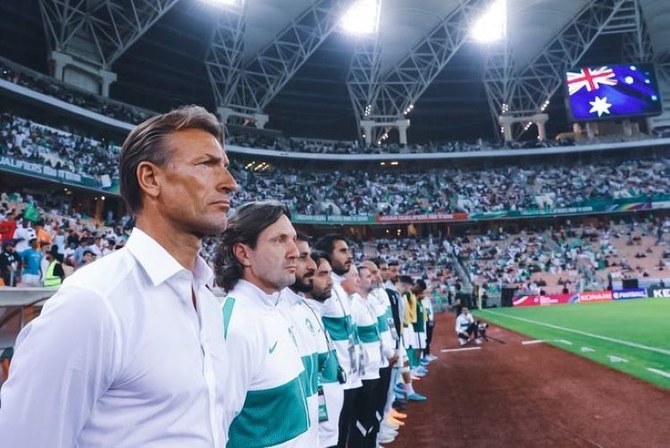
Herve Renard ‘here to stay’ as Saudi Arabia coach extends contract to 2027

Herve Renard has agreed to extend his contract as head coach of the Saudi national team to 2027. (Twitter Photo)
Short Url
Updated 29 May 2022
Follow

Herve Renard ‘here to stay’ as Saudi Arabia coach extends contract to 2027

  • Frenchman arrived in Kingdom 3 years ago, steered Green Falcons to 2022 World Cup in Qatar
  • The Saudi defense has become more comfortable in possession and the defensive midfield is solid

RIYADH: There was a significant signing made in Saudi Arabia on Thursday as it was announced that Herve Renard had agreed to extend his contract as head coach of the national team to 2027.

The Frenchman revealed the news in a video released by the country’s football association.

He said: “From the moment I arrived, I felt as if I was one of you. I felt the passion for football, people’s desire for success and glory. I saw a country full of young, talented players. We achieved our first target, let’s work together for the rest.”

The former defender then signed a shirt with the number 2027 on the back and added: “I’m here to stay.”

It will be welcome news for most people associated with Saudi Arabian football.

Renard arrived three years ago to take over a team that had exited the Asian Cup in January in the Round of 16. In the 22 months or so prior to that, there had been four men in charge of the Green Falcons. At the very least, the man from east of Lyon has brought some much-needed stability.

But he has done far more than that. The national team is a different beast now than it was in July 2019. He arrived as the man who won the Africa Cup of Nations with Zambia in 2012 which was a hugely impressive achievement and a first ever continental title for the Copper Bullets. He then repeated the feat with Ivory Coast three years later, only a second ever title for the Elephants.

Football exists outside the big leagues of Europe, and Renard’s curriculum vitae is an excellent one and also includes taking Morocco to the 2018 World Cup where they performed well in a tough group.

And his CV is quite lengthy too. The 53-year-old’s job in Riyadh is his 12th as a head coach and already the longest he has stayed at one position. There does seem to be a sense that the coach and the team are good for each other.

There was not much sign of that when it started. Weeks after arriving in the country, qualification began for the 2022 World Cup, and it failed to start the way fans wanted or expected.

There was a surprising 2-2 draw with Yemen in the first game in September 2019 and a goalless stalemate with Palestine in the third match. At the halfway stage of the second round, Saudi Arabia were second behind Uzbekistan and with only the top team sure of progressing to the next stage, the situation was uncertain. In this part of the world, coaches have lost their jobs for less.

Then came the coronavirus pandemic. Renard obviously used the 15 months pause between qualifiers to good effect. When the group resumed action in March last year, Saudi Arabia won all four games, scoring 14, conceding none, and topping the group.

This was a team with the ability to manage games and to change their approach depending on the situation. They could keep the ball for long periods and slowly build or they could get physical and launch direct attacks.

The defense has become more comfortable in possession, and the defensive midfield is technically excellent which has given creative talents such as Salman Al-Faraj and the increasingly impressive Salem Al-Dawsari the space to really show what they can do.

There was now no looking back. The third round of qualification is where there is little room for slip-ups and Saudi Arabia were almost textbook. It started with four wins out of four, 12 points that put them in control of Group B and they rarely looked like letting it go. The exciting 3-2 win over China showed their attacking capabilities, and the 1-0 victory over Japan demonstrated control, defensive discipline, and intelligence.

Then came a tricky trip to Australia, a place where Saudi Arabia have usually struggled but this is a different team now. The players showed they could mix it physically with the Socceroos and, in the end, came away from Sydney disappointed to have just one point. The one defeat came in Japan, but the team bounced back and ended up winning the group.

There are issues of course. Renard has talked about the lack of strikers available. The squad is entirely domestic-based and when most clubs import striking talent, it does not leave many opportunities for local forwards. There is not much Renard can do about that other than just point it out, and it was encouraging that Firas Al-Buraikan and Saleh Al-Shehri were second and top joint scorers, respectively, in the third round of qualification. The recent injury to Al-Shehri has added to the worries caused by another long-term absence to midfielder Abdulellah Al-Malki.

All teams have to overcome absences, but Renard has done much more than that. He has made Saudi Arabia a more feared and respected team in Asia. He has improved players and the team and changed the mentality. There is now a confidence, an intensity that has created a feeling that the whole set up is moving in the right direction. Things can change quickly in football, but coach and team complement each other very well.

Keeping one of the best coaches working outside Europe may seem like an easy decision but the Saudi Arabian Football Federation should be congratulated for moving quickly to do the deal.

Extending the contract to 2027 could see Renard in charge of the Green Falcons when the country hosts the Asian Cup. That is a long time in the future but if there is the same improvement in the next three years as there has been in the past three years then Saudi Arabia really will be a force to be reckoned with.



Enduring cricket aspects that may carry over into 2026 

Updated 12 sec ago
Follow

Enduring cricket aspects that may carry over into 2026 

  • Over the last 24 months, One-Day International cricket has generally been regarded as under threat, caught in the pincers between Test and T20 cricket

Two years ago, my column reflected on significant moments in matches which I attended in 2023 and which seemed to have deep significance for the game. Five themes emerged.
First was the increase in franchised T20 leagues. Second was the experience of attending ODI World Cup matches in India. Third was the shifting balance in the number of international matches played in each format. Fourth was the gallant strategy adopted by the England’s men’s test team to breathe fresh life into the format. Fifth was a dispelling of the notion, in the form of Australia’s Pat Cummins, that a fast bowler cannot be a successful captain.
My reflection at the end of 2025 is geared to exploring how these themes played out over the last 24 months and how they may continue in 2026.
January 2023 heralded the inaugural edition of the DP World ILT20 in the UAE. At the time, it looked like another brick in the wall of the modern game, symptomatic of its future shape. In the last two years, there have been three more editions of ILT20, the latest of which started on Dec. 2 and will conclude on Jan. 4, 2026. In South Africa, SA20 opened its third edition on Dec. 26, 2025, as did the Bangladesh Premier League.
Australia’s Big Bash League began its 15th edition on Dec. 14, 2025. Each of these leagues has been establishing its place in cricket’s global landscape, developing its own characteristics and points of difference. They compete for players and there is some player movement between the leagues during their schedules, usually at the beginning and toward the end.
After the clutch of leagues in January/February, there is a break until the Pakistan Super League, which will run between March 26 and May 3, 2026. This will overlap with the Indian Premier League, which occupies the space between March 26 and May 31, 2026. The PSL is set to expand from six to eight teams, with an auction set for Jan. 8, 2026. Another league with expansionist plans is the Major Cricket League in the US, scheduled to run between June 18 and July 18, 2026.
This means it will not clash with The Hundred in England and Wales, during August. Equity has been acquired in each of the eight franchises by outside investors at significant cost. A European franchise league is mooted, whilst the sixth edition of the Lanka Premier League, originally scheduled for December 2025, is now set for July 8 to Aug. 8. The postponement was made so that stadiums can be made ready to host matches in the ICC Men’s T20 World Cup 2026, which will be co-hosted by Sri Lanka and India during February and March 2026. Completing this second clutch of leagues, the Caribbean Premier League is scheduled between Aug. 15 and Sept. 22.
What might have looked in 2023 as a gamble for the two new entrants, ILT20 and SA20, is not turning out that way. ILT20 differs from other franchise leagues in that it mandates the inclusion of players from the UAE and actively seeks to recruit players from associate countries. One of its franchises is owned by Americans, who have recruited several Pakistani players. These strategies are planned to have long-lasting benefits for UAE cricket. It must also be said that South Africa’s performances on the world stage have improved sensationally over the last 24 months, since SA20 began. Expansion may be expected in terms of team numbers in several of the leagues, but over the last 24 months a place for them has emerged within cricket’s calendar.
The second theme in my end-of-year 2023 reflections relating to the experience of attending World Cup matches in India was probably a one-off, albeit an unforgettable one. There was little doubt it provided an eye-opener into the Indian way of attending cricket. It was clear that interest in matches which did not involve India was low, but the passion when the Indian team was playing was overwhelming. This was also apparent in the summer of 2025 when India toured England, as passions spilled over onto the field. Unfortunately, these passions have manifested themselves in and around matches between India and Pakistan over the last 24 months.
In terms of the third theme, the balance between formats, One-Day International cricket is generally regarded as under threat, caught in the pincers between Test and T20 cricket. In 2023, the highest-ever number of men’s ODI internationals was played, 220, exceeding the previous high of 197 in 2007, also a World Cup year. The yearly average of ODIs played between 2000 and 2023 was 144. In 2024 and 2025, the numbers fell to 103 and 114, respectively, giving some support for concerns of its decline.
In comparison, 448 men’s T20Is were played in 2023, a fall from the highest-ever number of 536 in 2022, a T20I World Cup year. The average number played between 2007 and 2018 was 60. In April 2018, the ICC decided to grant, with effect from Jan. 1, 2019, T20I status to all of its 105 members, not just Full members. At one fell swoop, the mechanism to formally increase the number of T20Is was introduced. They soared to 324 in 2019. In 2024, a World Cup year, they doubled to 653 and fell back slightly to 576 in 2025. A more meaningful statistic might be how many ODIs and T20Is full members have played. Nevertheless, the shift of focus and balance of resources is clear to see in cricket’s growth landscape, based on the T20 format.
The impact on Test cricket appears to be neutral, so far. The long run average of Tests played per year between 2000 and 2023, excluding COVID-19-affected 2022, is 44, in a range of 31 to 55. In 2023, 34 were played, but it is not uncommon for the number to fall in an ODI World Cup year. This was the case in both 2019 and 2007. In 2024, 61 were played and 41 in 2025. The numbers do not yet give cause for concern, but performances do, leading onto the fourth theme. In 2023, the new leaders of the England’s men’s test team adopted an attacking mentality and removed fear of failure. It was termed “Bazball” by several in the media to reflect the influence of the coach, Brendon McCullum, who dislikes the moniker.
There is no doubt that the approach has generated some exhilarating cricket and some extreme lows. It has also generated intense debate, books, millions of column inches and acrimony. The ultimate aim of the approach was to win the current Ashes tour of Australia. After defeat in the first three Tests, myriad obituaries were written for “Bazball.” Apart from failure, it was accused of having become a cult in which its members were impervious to criticism, had developed groupthink and had become arrogant to the point of boorishness. Yet, the obituaries proved to be premature. Over the course of two days at Melbourne, England’s approach dramatically overcame the odds.
The main controversy over the match was the pitch. An unusual amount of grass was left on it, providing conditions more suited to bowlers than batters. One of the highlights of cricket’s calendar, the Melbourne Test, which attracted a record crowd of 91,000 on the first day, ended prematurely. Not only was this a disappointment to ticketholders for days three to five, but it also means heavy financial losses for Cricket Australia, broadcasters and other stakeholders. When added to the losses suffered by the premature ending of the Perth Test, this Ashes series will be remembered with a degree of infamy. It has also raised questions about the impact of T20 cricket on batter’s techniques and their ability and willingness to construct the longer innings traditionally required for Test cricket.
A corollary of batters’ changing techniques is the ability of bowlers to take advantage. In Test cricket history, few fast bowlers have been made captain, the subject of theme five.
Eyebrows were raised when Pat Cummins was made Australia’s captain in November 2021. Since then, his win percentage as captain in 38 Tests is 63, placing him behind only Steve Waugh, with a 72 percent record and on a par with Ricky Ponting. He has led in 17 ODIs, achieving a 76 percent record, as well as leading teams which won the ODI World Cup and the World Test Championship.
He has only played one Test in the current Ashes series, because of a back injury, something which plagued his early career. In the last 24 months he has established a place in Test cricket’s history as possibly the most successful fast bowler captain ever. I say possibly, because the fast-bowling allrounder, Imran Khan, would be the first person to spring to mind. Perhaps the most poignant reflection on the last 24 months should focus on the fate that has befallen one of cricket’s all-time great players.