Joyland, first Pakistani film selected in Cannes, wins two prizes 

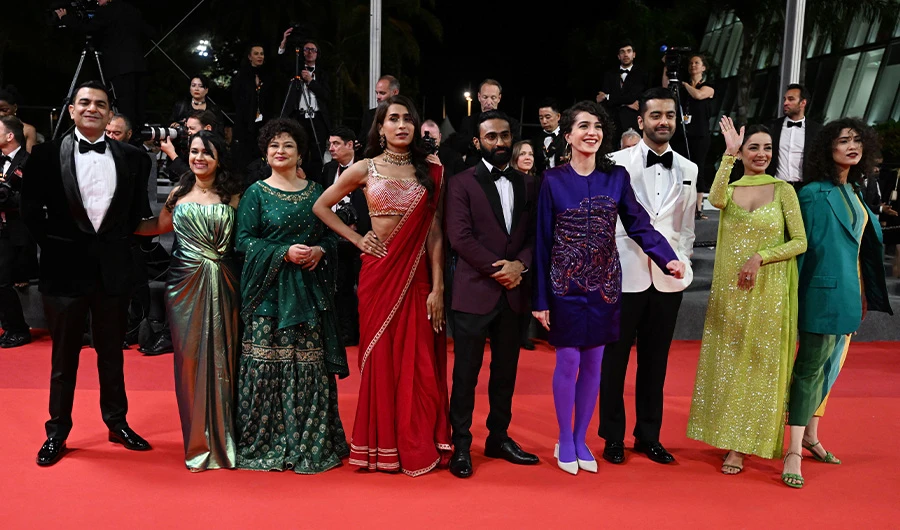
The team of Pakistani film "Joyland" poses for a photo at the 75th edition of the Cannes Film Festival in Cannes, southern France, on May 22, 2022. (AFP)
Short Url
Updated 28 May 2022
Follow

Joyland, first Pakistani film selected in Cannes, wins two prizes 

  • The first-ever Pakistani competitive entry beat off several other strong contenders at the festival 
  • Film left Cannes audiences slack-jawed, got nearly 10-minute standing ovation on opening night 

ISLAMABAD: Pakistani Saim Sadiq’s feature debut, “Joyland,” the first Pakistani film to be selected in Cannes, on Friday won two prizes at the 2022 film festival.

The film, which celebrates ‘transgender culture’ in Pakistan and tells the story of a family torn between modernity and tradition in contemporary Lahore, won the Cannes “Queer Palm” prize for best feminist-themed movie as well as the Jury Prize in the “Un Certain Regard” competition, a segment focusing on young, innovative cinema talent.

“Joyland” beat off several other strong entries, including “Close” by Belgian director Lukas Dhont and “Tchaikovsky’s Wife” by Kirill Serebrennikov, both hot contenders for the Cannes Festival’s top Palme d’Or award which will be announced on Saturday.

“It’s a very powerful film, that represents everything that we stand for,” Catherine Corsini, French director and the “Queer Palm” jury head, told AFP.

“’Joyland’ will echo across the world. It has strong characters who are both complex and real. Nothing is distorted. We were blown away by this film.”

The first-ever Pakistani competitive entry left Cannes audiences slack-jawed and admiring, and got a nearly 10-minute-long standing ovation from the opening night’s crowd.

Part of the surprise came from the discovery by many that Pakistan is one the first nations to have given legal protection against discrimination of transgender people.

In 2018, Pakistan passed a landmark transgender rights bill that provides the country’s trans citizens with fundamental rights including prohibiting discrimination and harassment against them educationally and socially, allowing them to obtain driving licenses and passports and to change their gender in the national database at their own discretion.

“Pakistan is very schizophrenic, almost bipolar,” Sadiq, who drew inspiration from his own family and a theater close to his Lahore home, told AFP in an interview.

“You get, of course, prejudice and some violence against a particular community on the one hand, but you also get this very progressive law which basically allows everyone to identify their own gender, and also identifies a third gender,” he said.
Pakistan steps up local vaccine manufacturing push with Saudi cooperation Eleven-member Saudi delegation’ to arrive in Pakistan today to give practical shape to local vaccine manufacturing in Pakistan, says health ministry Domestic vaccine manufacturing

Updated 5 sec ago
Follow

Pakistan steps up local vaccine manufacturing push with Saudi cooperation Eleven-member Saudi delegation’ to arrive in Pakistan today to give practical shape to local vaccine manufacturing in Pakistan, says health ministry Domestic vaccine manufacturing

  • Talks with Saudi delegation aim to support domestic production for national immunization needs, ministry says
  • Pakistan currently imports all vaccines, which ramps up foreign exchange and procurement pressures

ISLAMABAD: A high-level Saudi delegation is arriving in Pakistan today, Monday, to give practical shape to local vaccine manufacturing in Pakistan, the health ministry said in a statement amid Islamabad’s push to meet its national immunization needs. 

The eleven-member Saudi delegation’s visit marks a “critical milestone” in strengthening bilateral cooperation between Pakistan and Saudi Arabia in health, pharmaceutical manufacturing and industrial collaboration, the ministry said. 

It added that the development takes place after Pakistan Health Minister Syed Mustafa Kamal held three meetings with his Saudi counterpart over the past seven months in which both sides discussed local vaccine manufacturing, investment opportunities and technical cooperation. Kamal also met Saudi Arabia’s minister of industry to discuss the same. Both sides designated focal persons to ensure effective coordination and follow-up after the meetings. 

“The visit of the high-level Saudi delegation is expected to prove a decisive step toward giving practical shape to the process of local vaccine manufacturing in Pakistan,” Kamal was quoted as saying by the health ministry. 

The Pakistani health minister reaffirmed Islamabad’s commitment to establishing local vaccine production facilities, stating that domestic manufacturing will not only meet Pakistan’s national immunization needs but will also enable surplus production for export. 

This, he said, would contribute to Pakistan’s economic growth and national stability.

“Ensuring the availability of safe, high-quality vaccines for the public remains the government’s top priority, ” the minister said. 

Since Pakistan does not produce vaccines locally, it has to import them from other countries. Producing vaccines will help the South Asian country save valuable foreign exchange and avoid longer procurement delays as it seeks to inoculate its population against various diseases. 

Pakistan, a country of over 240 million people, regularly holds national immunization campaigns against diseases such as polio, measles, rubella and hepatitis.