US, Netherlands back UN aim to raise $144 million for Yemen’s Safer tanker emergency operation

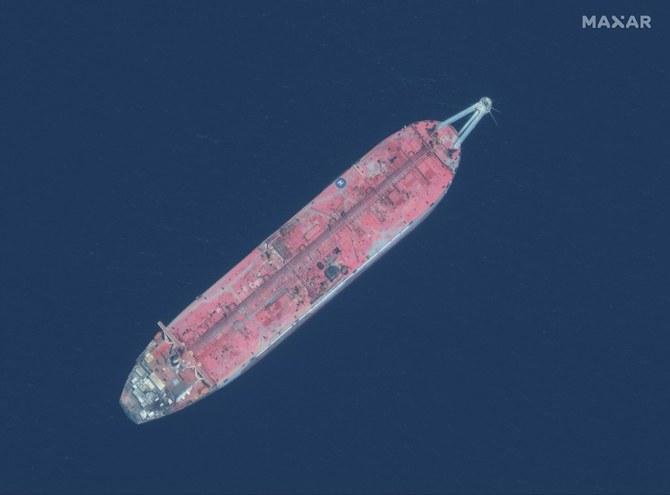
Safer is a rapidly decaying and the unstable oil tanker that could leak, spill or explode at any time. (File/AFP)
Short Url
Updated 28 May 2022
Follow

US, Netherlands back UN aim to raise $144 million for Yemen’s Safer tanker emergency operation

  • In the event of an oil spill, the cleanup alone is expected to cost $20 billion

The US and the Netherlands support UN efforts to address and avert the economic, environmental, and humanitarian threats posed by Yemen’s Safer oil tanker in the Red Sea region.

Dutch Ambassador to the US André Haspels hosted a meeting joined by US Special Envoy Lenderking, Yemeni Ambassador to the US Mohammed Al-Hadrami and representatives from the diplomatic community in Washington, on Friday.

They stressed the importance of raising $144 million to fund the UN’s operational plan, which includes $80 million for an emergency operation to offload the oil from the decaying tanker to a temporary vessel, an official joint statement said.

At a pledging event co-hosted by the UN and the Netherlands earlier this month, nearly half the funds required for the emergency operation were raised, but more was urgently needed to move forward.

Safer is a rapidly decaying and the unstable oil tanker that could leak, spill or explode at any time and could severely disrupt shipping routes in the Gulf region and other industries across the Red Sea, unleash an environmental disaster and worsen the humanitarian crisis in Yemen.

By October, high winds and volatile currents will make the UN operation more dangerous and increase the risk of the ship breaking apart. In the event of a spill, the cleanup alone is expected to cost $20 billion.

“We urge public and private donors to consider generous contributions to help prevent a leak, spill, or explosion, whose effects would destroy livelihoods, tourism, and commerce in one of the world’s vital shipping lanes,” the statement read.

Last month, Lenderking and Dutch Ambassador to Yemen Peter Derrek Hof joined UN Resident and Humanitarian Coordinator for Yemen David Gressly on a trip in the Gulf to increase awareness of the imminent risks the Safer poses to the entire region.

“The international community, private sector included, must take action now to address the imminent threats posed by the Safer,” the statement said.


UNESCO fears for fate of historical sites during Iran war

Updated 11 March 2026
Follow

UNESCO fears for fate of historical sites during Iran war

  • “UNESCO is deeply concerned by the first impact that the hostilities are already having on many world heritage sites,” Assomo said
  • Tehran’s Golestan palace, damaged in US–Israeli strikes, is testimony to the grandeur of Iran’s civilization in the 19th century

PARIS: UNESCO said it is deeply concerned about the fate of world heritage sites in Iran and across the region, after Tehran’s Golestan palace, often compared to Versailles, and a historic mosque and palace in Isfahan were damaged in the war.
The United Nations’ cultural agency on Wednesday urged all parties to protect the region’s outstanding cultural sites, saying four of Iran’s 29 world heritage sites had been damaged since the start of the US and Israeli war with Iran.
“UNESCO is deeply concerned by the first impact that the hostilities are already having on many world heritage sites,” Lazare Eloundou Assomo, director of the World ⁠Heritage Center, told Reuters, ⁠adding he was also concerned for sites in Israel, Lebanon and across the Middle East.
Tehran’s Golestan palace, damaged in US–Israeli strikes, is testimony to the grandeur of Iran’s civilization in the 19th century, he said.
The palace was chosen as the Persian royal residence and seat of power by the Qajar family and shows the introduction ⁠of European styles in Persian arts, according to the UNESCO website. The last Shah of Iran, Mohammad Reza Pahlavi, held a coronation ceremony there in 1969.
“We sometimes even compare it with the Versailles Palace in France, for instance, and it has suffered, unfortunately, some damage. We don’t know the extent for the moment. But clearly, with the images that we have been able to receive, we can confirm ... it has been affected,” Eloundou Assomo said.
Photos of the interior of the palace have shown piles of smashed glass and shards of ⁠wood on ⁠the floor, and shattered woodwork.
Isfahan was one of Central Asia’s most important cities and a key point on the Silk Road trading route. Its Masjed-e Jame (Jameh Mosque) is more than 1,000 years old and shows the development of Islamic art through 12 centuries.
Buildings close to the buffer zone of the prehistoric sites of the Khorramabad Valley have also been damaged, UNESCO said.
UNESCO has shared coordinates of key cultural sites to all parties, Eloundou Assomo said, and was monitoring damage.
“We are calling for the protection of all sites of cultural significance ... everything that tells the history of all the civilizations of the 18 countries in the region,” he said.