

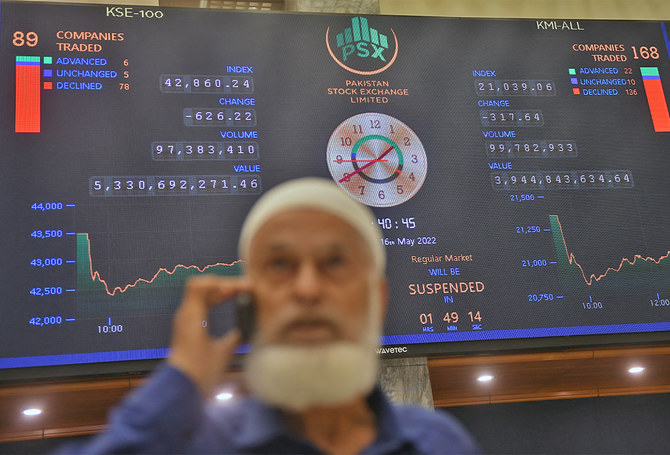

KARACHI: Bulls at Pakistan’s currency and stock markets on Friday celebrated the weekend trading session with considerable gains, traders and analysts said, after the government increased fuel prices as prior action for the revival of $6 billion International Monetary Fund (IMF) program.
The rupee recovered 1.13 percent of its value as the United States (US) dollar closed at Rs199.76. On Thursday, the greenback hit another all-time high of Rs202.01, with the Pakistani currency losing its value by over Rs20 since April 16.
The equity market closed in the green zone as well, with the benchmark KSE100 index reaching 42,861-point level by gaining 319 points on the back of the fuel price hike, which is expected to unlock IMF funding.
“Stocks closed bullish amid higher trades as investors weigh petroleum price hike by the government, abolishing energy subsidies and paving way for the IMF release of $900 million under the EFF (Extended Fund Facility),” Ahsan Mehanti, chief executive officer (CEO) of the Karachi-based Arif Habib Corporation business conglomerate, told Arab News.
“The 7th review Doha talks setting up targets for FY23 and discussions over federal budget due next month and surging global equities played a catalyst role in the bullish close.”
Pakistan’s reluctant new government finally increased the petroleum prices by over 20 percent, or Rs30 ($0.15) per liter, after a meeting with IMF officials in Doha, in which the global lender emphasized the importance rolling back energy subsidies announced by former premier Imran Khan earlier this year.
Financial experts said the impact of the fuel price hike would reflect on the inflation numbers next month. Inflation in the country is expected to rise to 15.8 percent from 13.4 percent in April and an expected 14.3 percent in May, they said.
“For every Rs10 per liter change in petroleum prices, the impact on CPI (Consumer Price Index) is expected to be around 24 basis points. So, for the current Rs30 per liter increase, the impact would be around 72 bps (0.72 percent),” said Tahir Abbas, head of research at the Arif Habib Limited brokerage firm.
“Also, this is the direct impact on the CPI, indirect impact would also be there with some lag. It would be visible in June 2022 and we expect inflation would increase to 15.8 percent in June 2022.”
Pakistan’s energy subsidies, compared to the country’s GDP, were one of the highest in the region. The government was estimated to give around $2 billion in petroleum and electricity subsidies from April till June.
“Today’s subsidy is the future’s inflation,” Khurram Schehzad, CEO of the Alpha Beta Core financial advisory firm, said. “We, as a nation, need to understand this very basic yet very important underlying relation that leads to structural problems disrupting the country’s finances eternally.”
Schehzad said inflation varied from person to person according to their income levels. “Inflation is always relative, and not the same for all... inflation for people earning Rs100,000 ($502) per month would be entirely different from ones earning Rs20,000 ($100) per month, and those earning nothing at all,” he said.
The removal of fuel subsidies is also expected to have political consequences for the new coalition government, especially when the next general elections are expected within the next one-and-a-half year.


