

Pakistan raises fuel prices after inconclusive IMF talks in Doha

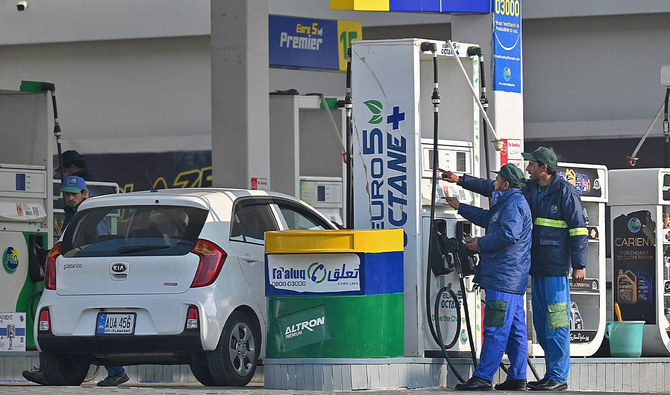
Employees at a fuel station attend to their customers in Islamabad, Pakistan, on February 16, 2022. (AFP/File)
Short Url
Updated 26 May 2022
Follow

Pakistan raises fuel prices after inconclusive IMF talks in Doha

  • Finance minister Miftah Ismail says the government has increased petroleum prices by Rs30 per liter
  • Pakistan hopes to reach a staff level agreement with the IMF for the resumption of $6 billion loan facility

KARACHI: Pakistan’s finance minister Miftah Ismail announced on Thursday the government had decided to increase fuel prices by Rs30 per liter after his negotiations with the International Monetary Fund (IMF) for the resumption of a $6 billion loan package remained inconclusive due to subsidies on petroleum products.

The subsidies were part of a relief package provided by former prime minister Imran Khan in February amid rising inflation which he said was going to cost over $2 billion between April and June 2022. The IMF had objected over his decision while refusing to release the next loan installment of about $1 billion.

Pakistan desperately needs external financing to boost its falling foreign exchange reserves which, at the current level of $10 billion, can barely cover two months of import payments. The new government has been seeking the IMF support since assuming the political power of the country, though it remained reluctant to meet the stringent terms and conditions of the international lending agency.

“The government has decided to protect the poor and its details will soon be announced by the prime minister himself in an address to the nation,” Ismail told a news conference in Islamabad. “I have only come here to tell you that the government has decided that from Friday, 27th of May, the prices of petrol, diesel, kerosene oil and light diesel oil will be increased by Rs30 per liter.”

He said that the new price of petrol and diesel would be Rs179.86 and Rs174.15 per liter, respectively.

Ismail hoped the government’s decision would help stabilize markets.

“It will also stabilize the rupee and improve the situation at the stock market,” he continued. “Most importantly, it will bring back some balance within the economy.”

The finance minister maintained it was a difficult decision since increased fuel prices would to negatively impact the government’s political capital.

However, he added it was the right move for the country since it was important for everyone to know that the new administration was truly determined to fix Pakistan’s economic woes.

Responding to a question, he said he was optimistic that Pakistan would soon reach a staff level agreement with the IMF.

The finance minister discussed the possibility of increasing the size of the loan by another $2 billion for an extended period of one year during his meetings with IMF officials in Washington in April.

He later told journalists in the US that the resumption of IMF loan program would also help unlock more funding from multilateral donors.

In the absence of a breakthrough in recent talks with the international lending agency in Doha, however, Pakistan’s national currency hit another all-time low of Rs202.01 against the greenback on Thursday due to increasing demand for the US dollar for import payments.

Pakistani economists criticized the government for not taking tough decisions earlier in the day, saying its indecisiveness was further aggravating the economic crisis.

“With reserves continuing to slide and no signal from the government that it is willing to take tough measures, Pakistan faces a situation where things can very quickly spiral out of control,” Uzair Younus, who works with Pakistan Initiative at Washington-based Atlantic Council, told Arab News. “Once herd mentality kicks in, it will be even more painful to stabilize the economy.”


Sindh assembly passes resolution rejecting move to separate Karachi

Updated 21 February 2026
Follow

Sindh assembly passes resolution rejecting move to separate Karachi

  • Chief Minister Shah cites constitutional safeguards against altering provincial boundaries
  • Calls to separate Karachi intensified amid governance concerns after a mall fire last month

ISLAMABAD: The provincial assembly of Pakistan’s southern Sindh province on Saturday passed a resolution rejecting any move to separate Karachi, declaring its territorial integrity “non-negotiable” amid political calls to carve the city out as a separate administrative unit.

The resolution comes after fresh demands by the Muttahida Qaumi Movement (MQM) and other voices to grant Karachi provincial or federal status following governance challenges highlighted by the deadly Gul Plaza fire earlier this year that killed 80 people.

Karachi, Pakistan’s largest and most densely populated city, is the country’s main commercial hub and contributes a significant share to the national economy.

Chief Minister Syed Murad Ali Shah tabled the resolution in the assembly, condemning what he described as “divisive statements” about breaking up Sindh or detaching Karachi.

“The province that played a foundational role in the creation of Pakistan cannot allow the fragmentation of its own historic homeland,” Shah told lawmakers, adding that any attempt to divide Sindh or separate Karachi was contrary to the constitution and democratic norms.

Citing Article 239 of Pakistan’s 1973 Constitution, which requires the consent of not less than two-thirds of a provincial assembly to alter provincial boundaries, Shah said any such move could not proceed without the assembly’s approval.

“If any such move is attempted, it is this Assembly — by a two-thirds majority — that will decide,” he said.

The resolution reaffirmed that Karachi would “forever remain” an integral part of Sindh and directed the provincial government to forward the motion to the president, prime minister and parliamentary leadership for record.

Shah said the resolution was not aimed at anyone but referred to the shifting stance of MQM in the debate while warning that opposing the resolution would amount to supporting the division of Sindh.

The party has been a major political force in Karachi with a significant vote bank in the city and has frequently criticized Shah’s provincial administration over its governance of Pakistan’s largest metropolis.

Taha Ahmed Khan, a senior MQM leader, acknowledged that his party had “presented its demand openly on television channels with clear and logical arguments” to separate Karachi from Sindh.

“It is a purely constitutional debate,” he told Arab News by phone. “We are aware that the Pakistan Peoples Party, which rules the province, holds a two-thirds majority and that a new province cannot be created at this stage. But that does not mean new provinces can never be formed.”

Calls to alter Karachi’s status have periodically surfaced amid longstanding complaints over governance, infrastructure and administrative control in the megacity, though no formal proposal to redraw provincial boundaries has been introduced at the federal level.