RAMALLAH, West Bank: The Palestinian Authority on Thursday announced the results of its investigation into the shooting death of Al Jazeera journalist Shireen Abu Akleh, saying it had proven she was deliberately killed by Israeli forces as she tried to flee.
The findings echoed the results of a preliminary investigation announced nearly two weeks ago and were widely expected. Israel is likely to reject the report as biased and unfounded.
Abu Akleh, a veteran Palestinian-American reporter for Al Jazeera’s Arabic service, was shot in the head on May 11 during an Israeli military raid in the city of Jenin in the occupied West Bank.
Witnesses and Palestinian officials have said she was hit by Israeli fire. Israel says she was shot during a battle between Israeli soldiers and Palestinian militants. It says that only a ballistic analysis of the bullet — which is held by the Palestinian Authority — and the soldiers’ guns can determine who fired the fatal shot.
Announcing the results of his probe at a news conference in the West Bank city of Ramallah,, Palestinian Attorney General Akram Al Khateeb said he had determined there were no militants in the immediate area where Abu Akleh was located.
“The only shooting was by the occupation forces, with the aim of killing,” he said.
Abu Akleh was in a group of journalists wearing helmets and protective vests marked “press.” He said the army saw the journalists and knew they were journalists.
He accused Israel of shooting her “directly and deliberately” as she tried to escape. He also repeated the Palestinian position that the bullet will not be handed over to the Israelis for study. He said they decided not even to show images of the bullet “to deprive them of a new lie.”
Al Khateeb said his investigation was based on interviews with witnesses, an inspection of the scene and a forensic medical report.
There was no immediate response from Israel.
Israel denies targeting journalists and has offered two possible scenarios, saying she was either shot by Palestinian militants who were firing recklessly at an Israeli army convoy or that she was hit by Israeli gunfire aimed at a nearby militant. The military has identified the rifle that may have been used in that scenario, but says it needs to test the bullet to make any final determination.
An AP reconstruction of events has lent support to eyewitnesses who say she was shot by Israeli troops. But the reconstruction said it was impossible to reach a conclusive finding without further forensic analysis.
Palestinian witnesses say there were no militants or clashes anywhere near her. The only known militants in the area were on the other side of the convoy, some 300 meters (yards) from her position. They did not have a direct line of sight, unlike the convoy itself, which was some 200 (meters) away on a long straight road.
Israel has publicly called for a joint investigation with the PA, with US participation, and has asked the PA to hand over the bullet for testing. But the State Department said Wednesday that it had received no formal request for assistance from either side two weeks after her death.
The PA has refused to hand over the bullet to Israel or cooperate with it in any way, saying Israel cannot be trusted to investigate its own conduct. Rights groups say Israel has a poor record of investigating when security forces shoot Palestinians, with cases often languishing for months or years before being quietly closed.
The PA administers parts of the Israeli-occupied West Bank. Hussein Al Sheikh, a top Palestinian official, said Thursday’s report would be shared with the US administration. Copies will also be delivered to her family and to Al Jazeera, he said.
The Palestinians say they will share their results with international parties, including the International Criminal Court, which launched an investigation into possible Israeli war crimes last year. Israel has rejected that probe as being biased against it and is not cooperating with it.
The severe distrust means the Israeli and Palestinian investigations into Abu Akleh’s death are unfolding separately, with neither likely to accept any conclusions reached by the other.
Each side is in sole possession of potentially crucial evidence. Ballistic analysis could match the bullet to a specific firearm based on a microscopic signature, but only if investigators have access to both. Lt. Col. Amnon Shefler, a military spokesman, told the AP the military has additional footage from that day, but declined to say what it shows or when it would be released, citing the ongoing investigation.
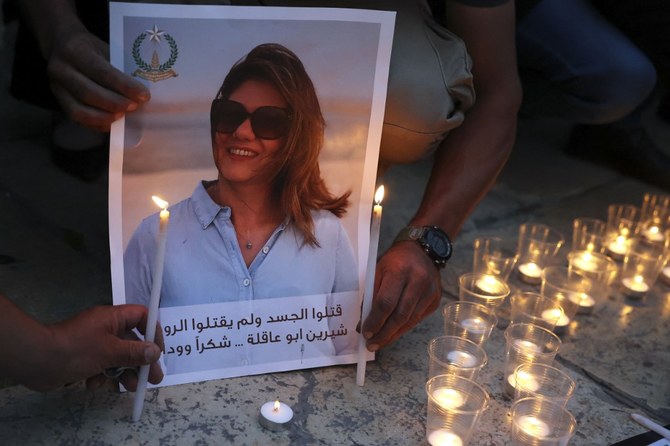
Palestinians are still mourning Abu Akleh, a widely known and respected on-air correspondent who rose to fame two decades ago, during the second Palestinian intifada, or uprising, against Israeli rule. The 51-year-old documented the harsh realities of life under Israeli military rule — now well into its sixth decade with no end in sight — for viewers across the Arab world.
Jenin has long been a bastion of Palestinian militants, and several recent attacks inside Israel have been carried out by young men from in and around the town. Israel has continued to carry out near-daily raids in Jenin since Abu Akleh’s death, which it says are aimed at preventing more.
Israel captured the West Bank in the 1967 war and has built settlements where nearly 500,000 Israelis live alongside nearly 3 million Palestinians. The Palestinians want the territory to form the main part of their future state, but peace talks broke down more than a decade ago, and Israel’s dominant right-wing parties are opposed to Palestinian statehood.
The PA itself is seen by many Palestinians as a corrupt and authoritarian body that aids the occupation by coordinating with Israel on security matters. Any cooperation with Israel on the Abu Akleh investigation would likely spark a popular backlash among Palestinians, who view her as a martyr to both journalism and their national cause.


Palestinians: Israel deliberately killed Al Jazeera reporter
https://arab.news/rprue
Palestinians: Israel deliberately killed Al Jazeera reporter

- The findings echoed the results of a preliminary investigation announced nearly two weeks ago and were widely expected
- Witnesses and Palestinian officials have said she was hit by Israeli fire


Saudi Arabia strengthens global ranking in 2026 Soft Power Index
- UAE maintains 10th place, Qatar climbs 2 spots
DUBAI: Saudi Arabia climbed three positions to 17th place in this year’s Soft Power Index, released on Tuesday by marketing consultancy Brand Finance.
Other Gulf nations also performed well, with the UAE maintaining its 10th-place ranking and Qatar and Bahrain each climbing two spots to No. 20 and No. 49, respectively, marking a rebound for the region after a softer showing in 2025.
The report indicates that the performance reflects sustained investment in proactive diplomacy, economic diversification and expanded initiatives across culture, tourism and sports.
It also comes at a time when several Western powers are recording declines in their rankings, highlighting the growing influence of Gulf states.
“The UAE remains a clear regional leader, while Saudi Arabia and Qatar have strengthened their global positions through focused economic diplomacy and international engagement,” said Savio D’Souza, managing director for the Middle East and Africa, Brand Finance.
Saudi Arabia and the UAE either maintained or improved their rankings across all key pillars, including familiarity, reputation and influence.
The Kingdom recorded notable gains, with increases of 25 points in the People & Values pillar and 12 points in the Culture & Heritage pillar.
“Although perceptions across some markets remain mixed, renewed upward movement in the rankings suggests that targeted, long-term soft power strategies are beginning to pay off,” D’Souza said.
Globally, the US retained its top position despite recording the steepest overall decline in its score, followed by China in second place. Japan rose to third place, overtaking the UK, which ranked fourth, while Germany placed fifth.
Brand Finance defines “soft power” as a “nation’s ability to influence the preferences and behaviors of various actors in the international arena (states, corporations, communities, publics, etc.) through attraction and persuasion rather than coercion.”
Each nation is assessed across 55 individual metrics, producing an overall score out of 100 and a ranking from first to 193rd.


