
KARACHI: Political turmoil in Pakistan over an opposition long march and uncertainty about the revival of a $6 billion International Monetary Fund (IMF) program are continuing to jolt the country’s local currency, as the rupee hit another historic low against the United States dollar on Wednesday, closing at Rs201.92.
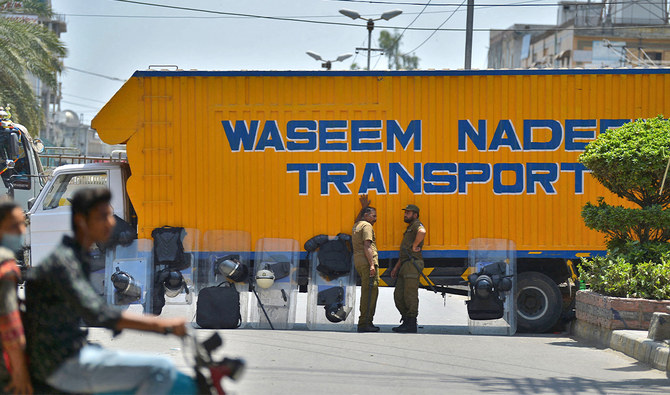
Pakistan’s economic woes have been compounded by an anti-government march to the capital announced by former prime minister Imran Khan. Clashes between Khan’s supporters and law enforcers on Wednesday have dampened investor confidence, economists and experts said.
On Wednesday, the country’s stock market also traded 300 points below the previous closing.
“The political noise and delay in the IMF [deal] has been affecting investor confidence. This is why the stock market and rupee are falling. Clarity on both will help restore confidence,” Muhammad Sohail, CEO of the brokerage company Topline Securities, told Arab News.
The rupee was expected to show some recovery after the Saudi minister of finance said on Tuesday the kingdom was finalizing extending a $3 billion deposit to Pakistan.
“The market was expected to depict some positive sentiments [after Saudi announcement] but the current political situation overshadowed it,” Samiullah Tariq, director of research at the Pakistan Kuwait Investment Company, said.
Pakistani economists and financial experts said the current political turmoil in the country was wreaking havoc on an already fragile economy.
“The mayhem created by the call for the long march, coupled with [the government’s] unwise and violent means to stop PTI supporters, are going to completely wreck the already rustic and dysfunctional economic ship of Pakistan,” Dr. Ikram ul Haq, a Lahore-based financial expert, told Arab News.
“With foreign reserves left for less than two months and the rupee plunging to the lowest in history by crossing the psychological barrier of 200, the call for the long march and the way it is being handled, is going to provide a sure recipe for disaster,” he added.
Economic experts also say a nearly $1.5 billion fuel and electricity subsidy announced by the last government of Khan was proving to be an “economic land mine” for the current administration.
“The current economic crisis, whether it relates to the delay in the IMF program and fiscal stress, is to a large extent created by the outgoing government which laid economic land mines in the form of petroleum subsidies,” Dr. Sajid Amin, Deputy Executive Director of the Sustainable Development Policy Institute (SDPI), told Arab News.
“The current economic problems and political uncertainty have been inherited by the incumbent government but its indecisiveness has further compounded the situation,” he added.
Pakistan is currently negotiating with the IMF to secure around $3 billion needed to stabilize its economy, marred by an ongoing political crisis, rising trade and fiscal deficit, and depleting foreign-exchange reserves, which at $10.2 billion, are not enough to cover even two months of imports.
“The outgoing government, sensing that it was about to go, had announced the relief package to push the incoming government in troubling waters and [had also] frozen petroleum prices, which was not possible,” Amin said. “It has distorted the IMF program. Now the incumbent government is not removing the subsidies, fearing a political cost.”
Negotiations with the international money lender come at a time when Pakistan is battling the second-fastest inflation rate in Asia at 13.4 percent. To sail through the IMF deal, the country has to make the politically tough decision of raising fuel prices to ensure financial viability.
“Already burdened with the unbearable fuel subsidy left by the PTI coalition government, those at the helm of affairs are making sure that the state loses its financial viability,” said Haq.
Muzzamil Aslam, PTI’s spokesperson on finance, denied political rallies were destabilizing the economy.
“It is the indecisiveness of the current government,” he said, “which is responsible for the economic turmoil.”