Boat carrying Rohingya fleeing Myanmar capsizes, killing 16

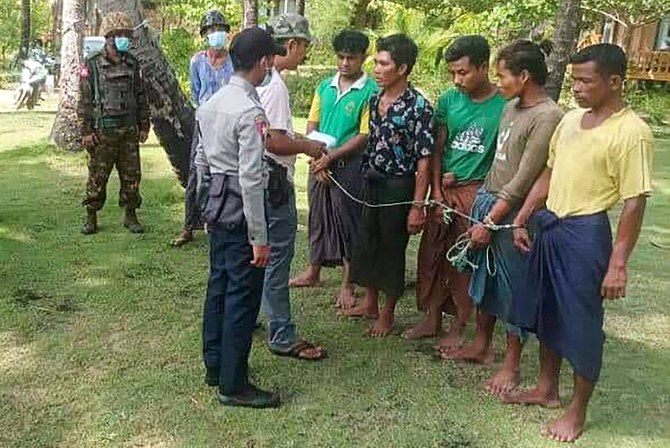
Officials talk to survivors from a boat carrying 61 people that left from Rakhine state which capsized, in Pathein district, about 200km west of Yangon. (AFP)
Short Url
Updated 24 May 2022
Follow

Boat carrying Rohingya fleeing Myanmar capsizes, killing 16

  • There were 35 survivors of Saturday's accident that took place Saturday off Myanmar’s southwestern coast
  • UNHCR said at least 17 Rohingya, including children, had died

BANGKOK: At least 16 people from Myanmar’s Rohingya minority have died after a storm capsized the boat they were traveling on to seek refuge in another country, officials and a recovery team member said Tuesday.
There were 35 survivors of Saturday’s accident that took place Saturday off Myanmar’s southwestern coast and four people were missing, the officials said.
UNHCR, the UN’s refugee agency, expressed shock and sadness about the accident in a statement and said at least 17 Rohingya, including children, had died.
The boat left the western state of Rakhine last Thursday and encountered bad weather two days later off Ayeyarwaddy Region on Myanmar’s southwestern coast, causing it to capsize, the statement said.
The Rohingya, a Muslim minority, have long been persecuted in Myanmar. More than 700,000 Rohingya have fled the country to neighboring Bangladesh since August 2017 to escape the brutal counterinsurgency campaign of Myanmar’s military following an attack by a Rohingya insurgent group in Rakhine State.
Myanmar’s government has denied accusations that security forces committed mass rapes and killings and burned thousands of homes, but the US government recently labeled actions by the country’s military as genocide.
There are more than 100,000 Rohingya left in Myanmar, confined in squalid displacement camps, along with those living in crowded refugee camps in Bangladesh.
Groups of Rohingya from camps in both countries embark on hazardous voyages to the Muslim-majority countries of Malaysia and Indonesia to seek a better living.
“Some 630 Rohingya have attempted sea journeys across the Bay of Bengal from January to May 2022,” the UNHCR statement said, with women and children making up 60 percent of those trying to flee.
The statement added: “The risk of abuse at the hands of smugglers and the peril of the sea journey itself are both exacerbated during prolonged journeys, when a safe harbor for disembarkation cannot be found.”
An Ayeyarwaddy Region resident said the 16 bodies, including those of two young boys, were recovered near Pathein township, about 300 kilometers (180 miles) west of Yangon, Myanmar’s largest city. He spoke on condition of anonymity because Myanmar’s military government seeks to tightly control the flow of information.
A local official, who also requested anonymity for the same reason, said most of the 50 people on board the boat were men under 30 years old. He said the bodies were buried and that the 35 survivors were taken away by the security forces.
Maung Maung Than, a spokesperson for the Ayeyarwaddy Region government, confirmed that the accident happened but did not give further details.
“The latest tragedy shows once again the sense of desperation being felt by Rohingya in Myanmar and in the region,” Indrika Ratwatte, UNHCR’s director for Asia and the Pacific said in the agency’s statement. “It is shocking to see increasing numbers of children, women and men embarking on these dangerous journeys and eventually losing their lives.”


US Vice President Vance heads to Armenia, Azerbaijan to push peace, trade

Updated 3 sec ago
Follow

US Vice President Vance heads to Armenia, Azerbaijan to push peace, trade

  • Vance is promoting TRIPP, a proposed 43-km corridor across southern Armenia linking Azerbaijan to its Nakhchivan exclave and ally Turkiye

TBILISI: US Vice President JD Vance will visit Armenia and Azerbaijan this week to push a Washington-brokered peace ​agreement that could transform energy and trade routes in the strategic South Caucasus region.

His two-day trip to Armenia, which begins later on Monday, comes just six months after the Armenian and Azerbaijani leaders signed an agreement at the White House seen as the first step toward peace after nearly 40 years of war.
Vance, the first US vice president to visit Armenia, is seeking to advance the Trump Route for International Peace and Prosperity (TRIPP), a proposed 43-kilometer (27-mile) corridor that would run across southern Armenia and give Azerbaijan a direct route to its exclave ‌of Nakhchivan ‌and in turn to Turkiye, Baku’s close ally.
“Vance’s visit should ‌serve ⁠to ​reaffirm the ‌US’s commitment to seeing the Trump Route through,” said Joshua Kucera, a senior South Caucasus analyst at Crisis Group.
“In a region like the Caucasus, even a small amount of attention from the US can make a significant impact.”
The Armenian government said on Monday that Vance would hold talks with Prime Minister Nikol Pashinyan and that both men would then make statements, without elaborating.
Vance will then visit Azerbaijan on Wednesday and Thursday, the White House has said.
Under the agreement signed last year, ⁠a private US firm, the TRIPP Development Company, has been granted exclusive rights to develop the proposed corridor, with Yerevan ‌retaining full sovereignty over its borders, customs, taxation and security. The ‍route would better connect Asia to Europe ‍while — crucially for Washington — bypassing Russia and Iran at a time when Western countries are ‍keen on diversifying energy and trade routes away from Russia due to its war in Ukraine. Russia has traditionally viewed the South Caucasus as part of its sphere of influence but has seen its clout there diminish as it is distracted by the war in Ukraine. Securing US access to supplies of ​critical minerals is also likely to be a key focus of Vance’s visit. TRIPP could prove a key transit corridor for the vast mineral wealth of ⁠Central Asia — including uranium, copper, gold and rare earths — to Western markets.

CLOSED BORDERS, BITTER RIVALS
In Soviet times the South Caucasus was criss-crossed by railways and oil pipelines until a series of wars beginning in the 1980s disrupted energy routes and shuttered the border between Armenia and Turkiye, Azerbaijan’s key regional ally.
Armenia and Azerbaijan were locked in bitter conflict for nearly four decades, primarily over the mountainous region of Nagorno-Karabakh, an internationally recognized part of Azerbaijan that broke away from Baku’s control as the Soviet Union fell apart in 1991.
Azerbaijan and Armenia fought two wars over Karabakh before Baku finally took it back in 2023. Karabakh’s entire ethnic Armenian population of around 100,000 people fled to Armenia. The two neighbors have made progress in recent months on normalizing relations, including restarting ‌some energy shipments.
But major hurdles remain to full and lasting peace, including a demand by Azerbaijan that Armenia change its constitution to remove what Baku says contains implicit claims on Azerbaijani territory.