

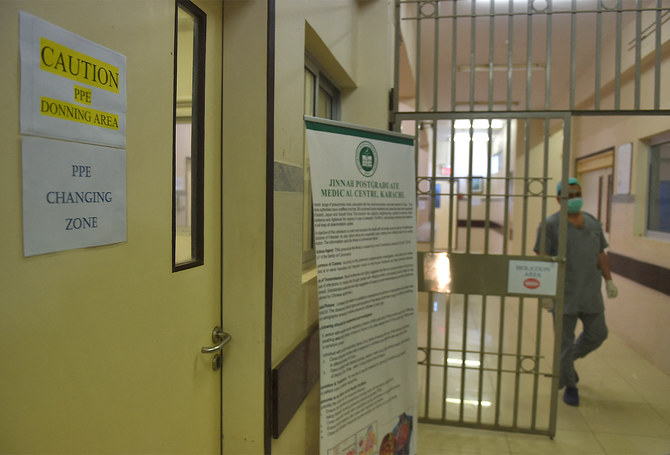

KARACHI: Health authorities on Tuesday isolated two children with “infection and rashes” on their body in the southern Pakistani port city of Karachi over suspicions of monkeypox as nearly 20 countries where the viral disease is not endemic reported outbreaks.
The World Health Organization has said there have been 131 confirmed monkeypox cases and 106 further suspected cases since the first was reported on May 7 outside the countries where it usually spreads. While the outbreak is unusual, it remains “containable” and limited, it said on Tuesday.
Monkeypox is a usually mild viral infection that is endemic in parts of west and central Africa, and spreads chiefly through close contact. So far, monkeypox cases have been reported in Belgium, France, Germany, Italy, the Netherlands, Portugal, Spain, Sweden and the United Kingdom, as well as the United States, Canada and Australia.
“Two children are under treatment in NICH (National Institute of Child Health) and being provided medical help in isolation. The children had come along with viral infection and rashes on body,” Dr. Hayat Buzdar, head of the emergency services at the NICH.
“They have no symptoms of the monkeypox but being isolated as precautionary measures. This is less likely to be monkeypox but the children are having skin infection, lesion and dermatosis.”
The children, who belong to Karachi and Larkana cities in the Sindh province, have no travel history, according to the medic. One of them is a newborn baby girl, while the other is a boy aged 5.
But Dr. Syed Jamal Raza, who also works at the NICH, said the five-year-old had symptoms that were in line with monkeypox.
“One newborn seems to have more of a skin infection and not pox. However, the other child symptoms are in line with the disease, there is also a history of having animals at home,” Dr. Raza told Arab News. “Currently being worked up for further evaluation and treatment.”
However, the NICH in a statement denied the children were affected by monkeypox virus.
“Two suspicious cases have been referred to us, but according to clinical examination and case definition, both children have bacterial rashes, while monkeypox is a viral zonotic disease,” it said.
The National Institutes of Health (NIH) in Islamabad also said that no case of monkeypox had yet been diagnosed in Pakistan.
“The news circulating on social media about monkeypox cases is incorrect,” it said on Twitter. “The situation is being closely monitored by the health authorities.”
Another NICH official, who wished not be named, said Pakistan doesn’t have the testing kits and different hospitals are trying to acquire them from abroad.
Under the current circumstances, the official added, health practitioners could declare a person suspected patient of the virus after analyzing the symptoms.
Earlier, Health experts said that monkeypox virus did not transmit too fast, though the government should improve its surveillance and conduct immediate contact tracing to control its spread against the backdrop of rising cases in Europe and elsewhere.
“This virus doesn’t spread fast and doesn’t infect someone as easily as COVID-19,” Dr. Faisal Mahmood, head of the infectious diseases at Aga Khan University Hospital, told Arab News, adding that usually skin contact with affected individuals or using their belongings, such as towels, can infect a person.
He added due to slow infection and low mortality rate, the virus was not considered dangerous, though the authorities needed to take steps to prevent it from spreading.
“For people there are no specific precautions other than reporting the symptoms on time, but several things can be done by the government. The authorities should do better surveillance, improve its detection and conduct immediate contact tracing to control the virus,” he maintained.
Pakistan’s National Institute of Health (NIH) along with provincial health department of Sindh province and Aga Khan University Hospital in Karachi issued alerts to health care facilities on Monday to report suspected monkeypox cases.
“All the national and provincial health authorities and other stakeholders ... are advised to remain on high alert for any suspected case,” the NIH said in its advisory. “Timely detection and notification are important for prompt implementation of preventive measures. All public and private hospitals must ensure readiness for isolation and treatment.”
Dr. Azizullah Khan Dhiloo, an infectious disease specialist, said the virus had reportedly spread through sexual interaction in most cases reported in the United Kingdom and elsewhere.
“It is immediately transmitted through physical contact, including sex, as it is reported in most cases, or touching the infected body parts,” he told Arab News. “But in terms of physical proximity, it can be transmitted only if someone sits with an infected person within three feet of distance for a minimum of three hours.”
Comparing it to COVID-19, he said the coronavirus could be transmitted within 15 minutes of face-to-face contact even at a greater distance.
Dr. Dhiloo said people should wash or sanitize their hands regularly and wear clean clothes.
There is no specific vaccine for the virus, though the one used against smallpox also works against this disease.
“Its anti-virus is hard to find but its control is very easy,” Dr. Mahmood of Aga Khan University Hospital said. “The patient with symptoms should be isolated immediately.”
Monkeypox causes symptoms that include fever, aches and bumpy rashes.
It is related to smallpox but is usually milder, particularly the West African strain which has also been identified in the US and has a fatality rate of about one percent.
Officials say most people fully recover from the disease within two to four weeks.


