

Opposition party warns government against using force to stop protest march to Islamabad

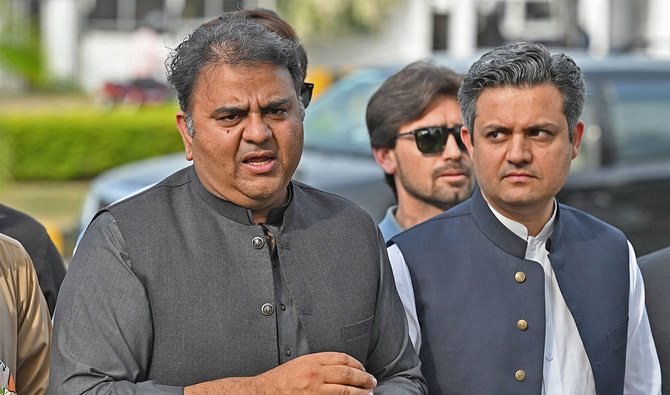
Leaders of the Pakistan Tehreek-e-Insaf party Fawad Chaudary (L) speaks to the media outside the parliament house building in Islamabad on April 11, 2022. (AFP/File)
Short Url
Updated 23 May 2022
Follow

Opposition party warns government against using force to stop protest march to Islamabad

  • Former PM Khan has called on supporters to march peacefully on Islamabad on May 25th to press for fresh elections
  • He says march is to protect country’s sovereignty as he alleges he was ousted from office in a US-organized plot

ISLAMABAD: Senior Vice President of the Pakistan Tehreek-e-Insaf party, Chaudhry Fawad Hussain, on Monday warned the government against using force to stop a protest march to Islamabad on May 25 to press for fresh elections.

Khan, who served as prime minister for over three and half years, was ousted last month in a no-confidence vote in parliament by an alliance of all major political parties. Since his ouster, he has addressed rallies in several cities as he mobilizes for a grand show of strength in the capital on Wednesday. He describes the planned march to Islamabad as a move to protect the country’s sovereignty, as he alleges that the vote that removed him was a United States-organized plot. Khan’s main goal is to pressure the government to announce immediate elections.

Addressing a press conference Hussain said it would not be in the government’s “favor” if it decided to arrest PTI leaders and supporters as they marched to the capital. He said Khan would lead the march from Peshawar to Islamabad himself.

Supporters would leave Peshawar on the morning of May 25 and reach Islamabad the same day, Hussain said, adding that the march to Islamabad was restricted to people in the Punjab and Khyber Pakhtunkwa provinces, while supporters in Karachi would hold protests in their own city.

He said Khan would also announce his next action plan on June 3.

Khan says the US wanted him gone from office because of his foreign policy choices in favor of Russia and China, and a visit he made on February 24 to Moscow, where he held talks with Russian President Vladimir Putin as Russian tanks rolled into Ukraine. He has also said the US dislikes his strident criticism of Washington’s war on terror.

The US State Department has denied any involvement in Pakistan’s internal politics.


Pakistan top military commander urges ‘multi-domain preparedness’ amid evolving security threats

Updated 23 December 2025
Follow

Pakistan top military commander urges ‘multi-domain preparedness’ amid evolving security threats

  • Asim Munir says Pakistan faces layered challenges spanning conventional, cyber, economic and information domains
  • His comments come against the backdrop of tensions with India, ongoing militant violence in western border regions

ISLAMABAD: Pakistan’s top military commander Field Marshal Asim Munir on Tuesday stressed the need for “multi-domain preparedness” to counter a broad spectrum of security challenges facing the country, saying they ranged from conventional military threats to cyber, economic and information warfare.

Pakistan’s security environment has remained volatile following a brief but intense conflict with India earlier this year, when the two nuclear-armed neighbors exchanged missile and artillery fire while deploying drones and fighter jets over four days before a ceasefire was brokered by the United States.

Pakistan has also been battling militant violence in its western provinces of Khyber Pakhtunkhwa and Balochistan, where authorities say armed groups operate from across the border in Afghanistan and receive backing from India. Both Kabul and New Delhi have rejected claims.

The military has also warned that disinformation constitutes a new form of security threat, prompting tighter regulations that critics say risk suppressing dissent. Munir also pointed to a “complex and evolving” global, regional and internal security landscape while addressing participants in the National Security and War Course at the National Defense University (NDU).

“These challenges span conventional, sub-conventional, intelligence, cyber, information, military, economic and other domains, requiring comprehensive multi-domain preparedness, continuous adaptation and synergy among all elements of national power,” he said, according to a military statement.

“Hostile elements increasingly employ indirect and ambiguous approaches, including the use of proxies to exploit internal fault lines, rather than overt confrontation,” he continued, adding that future leaders must be trained and remain alert to recognize, anticipate and counter these multi-layered challenges.

Munir also lauded the NDU for producing strategic thinkers who he said were capable of translating rigorous training and academic insight into effective policy formulation and operational outcomes.