

Three killed as fire in world’s largest pine nut forest in Pakistan enters tenth day

The collage of pictures shows an aerial view of smoke coming out of a pine nut forest in the Saraghalai area of district Sheerani on May 19, 2022 (left) and firefighters extinguishing the fire in district Musakhail in Pakistan's Balochistan province on May 16, 2022. (Forest Department Zhob)
Short Url
Updated 19 May 2022
Follow

Three killed as fire in world’s largest pine nut forest in Pakistan enters tenth day

  • The fires have affected different parts of the Koh-e-Sulaiman mountain range in Pakistan’s southwest
  • National Disaster Management Authority helicopter arrived today to extinguish fire with little luck

QUETTA: A massive forest fire that has been raging for ten days in different parts of the Koh-e-Sulaiman mountains in southwest Pakistan intensified on Wednesday, with three people reported dead as provincial and federal disaster management authorities struggled late into Thursday to douse the flames.

The fire has consumed hundreds of trees dotting the Koh-e-Sulaiman — a mountain range connecting the Pakistani provinces of Balochistan, Punjab and Khyber Pakhtunkhwa — and forced residents of nearby villages to move to safer locations.

The Koh-e-Sulaiman region is home to the world’s largest Chilghoza (pine nuts) forest, annually producing about 640,000 kilograms of the edible seed. It also houses different species of animals and birds, including chukar partridges, ibex goats and rabbits, which are under threat from the fires.

The first fire started on May 9 in Musakhail district, lasting over a week and affecting pine nut trees in a 22 kilometers radius. The fire had barely died down when a second blaze erupted late on Wednesday in the Saraghalai area of district Sheerani, with three locals killed as they tried to help in rescue operations.

“Three local residents who tried to extinguish the fire got killed,” the top administrative official of the area, Zhob division commissioner Bashir Bazai, told Arab News. “Four people are still stranded as the district administration is making efforts to retrieve the bodies and rescue the stranded individuals.”


Smoke engulfs a pine nut forest in the Koh-e-Sulaiman mountain range in the Saraghalai area of district Sheerani in Pakistan's Balochistan province on May 19, 2022. (Photo courtesy: Forest Department Zhob)

Locals helping with the rescue operation said neither provincial nor federal authorities were equipped to handle the disaster.

“The federal and provincial departments dealing with the fire are not trained and equipped to extinguish the fire in the Saraghalai area since the flames are too high,” local activist Salmeen Khpalwak, who works on climate change and environmental protection projects in the area, told Arab News on Thursday. “The fire is heading toward villages and many families have migrated to safe locations.”
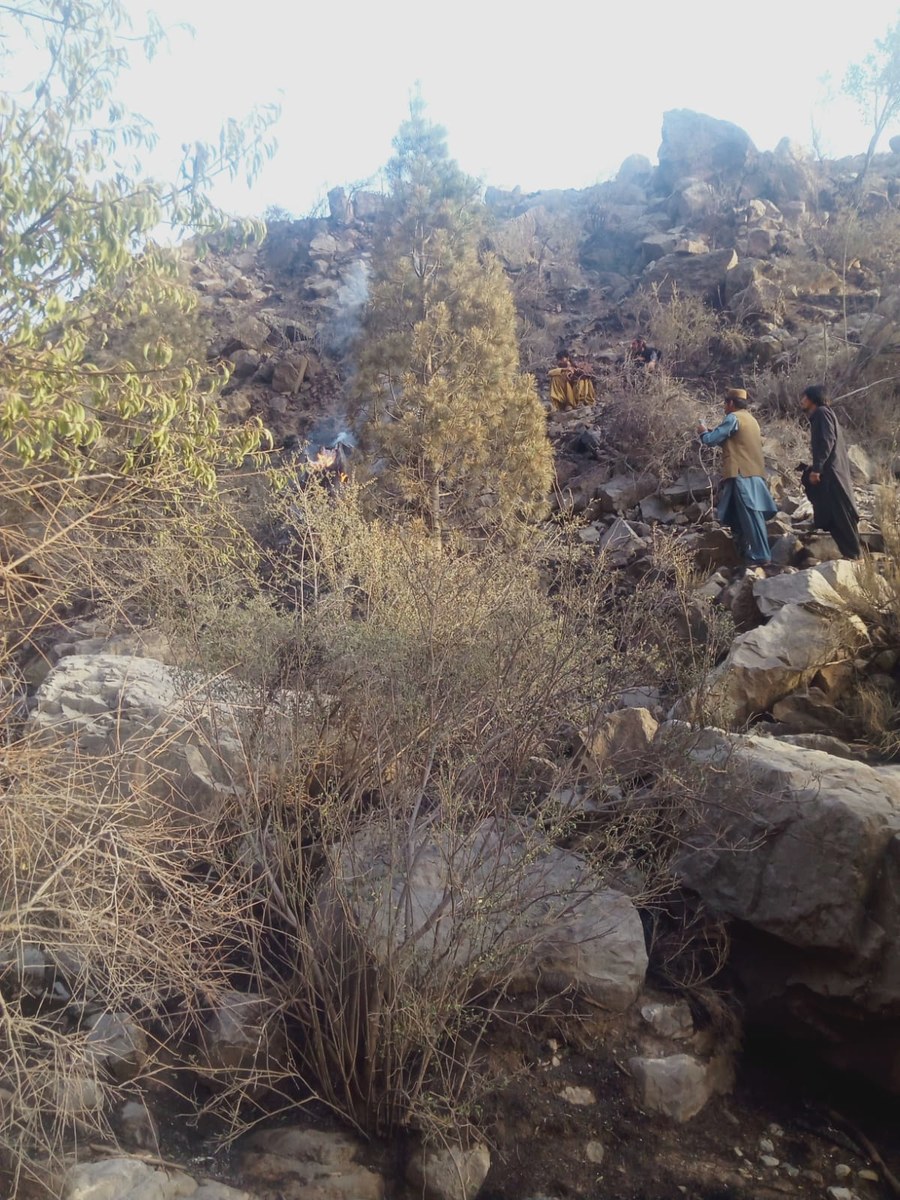


Firefighters and residents extinguish a fire that erupted in pine nut forest in district Musakhail in Pakistan's Balochistan province on May 16, 2022. (Photo courtesy: Forest Department Zhob)

Khpalwak said nearly 24 villages situated in the pine nut forest were currently in danger. He said the fire in Musakhail broke out during a thunderstorm when lightning hit but the reason behind the Saraghalai blaze was not yet known.

The National Disaster Management Authority (NDMA) sent a helicopter on Thursday to extinguish the fire, local officials said, though it was unable to put out the fire as it could not fly at a low altitude due to thick smoke and the mountainous terrain.

Muhammad Younus, who works with the Provincial Disaster Management Authority, said the NDMA had been requested to provide another helicopter due to the intensity of the fire.

“This morning, a helicopter splashed 3,500 liters of water fetched from the Sabakzai Dam about 45 kilometers away from the area engulfed in fire,” Atique Khan Kakar, a forest officer, told Arab News, “though it did not work.”


Karachi-bound bus crashes in fog, killing five in eastern Pakistan

Updated 7 sec ago
Follow

Karachi-bound bus crashes in fog, killing five in eastern Pakistan

  • Motorway closure forced the bus onto an alternate route, unfamiliar to the driver
  • Pakistan weather office reports visibility as low as 30 meters in parts of Punjab

ISLAMABAD: At least five people were killed and around 28 injured early on Wednesday when a passenger bus traveling from Rawalpindi to Karachi plunged into a ravine near Dhok Pathan in eastern Pakistan, after the driver diverted from a closed motorway due to dense fog, police said.

Poor visibility during Pakistan’s winter months frequently makes long-distance travel hazardous, prompting authorities to shut motorways and major roads during severe fog to prevent accidents. However, traffic mishaps involving both light and heavy vehicles are not uncommon during such conditions, sometimes triggering multi-vehicle pile-ups.

“A passenger bus traveling from Rawalpindi to Karachi plunged into a ravine near Dhok Pathan, killing at least five people and injuring around 28 others,” Adeel Sarfraz, a senior police officer and station house officer in the area near Chakwal, told Arab News over the phone.

“The accident occurred at around 2 a.m.,” he added. “Since the motorway was closed due to dense fog, the driver diverted the bus onto the GT [Grand Trunk] Road. However, the driver was unfamiliar with the route, and poor visibility caused by the fog led to the accident.”

Winter fog is a recurring hazard across Pakistan’s plains, particularly in Punjab and upper Sindh, where conditions can deteriorate sharply during late night and early morning hours.

Data shared by the Pakistan Meteorological Department earlier in the day showed extremely low visibility across several districts, with levels dropping to 30 meters in Narowal and Sheikhupura, 40 meters in Gujranwala and 50 meters in Faisalabad, Sialkot Airport and Toba Tek Singh.

Levels of 100 meters were reported in cities including Okara, Rahim Yar Khan, Bahawalpur and Sargodha, while some southern Punjab districts recorded relatively better conditions at around 200 meters.

The weather office warned that moderate to dense fog is likely to persist over much of Punjab, upper Sindh and plain areas of Khyber Pakhtunkhwa, advising travelers — especially those driving on highways and motorways — to exercise caution during nighttime and early morning hours.

Road accidents are also common in Pakistan due to poor infrastructure, speeding and limited enforcement of safety regulations, with fog-related incidents adding to seasonal risks during winter.