

Nearly 60m people internally displaced worldwide in 2021

Some 59.1 million people were registered as internally displaced worldwide in 2021. (File/AFP)
Short Url
Updated 19 May 2022
Follow

Nearly 60m people internally displaced worldwide in 2021

  • Some 59.1 million people were registered as internally displaced worldwide in 2021
  • That marks the second-highest annual number of new internal displacements in a decade after 2020

GENEVA: Conflicts and natural disasters forced tens of millions to flee within their own country last year, pushing the number of internally displaced people to a record high, monitors said Thursday.
Some 59.1 million people were registered as internally displaced worldwide in 2021 — an all-time record expected to be broken again this year amid mass displacement inside war-torn Ukraine.
Around 38 million new internal displacements were reported in 2021, with some people forced to flee multiple times during the year, according to a joint report by the Internal Displacement Monitoring Center (IDMC) and the Norwegian Refugee Council (NRC).
That marks the second-highest annual number of new internal displacements in a decade after 2020, which saw record-breaking movement due to a string of natural disasters.
Last year, new internal displacements from conflict surged to 14.4 million — marking a 50-percent jump from 2020 and more than doubling since 2012, the report showed. And global internal displacement figures are only expected to grow this year, driven in particular by the war in Ukraine.
More than eight million people have already been displaced within the war-ravaged country since Russia’s full-scale invasion began on February 24, in addition to the more than six million who have fled Ukraine as refugees.
NRC chief Jan Egeland agreed, warning: “It has never been as bad as this.”
“The world is falling apart,” he told reporters. “The situation today is phenomenally worse than even our record figure suggests.”
In 2021, sub-Saharan Africa counted the most internal movements, with more than five million displacements reported in Ethiopia alone, as the country grappled with the raging and expanding Tigray conflict and a devastating drought.
That marks the highest figure ever registered for a single country.
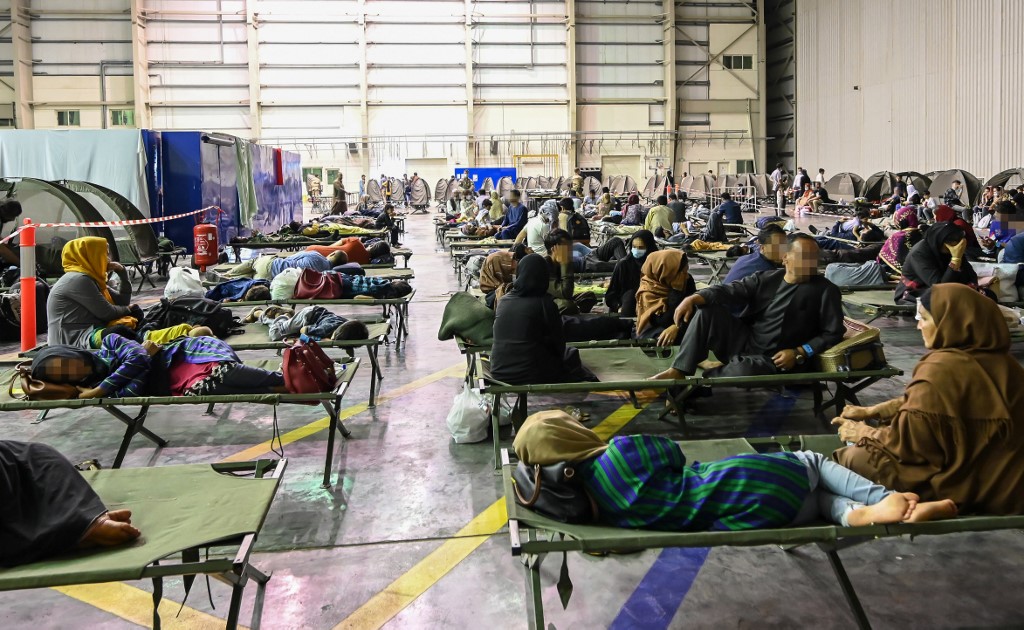


Unprecedented displacement numbers were also recorded last year in the Democratic Republic of Congo and Afghanistan, where the Taliban’s return to power, along with drought, saw many flee their homes. (File/AFP)

Unprecedented displacement numbers were also recorded last year in the Democratic Republic of Congo and Afghanistan, where the Taliban’s return to power, along with drought, saw many flee their homes.

The Middle East and North Africa region recorded its lowest number of new displacements in a decade, as the conflicts in Syria, Libya and Iraq de-escalated somewhat, but the overall number of displaced people in the region remained high.
Syria, where civil war has been raging for more than 11 years, still accounted for the world’s highest number of people living in internal displacement due to conflict — 6.7 million — at the end of 2021.
Despite the hike in conflict-related displacement, natural disasters continued to account for most new internal displacement, spurring 23.7 million such movements in 2021.
A full 94 percent of those were attributed to weather and climate-related disasters, like cyclones, monsoon rains, floods and droughts.
Experts say that climate change is increasing the intensity and frequency of such extreme weather events.



UN’s top court opens Myanmar Rohingya genocide case

Updated 12 January 2026
Follow

UN’s top court opens Myanmar Rohingya genocide case

  • The Gambia filed a case against Myanmar at the UN’s top court in 2019
  • Verdict expected to impact Israel’s genocide case over war on Gaza

DHAKA: The International Court of Justice on Monday opened a landmark case accusing Myanmar of genocide against its mostly Muslim Rohingya minority.

The Gambia filed a case against Myanmar at the UN’s top court in 2019, two years after a military offensive forced hundreds of thousands of Rohingya from their homes into neighboring Bangladesh.

The hearings will last three weeks and conclude on Jan. 29.

“The ICJ must secure justice for the persecuted Rohingya. This process should not take much longer, as we all know that justice delayed is justice denied,” said Asma Begum, who has been living in the Kutupalong refugee camp in Bangladesh’s Cox’s Bazar district since 2017.

A mostly Muslim ethnic minority, the Rohingya have lived for centuries in Myanmar’s western Rakhine state but were stripped of their citizenship in the 1980s and have faced systemic persecution ever since.

In 2017 alone, some 750,000 of them fled military atrocities and crossed to Bangladesh, in what the UN has called a textbook case of ethnic cleansing by Myanmar.

Today, about 1.3 million Rohingya shelter in 33 camps in Cox’s Bazar, turning the coastal district into the world’s largest refugee settlement.

“We experienced horrific acts such as arson, killings and rape in 2017, and fled to Bangladesh,” Begum told Arab News.

“I believe the ICJ verdict will pave the way for our repatriation to our homeland. The world should not forget us.”

A UN fact-finding mission has concluded that the Myanmar 2017 offensive included “genocidal acts” — an accusation rejected by Myanmar, which said it was a “clearance operation” against militants.

Now, there is hope for justice and a new future for those who have been displaced for years.

“We also have the right to live with dignity. I want to return to my homeland and live the rest of my life in my ancestral land. My children will reconnect with their roots and be able to build their own future,” said Syed Ahmed, who fled Myanmar in 2017 and has since been raising his four children in the Kutupalong camp.

“Despite the delay, I am optimistic that the perpetrators will be held accountable through the ICJ verdict. It will set a strong precedent for the world.”

The Myanmar trial is the first genocide case in more than a decade to be taken up by the ICJ. The outcome will also impact the genocide case that Israel is facing over its war on Gaza.

“The momentum of this case at the ICJ will send a strong message to all those (places) around the world where crimes against humanity have been committed,” Nur Khan, a Bangladeshi lawyer and human rights activist, told Arab News.

“The ICJ will play a significant role in ensuring justice regarding accusations of genocide in other parts of the world, such as the genocide and crimes against humanity committed by Israel against the people of Gaza.”