

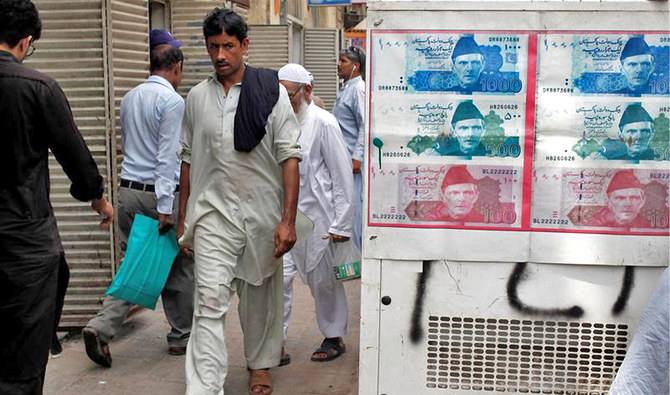

KARACHI: The Pakistani rupee continued its downward journey on Wednesday, hitting another historic low of Rs198.39 against the US dollar despite resumption of talks with the International Monetary Fund (IMF) for the revival of a loan facility amounting to $6 billion.
The rupee continued its losing streak against the greenback and depreciated by 1.34 percent, or Rs2.65 in the interbank market, during the day as uncertainty surrounding the outcome of the IMF talks built pressure on the national currency amid rising imports and depleting foreign exchange reserves.
“The recent freefall of rupee against the dollar is due to the high demand of dollar for import payments mainly for oil as both quantity and prices of oil products are rising in international market,” Abdul Azeem, head of research at Spectrum Securities, told Arab News.
The Pak rupee has been consistently on a decline since the last 10 trading sessions, losing its value by 6.65 percent against the greenback. The currency has lost its value by 11.03 percent since the start of the current calendar year while it has devalued by 20.59 percent during the current fiscal year which began in last July.
The currency depreciation continued despite the resumption of talks between the IMF and Pakistani authorities in Doha, Qatar, for the completion of seventh review of the $6 billion Extended Fund Facility.
“The market expectation regarding the outcome of talks between the fund and Pakistan authorities was not positive,” Azeem said.
Pakistani officials started negotiating with the IMF on Wednesday, with finance minister Miftah Ismail, minister of state for finance Dr. Aisha Ghous Pasha, acting governor of the State Bank Dr. Murtaza Syed, finance secretary Hamed Yaqoob Shaikh, chairman Federal Board of Revenue Asim Ahmad and senior officials joining the talks virtually.
According to an official statement, the finance minister reaffirmed the government’s commitment to undertake the reforms envisaged under the loan facility and meet the required structural benchmarks. IMF mission chief Nathan Porter also shared his assessment of the challenges facing the economy, saying that Pakistan needed both immediate and long-term measures to stabilize itself financially.
Islamabad has so far received $3 billion from the IMF under the loan program which the country secured back in 2019 to stabilize its wobbly economy. Pakistan is currently seeking an extension to the program until June 2023 with an additional loan amount of $2 billion.
A major sticking point between the IMF and Pakistan is likely to be an economic relief package worth about $1.7 billion that includes costly subsidies on fuel and electricity, announced by former prime minister Imran Khan earlier this year.
While the incumbent administration of Prime Minister Shahbaz Sharif is reluctant to remove energy subsidies fearing public backlash, economists suggest the government should take the tough decision since any further delay would entail greater political cost.
“It is the right decision to remove, in a staggered manner, the subsidies on energy, both on petroleum products as well as electricity,” Dr. Khaqan Najeeb, senior economist and former adviser to the finance ministry, told Arab News. “It would have been easier for the new government to have done this on April 15 [after it came into power].”
“The other action along with it like going to the IMF earlier would have ensured stability in the dollar-rupee parity,” he added.
The finance ministry quoted Miftah Ismail in its statement on the IMF talks released on Wednesday that the government understood the country’s economic woes and would need to take tough decisions while mitigating the effects of inflation on the middle to low-income groups.
Pakistan has repeatedly sought financial assistance from the IMF and other international donors to support its economy due to crippling national debt, burgeoning inflation and weakening currency.


