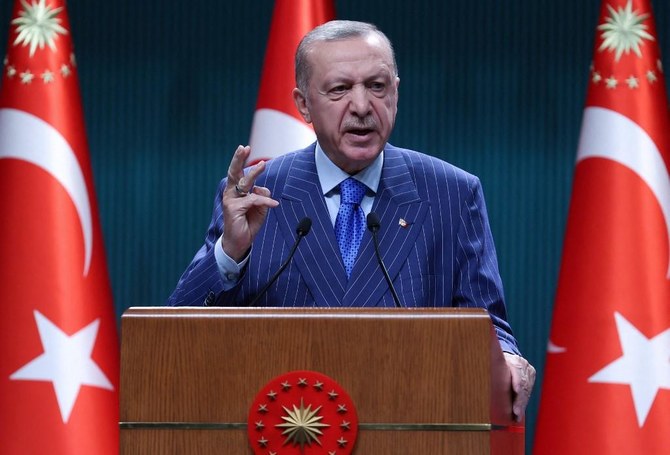
President Tayyip Erdogan said on Wednesday Sweden should not expect Turkey to approve its NATO bid without returning “terrorists,” and Swedish and Finnish delegations should not come to Turkey to convince it to back their NATO bids.
Earlier, Finland and Sweden formally applied to join the NATO alliance, a decision spurred by Russia’s invasion of Ukraine, with the accession process expected to take only a few weeks despite Turkey’s objections.
“We have such a sensitivity as protecting our borders from attacks by terrorists organizations,” Erdogan told MPs from his AK Party in parliament.
Erdogan said NATO allies had never supported Turkey in its fight against Kurdish militant groups, including the Syrian Kurdish YPG.
“NATO expansion is only meaningful for us in proportion to the respect that will be shown to our sensitivities,” he said.
Ankara says Sweden and Finland harbor people it says are linked to groups it deems terrorists, namely the Kurdistan Workers Party (PKK) militant group and followers of Fethullah Gulen, whom Ankara accuses of orchestrating a 2016 coup attempt.
Turkish state broadcaster TRT Haber said on Monday Sweden and Finland had not granted approval for the repatriation of 33 people that Turkey requested.
“So you won’t give us back terrorists but you ask us for NATO membership? NATO is an entity for security, an organization for security. Therefore, we cannot say ‘yes’ to this security organization being deprived of security,” he said.
NATO and the United States have said they were confident Turkey would not hold up membership of Finland and Sweden.

Erdogan says NATO should understand Turkey’s security sensitivities
Short Url
https://arab.news/vxan3
Erdogan says NATO should understand Turkey’s security sensitivities
- President Tayyip Erdogan said on Wednesday he expected Turkey’s NATO allies to understand its sensitivities on security
Ethiopia demands Eritrea ‘immediately withdraw’ troops from its territory
- Relations between the two Horn of Africa countries have long been fraught
- In recent months, Addis Ababa has accused Eritrea of supporting insurgents on Ethiopian soil
ADDIS ABABA: Ethiopia has ordered neighboring Eritrea to “immediately withdraw its troops” from Ethiopian territory, accusing Asmara’s forces of an “incursion” and working with “rebel groups” along its northwestern border.
Relations between the two Horn of Africa countries have long been fraught. In recent months, Addis Ababa has accused Eritrea of supporting insurgents on Ethiopian soil — allegations Asmara denies.
“Developments over the last few days indicate that the Government of Eritrea has chosen the path of further escalation,” foreign minister Gedion Timothewos told his Eritrean counterpart in a letter dated Saturday.
He demanded that Asmara “withdraw its troops from Ethiopian territory and cease all forms of collaboration with rebel groups.”
These actions were “not just provocations but acts of outright aggression,” he said.
But he said that he believed the “cycle of violence and mistrust” could still be broken through diplomacy.
The Eritrean government did not immediately respond to requests for comment.
Eritrea, one of the world’s most closed countries, gained independence from Ethiopia in 1993. They fought a devastating border war from 1998 to 2000 which claimed tens of thousands of lives.
The two governments cooperated against rebels from Ethiopia’s Tigray region during the 2020-2022 conflict, but fell out over the peace accord, from which Eritrea was excluded.
Relations between the two Horn of Africa countries have long been fraught. In recent months, Addis Ababa has accused Eritrea of supporting insurgents on Ethiopian soil — allegations Asmara denies.
“Developments over the last few days indicate that the Government of Eritrea has chosen the path of further escalation,” foreign minister Gedion Timothewos told his Eritrean counterpart in a letter dated Saturday.
He demanded that Asmara “withdraw its troops from Ethiopian territory and cease all forms of collaboration with rebel groups.”
These actions were “not just provocations but acts of outright aggression,” he said.
But he said that he believed the “cycle of violence and mistrust” could still be broken through diplomacy.
The Eritrean government did not immediately respond to requests for comment.
Eritrea, one of the world’s most closed countries, gained independence from Ethiopia in 1993. They fought a devastating border war from 1998 to 2000 which claimed tens of thousands of lives.
The two governments cooperated against rebels from Ethiopia’s Tigray region during the 2020-2022 conflict, but fell out over the peace accord, from which Eritrea was excluded.
© 2026 SAUDI RESEARCH & PUBLISHING COMPANY, All Rights Reserved And subject to Terms of Use Agreement.



