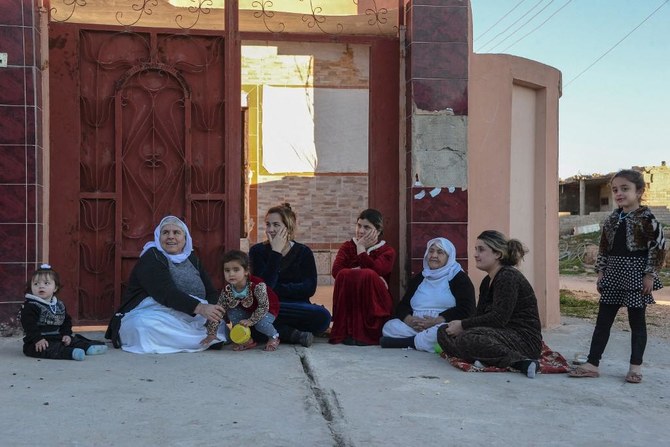
BAGHDAD: Violence and sluggish reconstruction have prevented the return to Iraq’s northwestern town of Sinjar of its predominantly Yazidi population after the abuses of militant rule, the Norwegian Refugee Council said Wednesday.
Five years after the defeat of the Daesh group, which committed massacres against the Yazidis and used their women as sex slaves, the town’s Yazidi, Muslim Kurdish and Arab residents are no closer to returning home, especially after a surge in violence earlier this month.
The aid group said that “nearly two-thirds of Sinjar’s population — over 193,000 Yazidis, Arabs, and Kurds — remain displaced.”
The Yazidis are a Kurdish-speaking minority who were persecuted by Daesh for their non-Muslim faith after its capture of the town in 2014.
“Widespread destruction of civilian houses, new clashes, and social tensions” are preventing returns, NRC said in a report.
Out of 1,500 people surveyed by the aid group to determine how decisions to return home are made, about 64 percent “said their homes were heavily damaged.”
“A staggering 99 percent of those who applied for government compensation had not received any funding for damaged property,” it said.
“Families from Sinjar remain in displacement, with thousands still living in camps,” NRC’s country director for Iraq, James Munn, said.
“We need durable solutions put in place so Iraqi families can once again start living their lives and plan for a safer future.”
The aid group called on the Iraqi government and the authorities in the autonomous Kurdistan region to “prioritize the rehabilitation of infrastructure and the restoration of services to allow for safe housing, land, and property, alongside public infrastructure.”
Some “80 percent of public infrastructure and 70 percent of civilian homes in Sinjar were destroyed” during the conflict years ago, the NRC said.
In early May, fighting broke out between Iraqi troops and Yazidi fighters affiliated with Turkey’s banned Kurdistan Workers’ Party (PKK), killing at least one Iraqi soldier.
The Iraqi army was seeking to apply an agreement between Baghdad and the Kurdistan region for the withdrawal of Yazidi and PKK fighters from Sinjar.
More than 10,000 people fled the latest fighting, adding to the population of displaced.

‘Conflict, destruction’ prevent return to Iraq’s Yazidi heartland: NGO
Short Url
https://arab.news/jg54m
‘Conflict, destruction’ prevent return to Iraq’s Yazidi heartland: NGO
- ‘Nearly two-thirds of Sinjar’s population — over 193,000 Yazidis, Arabs, and Kurds — remain displaced’
- The Yazidis are a Kurdish-speaking minority who were persecuted by Daesh for their non-Muslim faith
Israeli minister calls West Bank measures ‘de facto sovereignty,’ says no future Palestinian state
- Eli Cohen’s comments on Tuesday suggest these steps prevent the establishment of a Palestinian state
- alestinians, Arab countries, and human rights groups view the actions as annexation
RAMALLAH: A top Israeli official said Tuesday that measures adopted by the government that deepen Israeli control in the occupied West Bank amounted to implementing “de facto sovereignty,” using language that mirrors critics’ warnings about the intent behind the moves.
The steps “actually establish a fact on the ground that there will not be a Palestinian state,” Energy Minister Eli Cohen told Israel’s Army Radio.
Palestinians, Arab countries and human rights groups have called the moves announced Sunday an annexation of the territory, home to roughly 3.4 million Palestinians who seek it for a future state.
Cohen’s comments followed similar remarks by other members of Prime Minister Benjamin Netanyahu’s government, including Finance Minister Bezalel Smotrich and Defense Minister Israel Katz.
The moves — and Israeli officials’ own descriptions of them — put the country at odds with both regional allies and previous statements from US President Donald Trump. Netanyahu has traveled to Washington to meet with him later this week.
Last year, Trump said he won’t allow Israel to annex the West Bank. The US-brokered ceasefire between Israel and Hamas that aimed to stop the war in Gaza also acknowledged Palestinian aspirations for statehood.
Widespread condemnation
The measures further erode the Palestinian Authority’s limited powers, and it’s unclear the extent to which it can oppose them. Still, Hussein Al Sheikh, the Palestinian Authority’s deputy president, said on Tuesday “the Palestinian leadership called on all civil and security institutions in the State of Palestine” to reject them
In a post on X on Tuesday, he said the Israeli steps “contradict international law and the agreements signed with the Palestine Liberation Organization.”
A group of eight Arab and Muslim-majority countries expressed their “absolute rejection” of the measures, calling them in a joint statement Monday illegal and warning they would “fuel violence and conflict in the region.”
Israel’s pledge not to annex the West Bank is embedded in its diplomatic agreements with some of those countries and renewed warnings that it was a “red line” for the Emirates led Israel to shelve some high-level discussions on the matter last year.
United Nations Secretary General Antonio Guterres said he was “gravely concerned” by the measures.
“They are driving us further and further away from a two-State solution and from the ability of the Palestinian authority and the Palestinian people to control their own destiny,” his spokesperson, Stephane Dujarric, said on Monday.
What the measures mean
The measures, approved by Netanyahu’s Security Cabinet on Sunday, expand Israel’s enforcement authority over land use and planning in areas run by the Palestinian Authority, making it easier for Jewish settlers to force Palestinians to give up land.
Smotrich and Katz on Sunday said they would lift long-standing restrictions on land sales to Israeli Jews in the West Bank, shift some control over sensitive holy sites — including Hebron’s Ibrahimi Mosque, also known as the Tomb of the Patriarchs — and declassify land registry records to ease property acquisitions.
They also revive a government committee empowered to make what officials described as “proactive” land purchases in the territory, a step intended to reserve land for future settlement expansion.
Taken together, the moves add an official stamp to Israel’s accelerating expansion and would override parts of decades-old agreements that split the West Bank between areas under Israeli control and areas where the Palestinian Authority exercises limited autonomy.
Israel has increasingly legalized settler outposts built on land Palestinians say documents show they have long owned, evicted Palestinian communities from areas declared “military zones” and villages near archaeological sites it has reclassified as “national parks.”
More than 700,000 Israelis live in the occupied West Bank and east Jerusalem, territories captured by Israel in 1967 and sought by the Palestinians for an independent state along with the Gaza Strip.
Palestinians are not permitted to sell land privately to Israelis. Settlers can buy homes on land controlled by Israel’s government.
The international community overwhelmingly considers Israeli settlement construction to be illegal and an obstacle to peace.
“These decisions constitute a direct violation of the international agreements to which Israel is committed and are steps toward the annexation of Areas A and B,” anti-settlement watchdog group Peace Now said on Sunday, referring to parts of the West Bank where the Palestinian Authority exercised some autonomy.
The steps “actually establish a fact on the ground that there will not be a Palestinian state,” Energy Minister Eli Cohen told Israel’s Army Radio.
Palestinians, Arab countries and human rights groups have called the moves announced Sunday an annexation of the territory, home to roughly 3.4 million Palestinians who seek it for a future state.
Cohen’s comments followed similar remarks by other members of Prime Minister Benjamin Netanyahu’s government, including Finance Minister Bezalel Smotrich and Defense Minister Israel Katz.
The moves — and Israeli officials’ own descriptions of them — put the country at odds with both regional allies and previous statements from US President Donald Trump. Netanyahu has traveled to Washington to meet with him later this week.
Last year, Trump said he won’t allow Israel to annex the West Bank. The US-brokered ceasefire between Israel and Hamas that aimed to stop the war in Gaza also acknowledged Palestinian aspirations for statehood.
Widespread condemnation
The measures further erode the Palestinian Authority’s limited powers, and it’s unclear the extent to which it can oppose them. Still, Hussein Al Sheikh, the Palestinian Authority’s deputy president, said on Tuesday “the Palestinian leadership called on all civil and security institutions in the State of Palestine” to reject them
In a post on X on Tuesday, he said the Israeli steps “contradict international law and the agreements signed with the Palestine Liberation Organization.”
A group of eight Arab and Muslim-majority countries expressed their “absolute rejection” of the measures, calling them in a joint statement Monday illegal and warning they would “fuel violence and conflict in the region.”
Israel’s pledge not to annex the West Bank is embedded in its diplomatic agreements with some of those countries and renewed warnings that it was a “red line” for the Emirates led Israel to shelve some high-level discussions on the matter last year.
United Nations Secretary General Antonio Guterres said he was “gravely concerned” by the measures.
“They are driving us further and further away from a two-State solution and from the ability of the Palestinian authority and the Palestinian people to control their own destiny,” his spokesperson, Stephane Dujarric, said on Monday.
What the measures mean
The measures, approved by Netanyahu’s Security Cabinet on Sunday, expand Israel’s enforcement authority over land use and planning in areas run by the Palestinian Authority, making it easier for Jewish settlers to force Palestinians to give up land.
Smotrich and Katz on Sunday said they would lift long-standing restrictions on land sales to Israeli Jews in the West Bank, shift some control over sensitive holy sites — including Hebron’s Ibrahimi Mosque, also known as the Tomb of the Patriarchs — and declassify land registry records to ease property acquisitions.
They also revive a government committee empowered to make what officials described as “proactive” land purchases in the territory, a step intended to reserve land for future settlement expansion.
Taken together, the moves add an official stamp to Israel’s accelerating expansion and would override parts of decades-old agreements that split the West Bank between areas under Israeli control and areas where the Palestinian Authority exercises limited autonomy.
Israel has increasingly legalized settler outposts built on land Palestinians say documents show they have long owned, evicted Palestinian communities from areas declared “military zones” and villages near archaeological sites it has reclassified as “national parks.”
More than 700,000 Israelis live in the occupied West Bank and east Jerusalem, territories captured by Israel in 1967 and sought by the Palestinians for an independent state along with the Gaza Strip.
Palestinians are not permitted to sell land privately to Israelis. Settlers can buy homes on land controlled by Israel’s government.
The international community overwhelmingly considers Israeli settlement construction to be illegal and an obstacle to peace.
“These decisions constitute a direct violation of the international agreements to which Israel is committed and are steps toward the annexation of Areas A and B,” anti-settlement watchdog group Peace Now said on Sunday, referring to parts of the West Bank where the Palestinian Authority exercised some autonomy.
© 2026 SAUDI RESEARCH & PUBLISHING COMPANY, All Rights Reserved And subject to Terms of Use Agreement.


