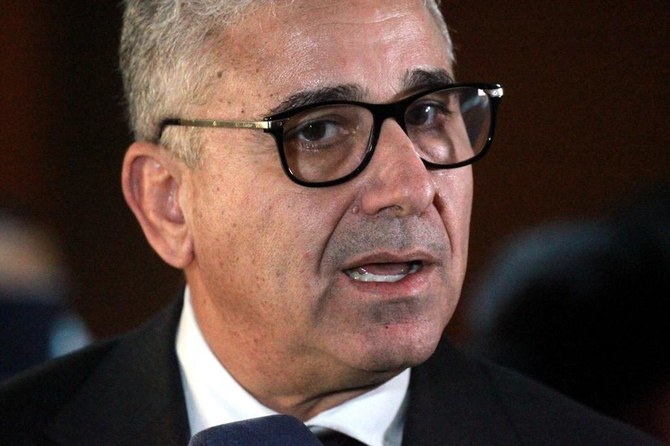
TRIPOLI: Libya’s parliament-appointed prime minister Fathi Bashagha left the capital Tripoli on Tuesday, his office said, hours after his attempt to enter the city led to clashes between rival factions.
Bashagha’s government earlier said it had arrived in the capital, where the unity government has refused to cede power, prompting fighting between their militia backers.
Its press service announced “the arrival of the prime minister of the Libyan government, Mr. Fathi Bashagha, accompanied by several ministers, in the capital Tripoli to begin his work there.”
Clashes broke out between rival armed groups shortly after he entered the western city, an AFP journalist reported.
In February, the parliament in the eastern city of Tobruk designated former interior minister Bashagha as prime minister.
But he has failed to oust the Tripoli-based unity administration led by premier Abdulhamid Dbeibah, who has said repeatedly he will only cede power to an elected government.
Dbeibah’s government was formed in 2020 as part of United Nations-led efforts to draw a line under a decade of conflict since a NATO-backed revolt toppled dictator Muammar Qaddafi in 2011.
Dbeibah was to lead the country until elections last December, but they were indefinitely postponed and his political opponents argue that his mandate has now finished.
The rise of Bashagha’s government gives the North African country two rival administrations, as was the case between 2014 and a 2020 cease-fire.

Libya’s parliament-appointed prime minister quits Tripoli after clashes
https://arab.news/v95sp
Libya’s parliament-appointed prime minister quits Tripoli after clashes
- Clashes break out between rival armed groups shortly after Fathi Bashagha enters the western city
Israel’s Supreme Court suspends govt move to shut army radio
- Israel’s Supreme Court has issued an interim order suspending a government decision to shut down Galei Tsahal, the country’s decades-old and widely listened-to military radio station
JERUSALEM: Israel’s Supreme Court has issued an interim order suspending a government decision to shut down Galei Tsahal, the country’s decades-old and widely listened-to military radio station.
In a ruling issued late Sunday, Supreme Court President Isaac Amit said the suspension was partly because the government “did not provide a clear commitment not to take irreversible steps before the court reaches a final decision.”
He added that Attorney General Gali Baharav-Miara supported the suspension.
The cabinet last week approved the closure of Galei Tsahal, with the shutdown scheduled to take effect before March 1, 2026.
Founded in 1950, Galei Tsahal is widely known for its flagship news programs and has long been followed by both domestic and foreign correspondents.
A government audience survey ranks it as Israel’s third most listened-to radio station, with a market share of 17.7 percent.
Prime Minister Benjamin Netanyahu had urged ministers to back the closure, saying there had been repeated proposals over the years to remove the station from the military, abolish it or privatise it.
But Baharav-Miara, who also serves as the government’s legal adviser and is facing dismissal proceedings initiated by the premier, has warned that closing the station raised “concerns about possible political interference in public broadcasting.”
She added that it “poses questions regarding an infringement on freedom of expression and of the press.”
Defense Minister Israel Katz said last week that Galei Tsahal broadcasts “political and divisive content” that does not align with military values.
He said soldiers, civilians and bereaved families had complained that the station did not represent them and undermined morale and the war effort.
Katz also argued that a military-run radio station serving the general public is an anomaly in democratic countries.
Opposition leader Yair Lapid had condemned the closure decision, calling it part of the government’s effort to suppress freedom of expression ahead of elections.
Israel is due to hold parliamentary elections in 2026, and Netanyahu has said he will seek another term as prime minister.


