Pakistan says it foiled suspected suicide attack against Chinese nationals

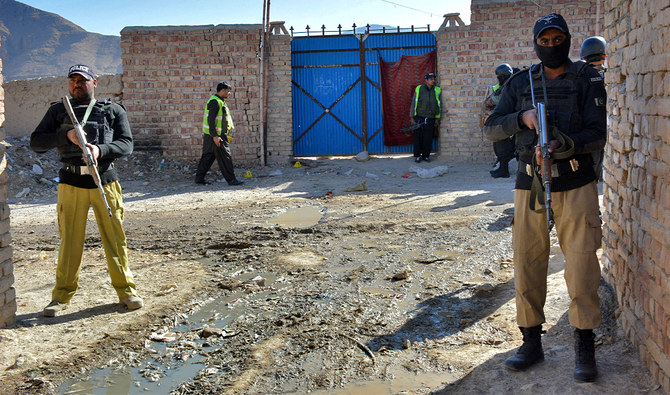
Pakistani policemen stand guard in Quetta, Pakistan, on January 18, 2018. (AFP/File)
Short Url
Updated 16 May 2022
Follow

Pakistan says it foiled suspected suicide attack against Chinese nationals

  • Arrest comes weeks after a woman suicide bomber killed three Chinese teachers, their Pakistani driver
  • Police arrested the militant in southwestern Balochistan province that borders Afghanistan and Iran

ISLAMABAD: Pakistani police arrested a would-be suicide bomber who planned to blow herself up near a convoy of Chinese nationals along the China Pakistan Economic-Corridor (CPEC), a police statement said. 

Monday's arrest came two weeks after a woman suicide bomber blew herself up on a university campus in the southern port city of Karachi, killing three Chinese teachers and their Pakistani driver. 

Police arrested the militant in southwestern Balochistan province that borders Afghanistan and Iran, the statement said. 

She belongs to the separatist Balochistan Liberation Army (BLA), which has started using women militants as suicide bombers, police said, a new phenomenon for counter-terrorism police who are more used to dealing with such attacks by militants. 

"The woman wanted to target a convoy of Chinese nationals," police said, adding the attack was planned along a route of China Pakistan Economic-Corridor (CPEC). 

Police recovered explosives and detonators from the woman and investigated her, revealing her plans to target Chinese nationals. No other evidence was produced to support their accusation. 

The Karachi suicide bomber was also a member of the BLA, the police statement said. 

China is a close Pakistan ally and the CPEC is $65 billion-plus investment in infrastructure in Pakistan, part of Beijing's Belt and Road Initiative to seek road and sea trade routes to connect with the rest of the world. 

Balochistan is home to a deep-water port in Gwadar city, which Beijing is developing under the CPEC. 

Baloch separatist guerrillas say they've been fighting for decades for a greater share in regional mine and mineral resources. 

They attack gas plants, infrastructure, security forces and Chinese interests, which they say amount to the occupation of their land and resources in the name of development. 

Their attacks against Chinese nationals have increased since the fall of the Afghan capital to the Taliban in August last year. 

The Taliban deny Pakistan's accusations that the insurgents use Afghan soil to train the militants and plan the attacks. 

Islamabad also blames arch-rival neighbouring India for backing the insurgents, a charge New Delhi denies. 


Bangladesh leader pushes for SAARC revival after meeting Indian, Pakistani dignitaries

Updated 5 sec ago
Follow

Bangladesh leader pushes for SAARC revival after meeting Indian, Pakistani dignitaries

  • Muhammad Yunus met Pakistan’s parliamentary speaker, Indian FM at Khaleda Zia’s funeral on Wednesday
  • SAARC has been dysfunctional since 2016, after India withdrew following a militant attack it blamed on Islamabad

ISLAMABAD: Bangladesh Chief Adviser Muhammad Younus this week pushed for reviving the South Asian Association for Regional Cooperation (SAARC) platform after meeting dignitaries from India, Pakistan and other parts of the region. 

SAARC has been effectively dysfunctional since 2016, when its planned Islamabad summit collapsed after India withdrew following a militant attack it blamed on Pakistan. Islamabad denied involvement, but New Delhi’s decision prompted Afghanistan, Bangladesh and Bhutan to pull out, leading to the indefinite postponement of the summit.

Younus met Pakistan’s National Assembly Speaker Ayaz Sadiq and Indian External Affairs Minister Subrahmanyam Jaishankar at former Bangladesh premier Khaleda Zia’s state funeral in Dhaka on Wednesday. The funeral also saw a handshake between the Indian and Pakistani representatives, the first high-level contact between officials of the two countries since their conflict in May. 

“During the meetings, Professor Yunus repeatedly emphasized the need to revive the South Asian Association for Regional Cooperation (SAARC),” Yunus’ account on social media platform X said.

“We witnessed a true SAARC spirit at the funeral yesterday,” the account quoted Yunus as saying. “SAARC is still alive. The SAARC spirit is still alive.”

The Bangladesh leader said apart from Jaishankar and Sadiq, representatives from South Asia who attended the funeral included Nepal’s Foreign Minister Bala Nanda Sharma, Sri Lanka’s Minister of Foreign Affairs, Employment and Tourism Vijitha Herath, and Maldives Minister of Higher Education and Labor Ali Haider Ahmed. 

Yunus said he tried to convene an informal gathering of SAARC leaders on the sidelines of the UN General Assembly in New York last year.

His statement to revive SAARC follows that of Pakistan’s Prime Minister Shehbaz Sharif, who earlier this month also called for reviving the South Asian platform. 

Sharif’s message last month came as the bloc marked the 40th anniversary of its founding charter. The Pakistani premier stressed the importance of deeper economic collaboration and collective responses to shared regional challenges such as poverty, climate-induced natural disasters, food and energy insecurity, and public-health vulnerabilities.