

Kim Jong Un orders North Korean military to stabilize supply of COVID-19 drugs

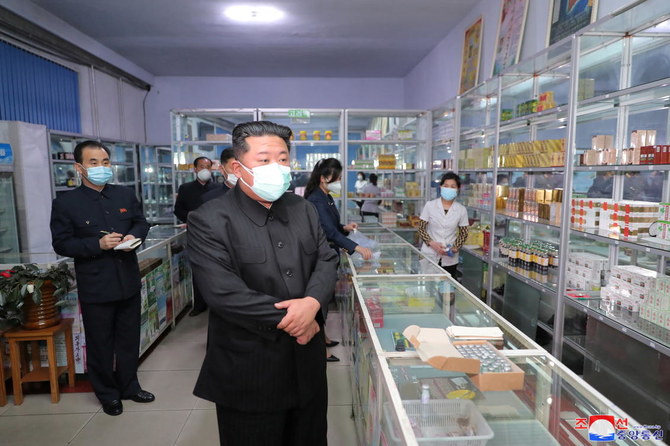
North Korean leader Kim Jong Un inspects a pharmacy in Pyongyang after he ordered the army’s medical corps to ‘stabilize the supply of medicines.’ (KCNA via Reuters)
Short Url
Updated 16 May 2022
Follow

Kim Jong Un orders North Korean military to stabilize supply of COVID-19 drugs

  • Last week brought Pyongyang’s first acknowledgment of an ‘explosive’ outbreak
  • Kim: Drugs procured by the state were not reaching people in a timely and accurate way

SEOUL: Leader Kim Jong Un has ordered North Korea’s military to stabilize distribution of COVID-19 medicines in the capital, Pyongyang, in the battle on the country’s first confirmed outbreak of the disease, state media said.
Last week brought the North’s first acknowledgment of an “explosive” outbreak, with experts warning it could wreak devastation in a country with limited medical supplies and no vaccine program.
Drugs procured by the state were not reaching people in a timely and accurate way, Kim told an emergency politburo meeting on Sunday, before visiting pharmacies near the capital’s Taedong River, state news agency KCNA said.
Kim ordered immediate deployment of the “powerful forces” of the army’s medical corps to “stabilize the supply of medicines in Pyongyang City,” it added.
Although authorities had ordered distribution of national reserves of medicine, pharmacies were not well-equipped to perform their functions smoothly, Kim added, the agency said.
Among their shortcomings were a lack of adequate drug storage other than showcases, while salespeople were not equipped with the proper sanitary clothing and hygiene in their surroundings fell short of standards, the leader said.
He criticized the “irresponsible” work attitude, organization and execution by the cabinet and the public health sector, it added.
Neighbouring South Korea will spare no effort to help the North fight its outbreak, President Yoon Suk-yeol told parliament on Monday, saying it was ready to provide COVID-19 vaccines and other medical support if Pyongyang agrees.
South Korea’s unification ministry has offered to hold working-level talks with North Korea on offering support for its neighbor, which is battling its first confirmed outbreak of COVID-19, the ministry said on Monday.
The ministry, charged with maintaining relations between the two nations, said it had expressed willingness to provide medicines, from vaccines to test kits, as well as technical co-operation, based on the South’s experience with quarantine.

North Korea’s tally of the fever-stricken stood at 1,213,550, with 50 deaths by Sunday, after KCNA reported 392,920 more cases of fever, and eight more deaths. It did not say how many suspected infections had tested positive for COVID-19.
The North has blamed a large number of the deaths on people who were “careless in taking drugs” because of a lack of knowledge about the omicron variant of coronavirus and its correct treatment.


Lawsuit challenges Trump administration’s ending of protections for Somalis

Updated 10 March 2026
Follow

Lawsuit challenges Trump administration’s ending of protections for Somalis

  • The lawsuit cites a series of statements Trump has made describing Somalis as “garbage” and “low IQ people” who “contribute nothing.”

BOSTON: Immigrant rights advocates filed a lawsuit on Monday seeking to stop US President Donald Trump’s administration from next ​week ending legal protections that allow nearly 1,100 Somalis to live and work in the United States. The lawsuit, brought by four Somalis and two advocacy groups, challenges the US Department of Homeland Security’s decision to end Temporary Protected Status for Somali immigrants, whom Trump has derided in public remarks. Outgoing Homeland Security Secretary Kristi Noem in January announced that TPS for Somalis would end on March 17, arguing that Somalia’s conditions had improved, despite fighting continuing between Somali forces and Al-Shabab militants. The plaintiffs, who ‌include the groups ‌African Communities Together and Partnership for the Advancement ​of ‌New ⁠Americans, in the ​lawsuit filed ⁠in Boston federal court argue the move was procedurally flawed and driven by a discriminatory, predetermined agenda.
The lawsuit cites a series of statements Trump has made describing Somalis as “garbage” and “low IQ people” who “contribute nothing.”
The plaintiffs said the administration is ending TPS for Somalia and other countries due to unconstitutional bias against non-white immigrants, not based on objective assessments of country conditions.
“The termination of TPS for Somalia is racism masking as immigration policy,” ⁠Omar Farah, executive director at the legal group Muslim Advocates, said ‌in a statement.
DHS did not respond to ‌a request for comment. It has previously said TPS ​was “never intended to be a de ‌facto amnesty program.”
TPS is a form of humanitarian immigration protection that shields eligible migrants ‌from deportation and allows them to work. Under Noem, DHS has moved to end TPS for a dozen countries, sparking legal challenges. The administration on Saturday announced plans to pursue an appeal at the US Supreme Court in order to end TPS for over 350,000 Haitians. It ‌also wants the high court to allow it to end TPS for about 6,000 Syrians.

SOMALI COMMUNITY TARGETED
Somalia was first designated ⁠for TPS in ⁠1991, with its latest extension in 2024. About 1,082 Somalis currently hold TPS, and 1,383 more have pending applications, according to DHS. Somalis in Minnesota in recent months had become a target of Trump’s immigration crackdown, with officials pointing to a fraud scandal in which many people charged come from the state’s large Somali community. The Trump administration cited those fraud allegations as a basis for a months-long immigration enforcement surge in Democratic-led Minnesota, during which about 3,000 immigration agents were deployed, spurring protests and leading to the killing of two US citizens by federal agents.
In November, Trump announced he would end TPS for Somalis in Minnesota, and a month later said ​he wanted them sent “back to where they ​came from.”
The US Department of State advises against traveling to Somalia, citing crime and civil unrest among numerous factors.