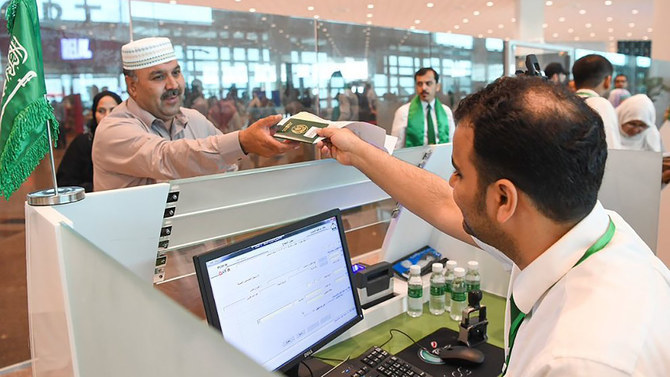
ISLAMABAD: Pakistan will select successful Hajj applicants under the government scheme through a balloting process on Sunday, reported state-owned Radio Pakistan.
Saudi Arabia this year announced the annual Hajj pilgrimage for all Muslims across the globe after a hiatus of two years due to the COVID-19 pandemic.
Pakistan will be sending 81,132 pilgrims for Hajj this year, with 60 percent of the quota allocated to private Hajj operators.
The maximum age limit for pilgrims this year is 65.
“Balloting of Hajj applications under government scheme is being held today in Islamabad,” Radio Pakistan said, adding: “Over 32,000 successful intending pilgrims will be selected out of the total 63,604 applicants.”
Last month, the Pakistan government announced people willing to perform Hajj this year could submit online applications from May 1 to 13, with token money of Rs50,000 ($270).
The ministry of religious affairs also requested all aspiring pilgrims to ensure their passports were valid till January 5, 2023, adding that people whose passports were going to expire before that should submit new ones by May 18.
Pakistan’s religious affairs minister Mufti Abdul Shakoor said on April 29 the per person cost of this year’s Hajj could range from Rs700,000 ($3,770) to Rs1,000,000 ($5,386), owing to the increase in taxes and cost of other facilities in the kingdom.

Pakistan to select successful Hajj applicants through government balloting scheme today
https://arab.news/j36qd
Pakistan to select successful Hajj applicants through government balloting scheme today
- Radio Pakistan says over 32,000 successful intending pilgrims will be selected from 63,604 applicants
- Saudi Arabia has announced Hajj for Muslims across the world after a two-year gap due to COVID-19
Pakistan business body writes to PM seeking ‘clear roadmap’ to spur investment
- Business confidence in Pakistan has fallen sharply amid rising inflation, high energy costs and unpredictable tax environment
- In a letter written to PM Shehbaz Sharif, the Pakistan Business Forum president highlights challenges facing the business community
KARACHI: The Pakistan Business Forum (PBF), a representative body of traders and businesspersons in the country, on Monday urged Prime Minister Shehbaz Sharif’s intervention in outlining a “clear economic roadmap” to promote long-term investment in Pakistan.
Business confidence in Pakistan has fallen sharply amid rising inflation, high energy costs and an unpredictable tax environment. Currency volatility and slowing demand have prompted many firms to delay investments and scale back expansion plans.
In a letter to PM Sharif, PBF President Khawaja Mehboob-ur-Rehman highlighted the challenges facing the business community, including high input costs, soaring energy tariffs and an increasingly “uncompetitive” tax regime that weakens exports.
“Looking ahead to 2026, the Pakistan Business Forum urged the prime minister to provide the business community with a clear, credible, and forward-looking economic roadmap,” read a PBF statement.
“Such clarity... is essential to restore confidence, encourage investment, and enable long-term planning by businesses.”
The South Asian country of more than 241 million people is currently navigating a tricky path to economic recovery under a $7 billion International Monetary Fund (IMF) program since averting a default in 2023.
Besides introducing structural reforms relating to expansion of the country’s tax base and privatization of loss-making entities, the government of PM Sharif says it is taking various measures to boost foreign investment and trade.
The PBF highlighted the business community is ready to play its role in competing with regional markets, if provided with the “necessary competitive tools.” It outlined critical reforms relating to regionally competitive electricity tariffs and corporate tax rates.
An increase in electricity tariffs would put further strain on industries and could lead to widespread downsizing and the closure of industrial units, according to the PBF.
It urged the government to include business representatives in the policymaking process to ensure it understands “on-ground realities.”


