

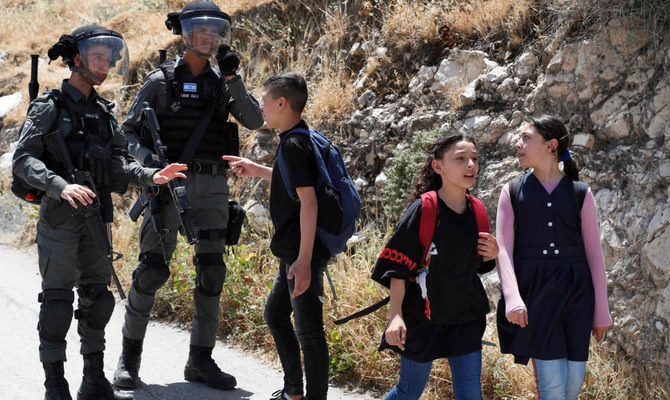

RAMALLAH: Israel has significantly escalated its security crackdown on the West Bank and East Jerusalem in an attempt to prevent Palestinian attacks, according to security experts.
It is doing this, they say, by stepping up arrests, using excessive force, demolishing the homes of suspects, and reinforcing its military presence across the West Bank and along the 1,200-kilometer segregation wall that separates the territory from Israel.
However, these measures will not work, the experts told Arab News, without a political process that offers Palestinians hope that the Israeli occupation will end.
Continuing Palestinian attacks have led to a dispute between the Israeli political and military establishments as there is no specific Palestinian culprit to blame and target in response to the attacks. This was also the case during the second Palestinian Intifada and Operation Defensive Shield in 2002.
Israeli Prime Minister Naftali Bennett has demanded that Hamas pay the price for incitement, in particular a speech by its leader, Yahya Sinwar, that he blamed for motivating the recent attacks. Meanwhile, military officials proposed the launch of a large-scale military operation against Jenin and surrounding villages on the grounds that most of the attackers came from there.
Israeli Defense Minister Benny Gantz threatened the Palestinians, saying: “Without security stability, the Palestinian economy will be damaged, the steps we have taken will collapse, and the land from where the perpetrators come will be shaken.”
Israeli security officials expect the wave of Palestinian attacks to continue for a several weeks. Security agency Shin Bet is finding it difficult to confront the threat because the attackers are not posting messages on social media before carrying out attacks.
On Tuesday, the first anniversary of the start of last year’s war in Gaza, described by Hamas as the ‘Sword of Jerusalem Battle,’ Palestinian factions confirmed their continued readiness to resist the Israelis.
The Palestinian Islamic Jihad movement said: “The ‘Jerusalem Sword’ battle constituted an important chapter in the history of the conflict with the Zionist enemy, who thought that his hand was free in Jerusalem and that his policies and plans had provided the opportunity to impose temporal and spatial division at Al-Aqsa Mosque and to displace our people in Sheikh Jarrah (a neighborhood in Jerusalem).
“The resistance imposed equations and rules of engagement that made Jerusalem and Al-Aqsa its top priorities.”
The Israeli army is preparing for the possibility of escalations in hostilities on upcoming dates that are of special significance to Palestinians, including: May 15, the anniversary of the Palestinian Catastrophe (Nakba); May 29, the anniversary of the occupation of Jerusalem, when settlers organize a march; and June 5, the anniversary of the occupation of the West Bank, Jerusalem, the Gaza Strip and the Syrian Golan Heights.
Ghassan Al-Khatib, a Palestinian political analyst, told Arab News that the violent reactions by Palestinians had been provoked by Israeli actions against them that have reached unprecedented levels.
“Provocations by Israeli extremist right-wingers at Al-Aqsa in Jerusalem, and a free hand given to settlers in the West Bank to attack the Palestinians and their properties, have caused Palestinian outrage,” he said.
“The problem is that the current Israeli government is fragile and is forced to make concessions to settlers and Israeli right-wing parties, whether regarding Al-Aqsa Mosque or in the West Bank, in addition to the economic hardships the Palestinians are experiencing.
“The solution to the problem of violent Palestinian reactions is not by using military force, but rather by mitigating provocations against the Palestinians, improving the economic situation and giving them hope for a political future.”
Israeli authorities launched a massive crackdown in East Jerusalem in April. Police arrested 894 Palestinians, imposed home-confinement orders on 37 others, banned 590 people from Al-Aqsa Mosque, injured 463 people, and demolished one house, according to a report issued by Jerusalem Governorate.


