

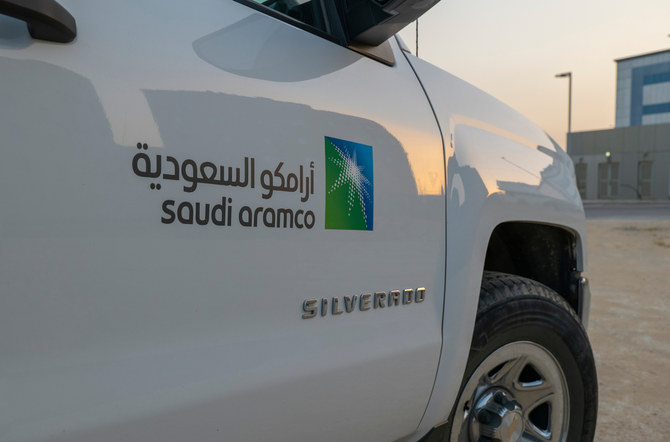
Saudi Aramco briefly becomes world’s top-valued company as shares surge

(Shutterstock)
Short Url
Updated 10 May 2022
Follow

Saudi Aramco briefly becomes world’s top-valued company as shares surge

RIYADH: Saudi Aramco briefly became the world’s top-valued company as its shares soared to yield a SR9.24 trillion ($2.463 trillion) market cap on Tuesday.

Shares of the oil giant hit SR46.2 in early trading, pushing its market valuation higher than that of tech major Apple, valued at $2.461 trillion, according to data by Bloomberg.

Aramco’s stock price slightly retreated later in the day to trade at SR46.05 as of 11:53 a.m. Saudi time, implying a market valuation of SR9.21 trillion.

With the latest share movement, the company is now the second-largest firm by market cap after Apple.

Aramco has been constantly hitting record highs, thanks to strong oil prices that continue to soar to date. 


Saudi Cabinet approves regulatory frameworks for 4 SEZs 

Updated 58 min 41 sec ago
Follow

Saudi Cabinet approves regulatory frameworks for 4 SEZs 

RIYADH: Saudi Arabia has formalized the regulatory frameworks for four Special Economic Zones located in Jazan, Cloud Computing Zone, King Abdullah Economic City, and Ras Al-Khair.

These zones are designed to stimulate investment by offering tailored incentives and governance, enhancing the Kingdom’s competitive edge in sectors such as advanced manufacturing, maritime logistics, cloud technology, and energy-related industries, the Saudi Press Agency reported.  

The SEZ initiative is part of Saudi Arabia’s broader economic transformation plan under Vision 2030, which aims to diversify the economy beyond oil revenues and develop new engines of growth through foreign direct investment and infrastructure development.  

Saudi Minister of Investment Khalid Al-Falih expressed his appreciation for the Cabinet’s approval of the SEZ regulations, stating in a tweet: “I extend my sincere thanks and gratitude to the leadership, may God support it, for its continued support of efforts to enhance the business environment, attract investments, and diversify and raise the competitiveness of the national economy, through the essential step embodied in the Cabinet’s approval of the regulatory frameworks for the Special Economic Zones.”  

The session, presided over by King Salman bin Abdulaziz Al Saud, included the approval of a wide range of cooperation agreements and memoranda of understanding.   

These included an MoU on energy cooperation with Pakistan, healthcare collaboration with Iraq, and a digital communication pact with Palestine.   

Additional approvals involved cooperation with the Hungarian judiciary, as well as agreements with UNESCO and the World Economic Forum.  

Notably, the Cabinet approved the establishment of a commercial and economic office for the Hong Kong Special Administrative Region in Riyadh, underlining growing bilateral trade and investment ties between Saudi Arabia and Asian financial hubs.  

On infrastructure, the Council noted the launch of phase three of the major road development program in Riyadh, which aims to enhance connectivity and transform the city into a regional center for sustainable transport and logistics services.  

Other approvals included Saudi Arabia’s accession to the Beijing 2010 Convention on the suppression of unlawful acts relating to international civil aviation, and revisions to the governance of the General Authority for Defense Development.  

The Cabinet also endorsed the closure of the national and regional tourism development councils and approved the final accounts of several government agencies.  

It directed further review on annual performance reports submitted by regulatory bodies and strategic institutes, including those focusing on food security, export development, and communications.  

Several high-level appointments and promotions in the foreign ministry and other government bodies were confirmed during the session, reflecting the Kingdom’s ongoing administrative reforms and leadership renewal across key sectors.