KARACHI: The Pakistan stock and currency markets on Monday closed on a bearish note amid worsening economic indicators, upcoming talks with the International Monetary Fund (IMF) and a global equity sell off, analysts and dealers said.
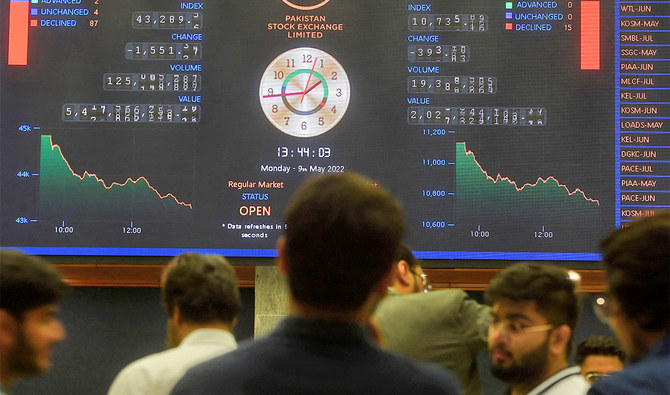
The benchmark KSE 100 index of the Pakistan Stock Exchange (PSX) lost over 1,500 points during trading, before closing at the 43,393.14 level after shedding 1,447.67 points, or 3.23 percent, as the bears took the benefit of economic uncertainty.
“Stocks fell across the board in the post earning season due to economic uncertainty,” Ahsan Mehanti, Chief Executive Officer at Arif Habib Corporation, told Arab News. “Slump in global equities, rupee instability, surge in national saving rates and uncertainty over approval of a $7.4 billion Saudi aid package sought by the government played a catalyst role in the bearish close.”
The government has increased the rates of national savings to between 0.96 percent and 2.5 percent on various instruments, effective from May 10, 2022.
Pakistan is expecting a generous package of up to $8 billion from Saudi Arabia to stabilize its foreign exchange reserves, continuously dwindling in the absence of major foreign inflows.
Analysts believe the completion of the 7th review of an IMF $6 billion extended facility would unlock additional funding not only from the lender but also from other multilateral lenders, including the World Bank and Asian Development Bank.
The currency market also witnessed a depressing trend during Monday’s trading, with the rupee losing its value by 0.48 percent to close at Rs187.53 against the United States Dollar in the interbank market.
“The rupee is under pressure due to the economic situation of the country,” Zafar Paracha, general secretary of the Exchange Companies Association of Pakistan (ECAP), told Arab News.
“Country’s trade deficit is increasing, import bill is swelling, interest rates are on the higher side,” Paracha added. “The currency is expected to remain under pressure in the coming days in the absence of any major inflow.”
Paracha said an ongoing fuel subsidy was adding to the woes of the country and could delay the 7th review of the IMF’s loan program.
Earlier this year, former Prime Minister Imran Khan announced a $1.7 billion economic relief package to offset the impact of high inflation but the populist move was a deviation from IMF program conditions and stalled talks with the fund.
After the change of regime in Pakistan last month, the new finance minister, Miftah Ismail, held meetings with IMF officials in Washington and requested the global lender to extend the size and duration of the loan program.
Though the new Pakistan government agrees in principle that the relief package is a burden on the national exchequer, it has failed to withdraw the fuel subsidies announced by Khan.
An IMF delegation is due this month to negotiate a reform program and the subsidies with authorities. If Islamabad clears the review, Pakistan will get an estimated $1 billion, which could unlock additional external funding and help stabilize the market and the economy.


![]()

Pakistan equity, currency markets close on bearish note, stocks shed over 1,500 points
Short Url
https://arab.news/vs2gd
Pakistan equity, currency markets close on bearish note, stocks shed over 1,500 points
- Benchmark KSE 100 index closes at 43,393.14 level after shedding 1,447.67 points or 3.23%
- Fall due to worsening economic indicators, upcoming talks with IMF, global equity sell off
Latest updates



© 2026 SAUDI RESEARCH & PUBLISHING COMPANY, All Rights Reserved And subject to Terms of Use Agreement.