

Dubai’s Museum of the Future partners with pathfinders to rewrite future

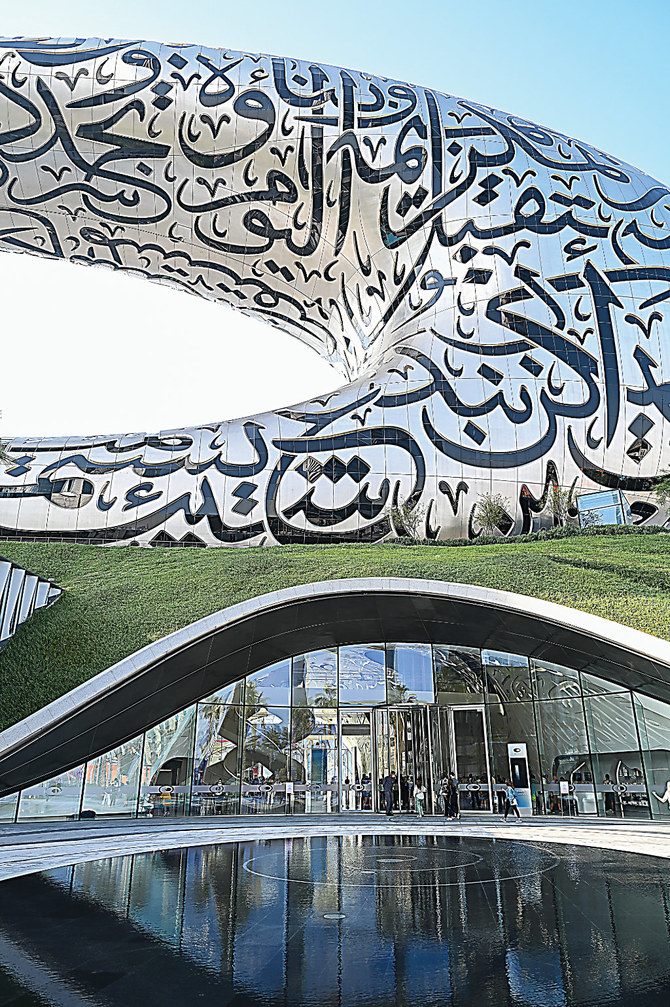
Embossed in Arabic calligraphy on 1,024 stainless steel panels on the museum’s facade is a message of hope for the future. (Shutterstock)
Short Url
Updated 09 May 2022
Follow

Dubai’s Museum of the Future partners with pathfinders to rewrite future

  • The modern architectural marvel tells a story of the future through interactive exhibitions

DUBAI: Symbolizing Dubai’s ruler Sheikh Mohammed bin Rashid Al-Maktoum’s futuristic vision and modernity of the UAE, the Museum of the Future is a cultural landmark and a center for future innovations that has turned the heads of all UAE citizens.

In contrast with traditional museums that showcase fragments of the past, the museum provides a window into the future in a scientific attempt to understand its variables, challenges, and challenges to come. The nine-floor building stands out in a city where skyscrapers and long streets surround fast-food chains.

About 77-feet tall, the modern architectural marvel tells a story of the future through interactive exhibitions that invite people to experience never-seen-before technology and humanity’s home in outer space, WAM added.

Embossed in Arabic calligraphy on 1,024 stainless steel panels on the museum’s facade is a message of hope for the future.

“The museum will create a global platform for pioneers, innovators and critical thinkers to exchange ideas, concepts and visions to accelerate sustainable socio-economic development and shape a fair future that works for everyone,” said Mohammad bin Abdullah Al-Gergawi, minister of cabinet affairs and chairman of the Museum of the Future in a statement to WAM.

Strategic partnerships

As part of its mission to be a key laboratory for futuristic and innovative technological solutions that address humanity’s greatest challenges, the Museum of the Future signed strategic partnerships with numerous global brands and national institutions in March.

The museum has partnered with these institutions to generate and test ideas, especially in developing areas related to society’s challenges, including health, education, smart cities, energy, and transportation.

The partners include Dubai’s Roads and Transport Authority, Dubai’s Electricity and Water Authority, Dubai Municipality, Dubai Holding, Emirates airline, Audi, SAP, PepsiCo and Visa.

The partnership between RTA and Audi will contribute to studying the future mobility of cities and communities. Soon, it will offer a range of creative ideas and solutions from around the world to develop smart mobility options.

Through the DEWA partnership, advanced technologies will be tested to produce renewable and clean energy, build low-carbon urban societies, and promote sustainable development.

By partnering with Dubai Municipality, the Museum of the Future identifies advanced technologies to replace traditional practices in urban planning, building infrastructure, developing urban areas, and designing cities that function sustainably using advanced materials, said WAM.

The museum’s partnership with SAP will highlight the company’s technological innovations and expertise, which address environmental, economic, and social challenges for the next generation. To help the world improve people’s lives, these technological advancements aim to provide a brighter future with zero emissions, zero waste, and zero inequality.

Preparing for the future

As part of its new Future Talks series in early March, the museum hosted Prof. Greg Clark, group adviser, future cities and new industries at HSBC Group.

“The main mission of the Museum of the Future is to bring together futurists and people with inspiring and innovative ideas about the future of humanity,” Al-Gergawi said.


Over 3k flights cancelled across the Middle East after attack on Iran by the US, Israel

Updated 01 March 2026
Follow

Over 3k flights cancelled across the Middle East after attack on Iran by the US, Israel

RIYADH: US and Israeli strikes on Iran led to widespread airspace shutdowns in the Middle East, canceling and rerouting thousands of flights and paralyzing key international travel corridors.

Flight cancellations affected seven airports across the Middle East, including Dubai and Abu Dhabi in the UAE, Doha in Qatar, and Manama in Bahrain.

Emirates Airlines said in a statement: “Due to multiple regional airspace closures, Emirates has temporarily suspended all operations to and from Dubai, up until 1500 hrs UAE time on Monday, 2 March.”

A flydubai spokesperson said the situation is evolving, and the airline is closely monitoring developments while coordinating with authorities to adjust its flight schedule.

“Our teams are working diligently to implement comprehensive welfare for all affected customers. The safety of our passengers and crew remains our highest priority,” the spokesperson said.

He added: “We are currently experiencing a high volume of calls and appreciate our customers’ patience while our teams work to assist everyone as quickly as possible.”

Qatar Airways announced that the airport will remain closed until at least the morning of March 2.

“Qatar Airways flights to, and from, Doha have been temporarily suspended due to the closure of Qatari airspace,” the airline said.

It added: “Qatar Airways will resume operations once the Qatar Civil Aviation Authority announces the safe reopening of Qatari airspace.”

Saudia also said in an official statement that it had canceled a number of flights due to developments in the region and the closure of airspace.

The organization said the decision was taken in line with aviation safety and security standards, noting that its Emergency Coordination Center is closely monitoring developments with relevant authorities.

Saudia urged passengers to verify the status of their flights before heading to the airport and said guests would be notified of updates through the contact details associated with their bookings.

The carrier added that further information would be announced in a subsequent statement if available.

Air Arabia also said its flights were experiencing cancellations, delays, or rerouting as a result of the evolving situation and airspace closures.

Airlines cited airspace closures and safety concerns as the main reasons for flight disruptions, urging passengers to check official channels for updates as the situation develops.

Israeli airspace also remained closed on March 1st. Israeli airline El Al said it was preparing a recovery effort to bring home Israelis stranded abroad once the airspace reopened.

Travelers were either stranded or diverted to other airports on Feb. 28 after Israel, Qatar, Syria, and Iran as well as Iraq, Kuwait and Bahrain, closed their airspace.

After the UAE announced a temporary partial airspace closure, FlightRadar24 recorded no flights over the country.

The closures affected key hub airports in Dubai, Abu Dhabi, and Doha. Emirates, Qatar Airways, and Etihad, airlines that operate from these hubs, normally handle around 90,000 passengers daily, with even more traveling to other Middle Eastern destinations, according to aviation analytics firm Cirium.

Airports hit by attacks

Two airports in the UAE reported incidents as the government there condemned what it called a “blatant attack involving Iranian ballistic missiles” on Feb.28.

Dubai International Airport, the UAE’s largest and one of the world’s busiest, reported four injuries, while Abu Dhabi’s Zayed International Airport said a drone attack killed one person and injured seven others. Strikes were also reported at Kuwait International Airport.

Though Iran did not publicly claim responsibility, the scope of retaliatory strikes that Gulf nations attributed to Iran extended beyond the US bases that it previously said it would target.

Flight delays, cancellations are likely to continue

“For travelers, there’s no way to sugarcoat this,” said Henry Harteveldt, an airline industry analyst and president of Atmosphere Research Group.

“You should prepare for delays or cancellations for the next few days as these attacks evolve and hopefully end,” he added.

To avoid conflict zones, airlines are rerouting Middle East flights over Saudi Arabia, adding hours and fuel costs, which could push ticket prices higher if the tensions persist.

The extra flights will strain air traffic controllers in the Kingdom, who may need to slow traffic for safety. Meanwhile, countries that closed their airspace will lose out on overflight fees from passing airlines.

Mike McCormick, former head of air traffic control at the FAA and now a professor at Embry-Riddle Aeronautical University, said some countries may reopen parts of their airspace in the coming days once US and Israeli officials provide airlines with details on military flight zones and Iran’s missile capabilities.

“Those countries then will be able to go through and say, ok, we can reopen this portion of our space but we’ll keep this portion of our airspace closed,” McCormick said.

“So, I think what we’ll see in the next 24 to 36 hours is how the use of airspace evolves as the kinetic activity gets more well-defined and as the capability of Iran to actually shoot missiles and create additional risk is diminished due to the attacks,” he added.

But it is unclear how long the disruption to flight operations could last. For comparison, the Israeli and US attack on Iran in June 2025 lasted 12 days.