Kremlin denies Russian assault on Azovstal steelworks in Ukraine

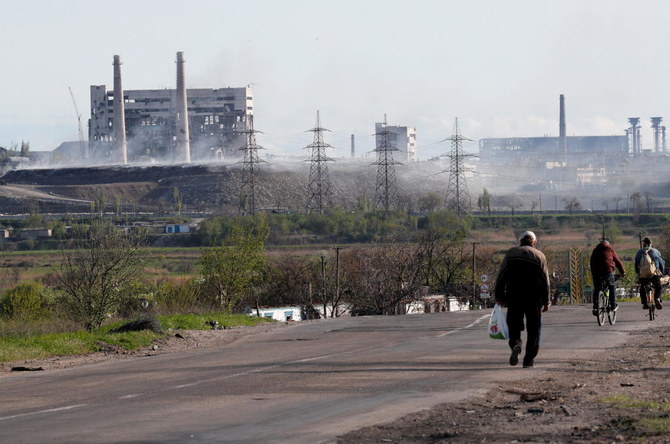
Some 100 civilians were evacuated from the tunnels beneath the Azovstal steel plant in Mariupol. (Reuters)
Short Url
Updated 04 May 2022
Follow

Kremlin denies Russian assault on Azovstal steelworks in Ukraine

  • ‘The order was publicly given by the supreme commander-in-chief to call off the assault’

MOSCOW: The Kremlin on Wednesday denied that Russia was storming the Azovstal steel plant in Mariupol, after Ukraine accused Moscow of launching a “powerful” assault on the industrial zone where Kyiv’s forces are holed up.
“The order was publicly given by the supreme commander-in-chief to call off the assault,” Kremlin spokesman Dmitry Peskov told reporters, referring to an order given by President Vladimir Putin last month not to pursue an attack on the area.
“There is no storming,” Peskov said.
He said that there are instances of “exacerbation” at the site when Ukrainian “militants take up firing positions.”
“These attempts are suppressed very quickly,” Peskov said.
The Ukrainian military said Tuesday that Russian forces had launched an offensive on the besieged Azovstal steel plant after some 100 civilians were evacuated from the tunnels beneath the steelworks.
The Russian army said its forces were using artillery and planes to target Azovstal, while the defense ministry accused Ukrainian troops of using a pause in fighting to once again take up their combat positions at the plant.
The strategic port of Mariupol is among the most battered cities in Ukraine, after Russian forces besieged the city for several weeks.


Australia to deploy long-range reconnaissance plane to Gulf

Updated 5 sec ago
Follow

Australia to deploy long-range reconnaissance plane to Gulf

  • The government says there are about 115,000 Australian nationals across the Middle East, of whom about 2,600 have returned home.

SYDNEY: Australia will deploy a long-range military reconnaissance plane to the Gulf to protect civilians, Prime Minister Anthony Albanese said Tuesday.
An E-7A Wedgetail aircraft and supporting defense force personnel will be sent for an initial period of four weeks to help “protect and secure the airspace above the Gulf,” Albanese told a news conference.
Australia also plans to provide advanced, medium-range air-to-air missiles to the United Arab Emirates “in response to a request,” the prime minister said.
The UAE, in which there are an estimated 24,000 Australians, has shot down more than 1,500 rockets and drones fired by Iran in reprisal following US-Israeli strikes, he said.
Albanese said he decided to send the advanced radar surveillance plane to the Gulf following a discussion with UAE President Mohammed bin Zayed Al Nahyan.
“The first priority of my government is, and always will be, to keep Australians safe,” the prime minister said.
“Helping Australians means also helping the UAE and other Gulf nations to defend themselves against what are unprovoked attacks,” he added.
“My government has been clear that we’re not taking offensive action against Iran, and we’ve been clear that we are not deploying Australian troops on the ground in Iran.”
The government says there are about 115,000 Australian nationals across the Middle East, of whom about 2,600 have returned home.
“Significant challenges remain, and further work is underway to support those still seeking to leave,” Albanese said.
Australia said last week it had deployed a heavy transport plane and a fuel transport plane to the Middle East as part of plans to get its citizens out of the region.
Canberra has been careful to make clear that its forces are not engaging in offensive operations against Iran.
On Friday, Albanese revealed that Australian military personnel were aboard an American submarine that sank an Iranian navy ship off Sri Lanka.
The personnel were on the submarine as part of training arrangements under AUKUS, a multi-decade defense pact with Britain and the United States, he said, stressing that they did not take part in the attack.