

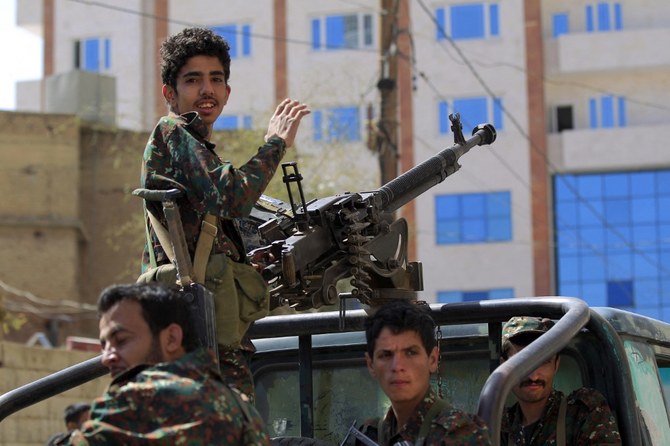
Houthis committed 2,158 violations against mosques in Yemen in 4 months

A rights group documented Houthi religious violence in 14 Yemeni governorates. (AFP)
Short Url
Updated 04 May 2022
Follow

Houthis committed 2,158 violations against mosques in Yemen in 4 months

  • The two-month ceasefire, which began at the start of Ramadan, has been repeatedly violated by the Iran-backed militia

DUBAI: The Houthi militia committed 2,158 transgressions against religious leaders, mosques and other places of worship in Yemen during the first four months of this year, according rights group Yemeni Network for Rights and Freedoms.

The group documented Houthi religious violence in 14 Yemeni governorates: Sana’a capital city, Amran, Hajjah, Saada, Al-Jawf, Marib, Dhamar, Ibb, Al-Bayda, Al-Dhalea, Taiz, Raymah and Al-Mahwit, including the killing of imams and preachers, as well as causing injuries, beating worshipers, kidnapping imams and worshipers, torture and prohibiting Tarawih prayers in the month of Ramadan.

The rights organization also reported that the Iran-backed group imposed on preachers Houthi ideologies as well as converted mosques into schools for sectarian radicalization of children.

Rashad Al-Alimi, who was appointed head of the Presidential Leadership Council on April 7 after former President Abed Rabbo Mansour Hadi transferred his powers to the council, had called on the Houthis to keep to the UN-brokered truce.

The two-month ceasefire, which began at the start of Ramadan, has been repeatedly violated by the Iran-backed militia, particularly in Marib where they used the cessation of hostilities to gain strategic advantage in the area.

The truce received a heavy blow when the first commercial flight from Sanaa airport was postponed as the Houthis insisted on adding dozens of passengers with unofficial passports.


Turkiye seals preliminary deals for largest foreign-funded railway project

Turkey's Transport Minister Abdulkadir Uraloglu. (AFP file photo)
Updated 25 February 2026
Follow

Turkiye seals preliminary deals for largest foreign-funded railway project

  • The funding will support the 125 km (78 mile) long Northern Ring Railway Project, which will ⁠carry passengers and freight from Gebze ‌to Halkali via ‌the Yavuz Sultan Selim ​Bridge connecting Istanbul’s ‌two main airports

ISTANBUL: Turkiye ‌has reached preliminary agreements with six international lenders to secure $6.75 billion for a new railway ​line across the Bosphorus in what would be Turkiye’s largest foreign-financed railway project, Transport Minister Abdulkadir Uraloglu said on Tuesday.
Once completed, the line that will pass through north Istanbul is expected to carry 33 million passengers ‌and 30 million ‌tons of freight ​annually, ‌he ⁠said, ​adding that ⁠it will open “a new era in logistics” by boosting the country’s rail capacity between Asia and Europe.
The funding will support the 125 km (78 mile) long Northern Ring Railway Project, which will ⁠carry passengers and freight from Gebze ‌to Halkali via ‌the Yavuz Sultan Selim ​Bridge connecting Istanbul’s ‌two main airports.
Preliminary deals were reached ‌with the World Bank, Asian Infrastructure Investment Bank, Asian Development Bank, Islamic Development Bank, OPEC Fund for International Development and the European Bank ‌for Reconstruction and Development, the minister said.
“We aim to complete ⁠the ⁠tender process and hand over the site this year so that (construction) work can start,” Uraloglu said.
An uninterrupted rail freight across the Bosphorus Strait is currently possible through the Marmaray railway tunnel and only during limited hours daily. According to the ministry’s website, a total of just 1.7 million tons of cargo ​were transported through ​Marmaray between 2020 and October 2025.