



KARACHI: With Eid Al-Fitr nearing with every passing hour, Muslims around the globe are making elaborate plans to celebrate the three-day Islamic festival. But all this festivity seems dull without the reddish-brown color of henna, which most women usually adorn their bodies with on Chand Raat, the eve of Eid Al-Fitr.
The refined, green powder, which gives the reddish-brown color when applied after mixing it with water, is obtained by crushing the henna plant leaves. The use of the henna plant traces its roots back to the Pharaoh-era Egypt some 9,000 years ago. It is said that Cleopatra, the last reigning queen of the Ptolemaic Kingdom of Egypt from 51 to 30 BC used to adorn her body and beautify herself with henna.
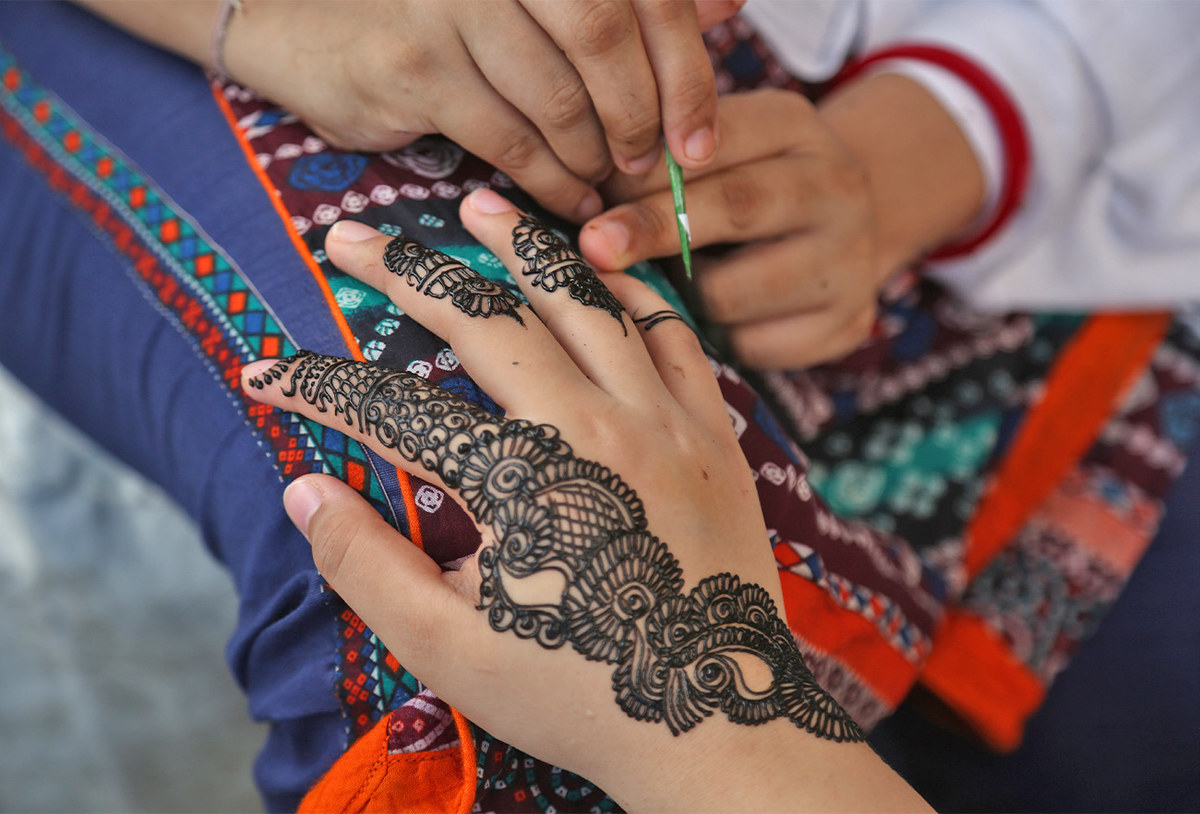
A day before Chand Raat, the eve of Eid Al-Fitr, a designer paints a henna design on the back of a customer's hand at the Gulf Market in Karachi, Pakistan, on May 1, 2022. (AN Photo/S.A.Babar)
Well, the times haven’t change much as women across many faiths continue to do so till date. In the Muslim world, women particularly adorn their hands, arms and feet with henna on Chand Raat.
In Pakistan, hundreds of stalls appear in markets just a day or two ahead of Eid, where artists showcase their skill and paint breathtaking designs to help women prepare for the Islamic festival.
In Karachi’s Gulf Market, Nazia Shehzad, a designer, zeroes in on a smartphone held by another girl to replicate a design on the palm of a costumer.
Shehzad, 16, is one of hundreds of artists whose stalls in the Pakistani port city attract thousands of women on Chand Raat.
“I can paint any design,” the teenage artist told Arab News on Sunday. “The customer just shows me one in their phone or select from our design booklet, I craft it.”
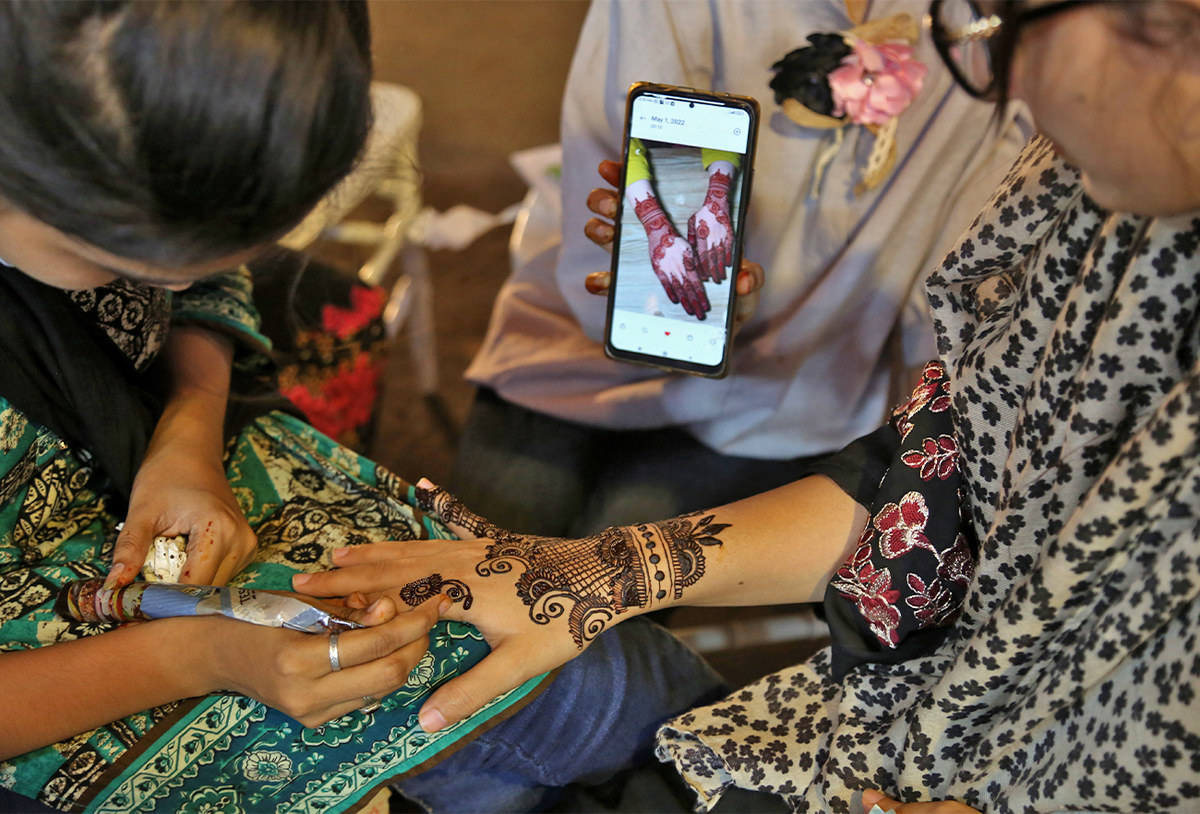
Nazia Shehzad, 16, zeroes in on a smartphone to paint a henna design at the Gulf Market in Karachi, Pakistan on May 1, 2022. Artists say smartphones have taken the place of design booklets from where customers would choose henna designs for their palms. (AN Photo/S.A.Babar)
Amna Saeed works at a beauty salon but she prefers to work at this roadside market on Eids.
“I like the vibe,” she said. “Here you have more costumers and a chance of earning more money as compared to working at the salon.”
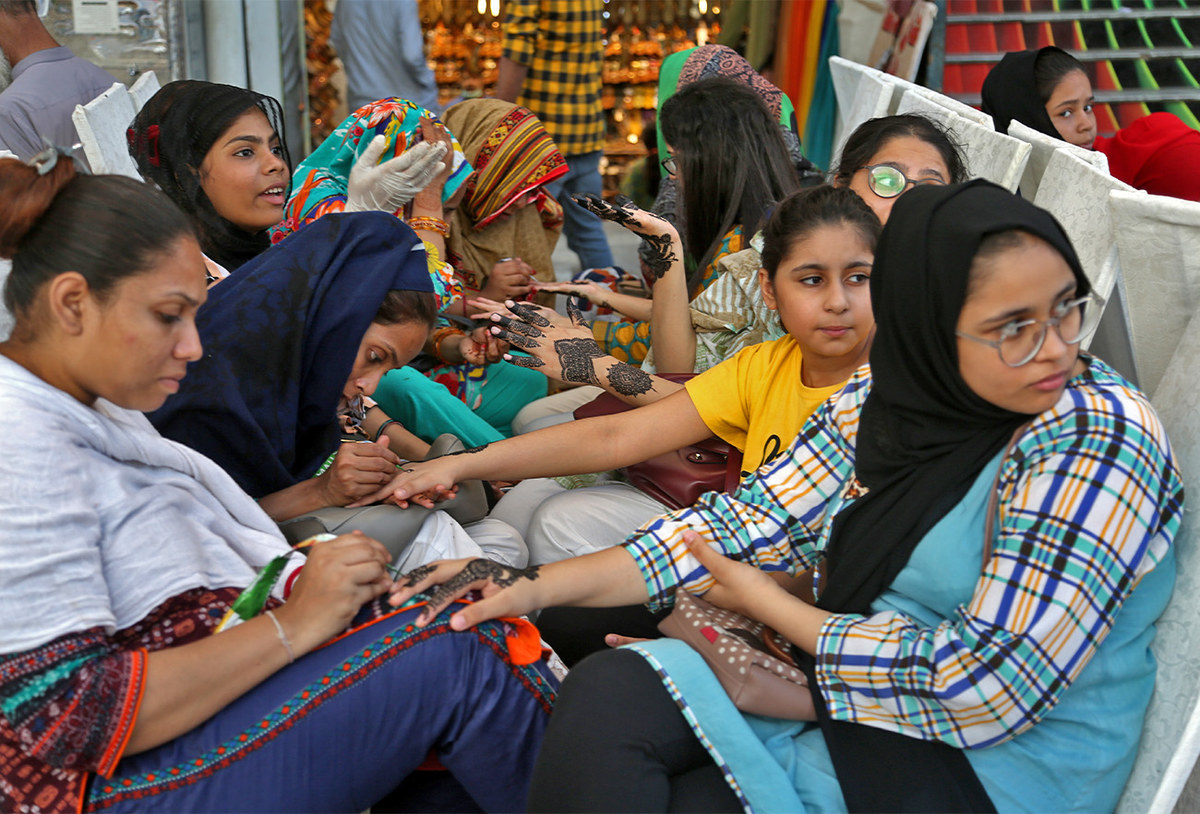
Designers paint henna designs at the Gulf Market in Karachi, Pakistan on May 1, 2022. (AN Photo/S.A.Babar)
Saeed says during her 10-hour stay at the market there is hardly any design left to paint. “From flowers to circles, pyramids to names of spouses and friends, you get a chance to paint everything,” she said.

A day before Chand Raat, the eve of Eid Al-Fitr, a designer paints a henna design on the back a custumer's hand at the Gulf Market in Karachi, Pakistan on May 1, 2022. (AN Photo/S.A.Babar)
Women who have stayed in the Middle East mostly prefer Arabic patterns with bigger flowers and thicker designs, according to Saeed. Indian designs are simple.
If the holy month of Ramadan lasts for thirty days, these henna stalls are established for the last two days of the month. In case of a 29-day fasting month depending upon the lunar cycle, the market is set up only on the eve of Eid Al-Fitr.
Muhammad Riasat, who organizes this market, says it has been over two decades that this bazaar is set up on Chand Raat and is the largest one in the city in terms of the number of henna designers.
“Over a thousand artists book stalls every year, including amateur designers, make-up artists and those doing it as a hobby,” Riasat said.
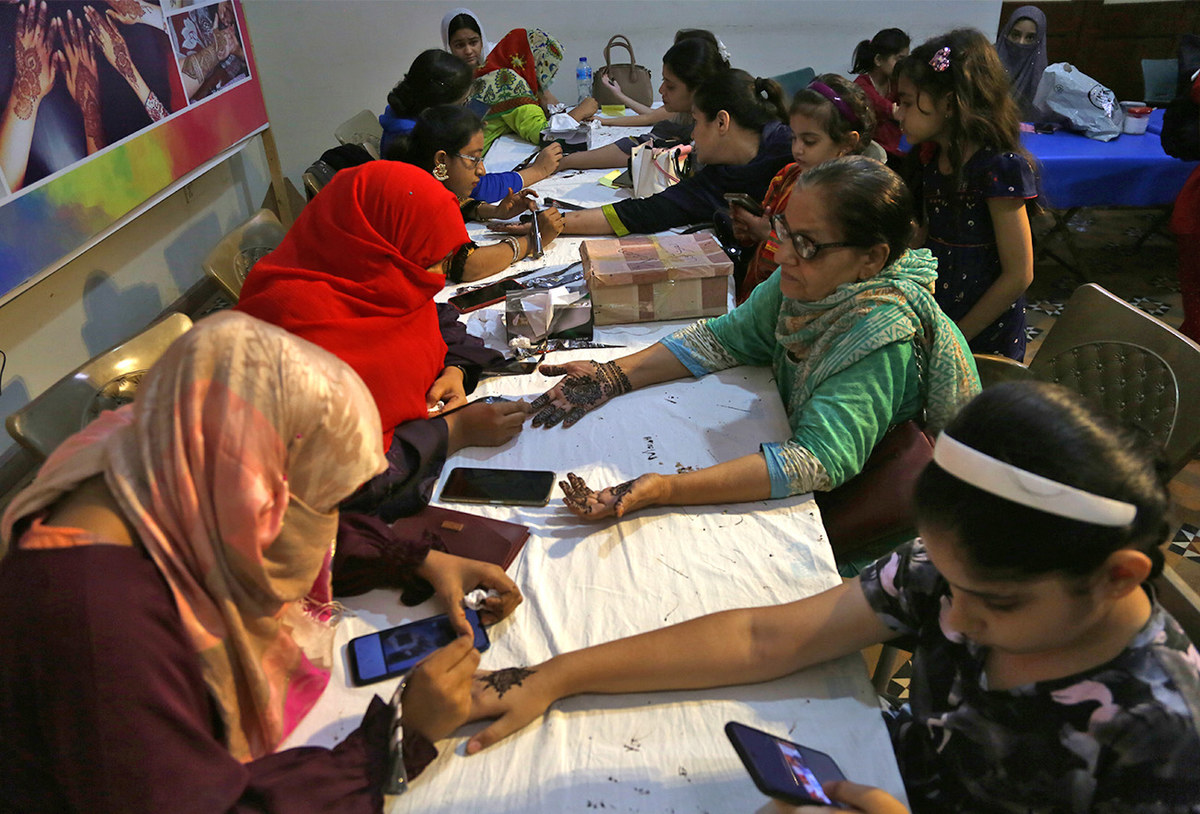
Designers paint henna designs at the Gulf Market in Karachi, Pakistan on May 1, 2022. (AN Photo/S.A.Babar)
Similar markets are set up on Eid Al-Fitr and Eid Al-Adha in different parts of the city, including the famous Meena Bazaar in Gulberg Town.
“But here it’s a like festival,” Riasat said, pointing toward women seated on hundreds of chairs and others standing in queues, waiting for their turn.
“Women keep coming here until the wee hours of Eid day.”
For Lubna Rashid, a housewife, her preparations for Eid start even ahead of Ramadan.
“Our preparations continue even before Ramadan but we make sure everything is done before Chand Raat, so that our mehndi (Urdu word for henna) could not be spoiled,” Rashid said, who queued up before a stall with her three daughters.
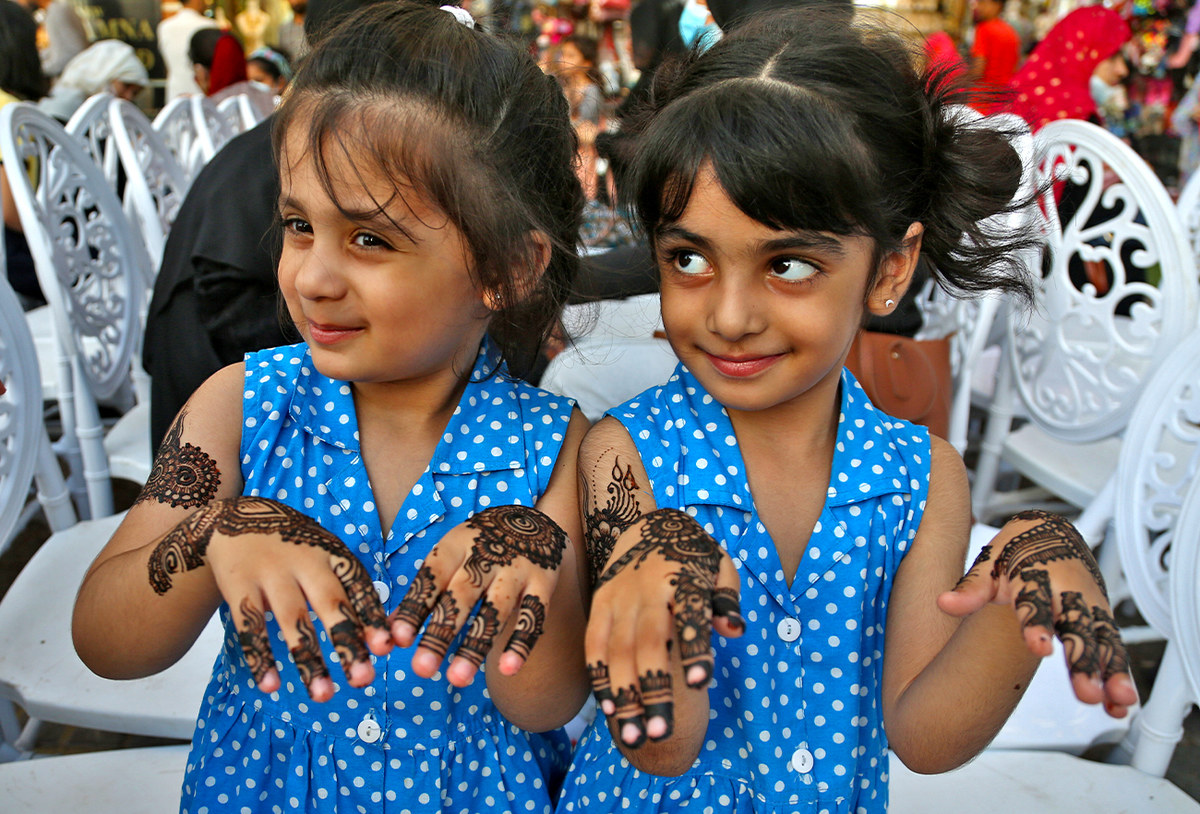
Girls show the patterns and designs of mehndi (Urdu word for henna) they have got on their hands at the Gulf Market in Karachi, Pakistan on May 1, 2022. Arabic, Indian and Bangladeshi patterns are most popular in Pakistan, according to artists. (AN Photo/S.A.Babar)
“This night is meant only for mehndi. For women, there is no Eid without mehndi.”
Among the artists, Rubina Naz is a lawyer by profession but her passion for henna art brings her to this marketplace every year on Eid.
“It’s my passion,” she said, “In court, I plead cases, here I apply best designs to the palms of women to make them happy.”

Girls show the patterns and designs of mehndi (Urdu word for henna) they have got on their hands at the Gulf Market in Karachi, Pakistan on May 1, 2022. Arabic, Indian and Bangladeshi patterns are most popular in Pakistan, according to artists. (AN Photo/S.A.Babar)
Saira Akhter, a college student who has learnt the art of painting henna designs from YouTube tutorials, says she doesn’t do it for fun.
“This is my hobby and I fondly wait for the day, so I may apply my skill,” she told Arab News.


