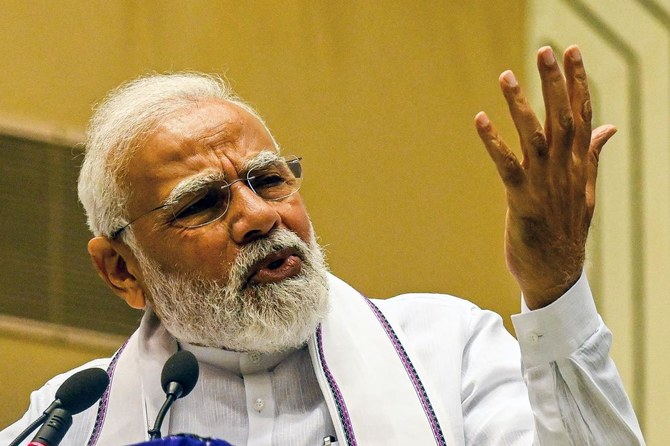
NEW DELHI: Indian Prime Minister Narendra Modi headed to Europe on Monday with New Delhi’s refusal to condemn Russia’s invasion of Ukraine set to be a key talking point in meetings with regional leaders.
India, which imports much of its military hardware from Russia, has long walked a diplomatic tightrope between the West and Moscow, and has called only for an immediate end to hostilities.
“My visit to Europe comes at a time when the region faces many challenges and choices,” Modi said in a statement released before his departure for Germany, Denmark and France.
The premier intended to “strengthen the spirit of cooperation” with European partners “who are important companions in India’s quest for peace and prosperity,” the statement added.
Modi was due to hold talks with German Chancellor Olaf Scholz in Berlin on Monday before heading to Copenhagen to join the prime ministers of Denmark, Iceland, Finland, Sweden and Norway at a two-day India-Nordic Summit from May 3.
He will then make a brief stopover in France to see President Emmanuel Macron to “share assessments on various regional and global issues and will take stock of ongoing bilateral cooperation,” the Indian statement said.
Germany’s Scholz was quoted by the Indian Express daily on Monday as saying the “attack on Ukraine by Russia is on the top of the agenda” in the discussions with Modi.
“The brutality of the Russian attack is shocking and appalling. Those responsible must be held accountable. I am confident that there is broad agreement between our countries on this,” the newspaper quoted Scholz as saying in an interview.
Scholz plans to invite Modi as a special guest to a Group of Seven (G7) leaders’ summit next month as part of an effort to forge a broader alliance against Russia, Bloomberg News reported Sunday.
Quoting unnamed sources, the report said Scholz was concerned over Modi’s refusal to condemn Russia and India’s increased fossil fuel imports from there, and was undecided on the invite until weeks ago.
India has significantly increased imports of Russian oil from March onwards, but has bristled at criticism of the move, saying Europe’s consumption of Russian energy commodities remains far higher.
In a media briefing on Sunday, Indian Foreign Secretary Vinay Kwatra said European countries “not only understand but also have deep appreciation” of India’s position on the conflict.
The principal focus of the visits and discussions is to strengthen bilateral partnership across a range of areas including trade, energy and sustainable development, Kwatra said.
With Russia reeling under Western sanctions, some 50 Indian food, ceramics and chemicals exporters will head to Moscow later this month after enquiries from Russian firms, the Times of India newspaper reported on Monday.
“Trade and financial sanctions imposed on Russia... have opened up numerous avenues for Indian businesses across various sectors,” the newspaper quoted Vivek Agarwal from lobby group the Trade Promotion Council of India, which is organizing the trip, as saying.
“Indian companies too are excited to tap the huge potential available for Indian products in Russia,” he told the newspaper.
The daily quoted unnamed government officials as suggesting that shipments would only start once the war in Ukraine ends.


![]()

Ukraine on agenda as Indian PM Narendra Modi heads to Europe
Short Url
https://arab.news/v6c2x
Ukraine on agenda as Indian PM Narendra Modi heads to Europe
- India has long walked a diplomatic tightrope between the West and Moscow


Latest updates


© 2026 SAUDI RESEARCH & PUBLISHING COMPANY, All Rights Reserved And subject to Terms of Use Agreement.