Saudi Arabia discusses augmenting $3bn deposit in Pakistan’s central bank

A handout picture provided by the Saudi Royal Palace shows Saudi Arabia's Crown Prince Mohammed Bin Salman (R) welcoming Pakistani Prime Minister Shehbaz Sharif in Jeddah on April 30, 2022. (AFP)
Short Url
Updated 01 May 2022
Follow

Saudi Arabia discusses augmenting $3bn deposit in Pakistan’s central bank

  • The two sides agreed to explore options to enhance financing of petroleum products
  • Finance minister Miftah Ismail is still in Saudi Arabia for ‘technical-level talks’

ISLAMABAD: Saudi Arabia has discussed enhancing its $3bn deposits in Pakistan’s central bank “through term extension or otherwise,” according to a joint statement issued at the conclusion of Prime Minister Shehbaz Sharif’s three-day visit to the kingdom.

The Pakistani prime minister arrived in Saudi Arabia on Thursday on his first official foreign trip since assuming office on April 11. He met Saudi Crown Prince Mohammed bin Salman at the Al-Salam Palace in Jeddah late Friday.

Their talks, according to the joint statement, revolved around enhancing bilateral trade, investment and encouraging cooperation between the private sector in both countries, among other issues.

Saudi Arabia deposited $3 billion in Pakistan’s central bank to help support its foreign reserves last year. The South Asian nation’s financial situation has not improved since then, and it still requires external finances due to its widening current account deficit and declining foreign exchange reserves.

“The Kingdom of Saudi Arabia affirmed its continued support to Pakistan and its economy including the discussion of augmenting the three billion USD deposit with the central bank through term extension or otherwise,” read the joint statement, shared by the Prime Minister’s Office.

The statement said that Pakistan “greatly appreciates” the strong support of the Saudi government to Pakistan.

Finance minister Miftah Ismail announced on Saturday he was still in the kingdom for “technical-level talks” after Prime Minister Sharif’s departure from the kingdom.

Saudi Arabia also said the two sides would explore options to further enhance the financing of petroleum products and support structural reforms for Pakistan’s growth.

Pakistan and Saudi Arabia stressed on the importance of cooperation between the two countries while discussing the opportunities available under the kingdom’s economic transformation plan through its Vision 2030 program.

The kingdom’s pledge to support Pakistan comes at a crucial time for the South Asian nation as it grapples with a widening current account deficit, depleting foreign exchange reserves and soaring inflation.

The Pakistani prime minister also landed in Abu Dhabi on his way back home and was received by Crown Prince and Deputy Supreme Commander of United Arab Emirates Armed Forces Sheikh Mohamed bin Zayed Al Nahyan ahead of their meeting at the royal palace.
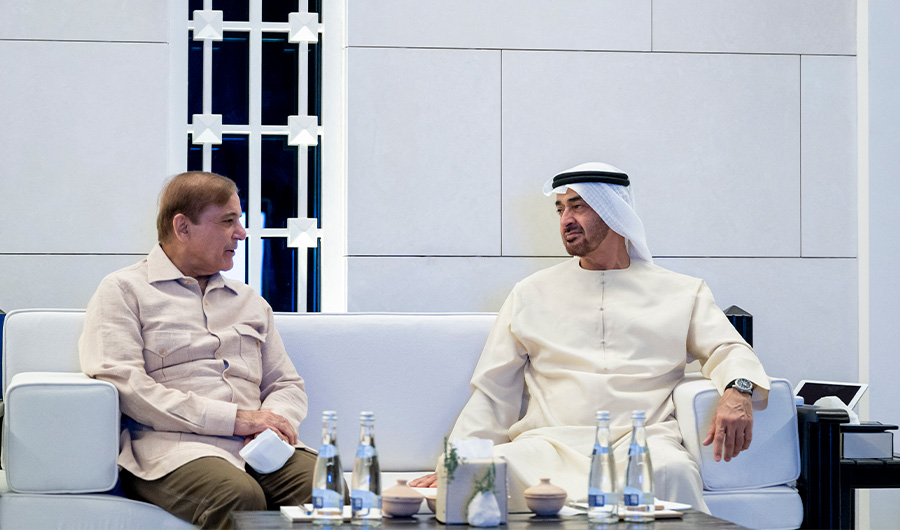


A handout picture released by UAE's Ministry of Presidential Affairs on April 30, 2022, shows Crown Prince of Abu Dhabi Mohamed bin Zayed Al Nahyan (R) meeting with Pakistan Prime Minister Shahbaz Sharif in the Gulf emirate. (AFP)


Pakistan, UK launch £10 million higher education partnership

Updated 5 sec ago
Follow

Pakistan, UK launch £10 million higher education partnership

  • Pak-UK Education Gateway second phase expands climate research, scholarships, university exchanges
  • First phase was launched in 2018 and delivered 165 partnerships, 2,000 joint studies and £5 million in grants

ISLAMABAD: Pakistan’s Higher Education Commission (HEC) and the British Council have launched the £10 million second phase of the Pak-UK Education Gateway, the HEC said on Monday, a joint initiative aimed at deepening collaboration between universities in both countries on research, mobility and higher-education reform.

The program, funded equally by the HEC and the British Council, builds on a partnership launched in 2018 and seeks to strengthen institutional ties between Pakistani and British universities, focusing on shared challenges including climate change, skills development and economic growth.

Education cooperation has become an increasingly important pillar of broader Pakistan-UK relations, as both countries look to expand academic mobility, research collaboration and international recognition of qualifications at a time when higher-education systems face pressure to respond to climate risks, labor-market shifts and funding constraints.

“This £10 million partnership is set to deepen collaboration between UK and Pakistani universities on critical issues like Climate Change and Mobility. A true system-to-system commitment,” the HEC said in an X post. 

According to the British Council and HEC, the first phase of the Pak-UK Education Gateway supported 165 institutional partnerships, generated around 2,000 joint research papers and awarded £5 million in research grants. Officials say the second phase aims to build on that foundation as part of a longer-term effort to internationalize Pakistan’s higher-education sector.

“Education is the building block of growth and prosperity. Our work on education in Pakistan supports people throughout their lives: from helping reform education policy at the school level, to our strong partnership in higher education,” British High Commissioner Jane Marriott said in a statement.

“This next phase builds on our already strong relationship, and will unlock opportunities to help both our higher education sectors thrive.”

Opportunities under the second phase include increased funding for scholarships, joint research grants and faculty exchanges, alongside a Start-Up Challenge Fund to support Pakistan-UK university collaborations pursuing commercial opportunities and access to new markets.

The program will also focus on leadership and governance reforms within Pakistan’s higher-education system, including quality assurance, improved campus accessibility for people with disabilities, and greater participation of women in senior leadership roles. It further aims to expand opportunities for Pakistani students to study UK-accredited courses without leaving their home cities, alongside a commitment to mutual recognition of qualifications.

Pakistan’s Minister for Federal Education and Professional Training Khalid Maqbool Siddiqui said the initiative had already delivered concrete results since its launch in 2018, calling education “the bridge that connects people, cultures, and futures.”

Acting HEC Chairperson Nadeem Mahbub described the Gateway as a system-to-system partnership rather than a stand-alone program, noting that it had benefited institutions and students in both countries.