Arabs often use saffron and cardamom in their traditional dishes as they enjoy the smell and flavor the spices exude.
Today’s recipe is for saffron and cardamom cookies that can be enjoyed with Arabic coffee.
To make the cookies you need 300g plain flour, 200g unsalted butter, 100g caster sugar, 1 tbsp warm milk, 1 tsp ground cardamom and a pinch of saffron and salt. You also need 50g sugar and 1 tsp ground cardamom for dusting.
Soak the saffron in the warm milk for 10 minutes and then stir the milk until it turns a bright orange-yellow color. Dice the butter and gently combine it with sugar using your hands.
In a large bowl, add the milk, butter mix and the other ingredients to the flour and mix well, but not too much — the dough should be flakey, otherwise the cookies will turn out hard.
Roll the dough into a cylindrical shape, wrap in clingfilm and refrigerate for 30 minutes before cutting the dough into 2cm-thick discs.
Place a parchment sheet on a baking tray and distribute the cookies. Put the tray in the preheated oven at 180 C and leave it to bake for 12-15 minutes or until the cookies turn a bit golden.
For the dusting mix the ground cardamom with sugar and dust on the baked cookies while they are still hot.


Ramadan Recipes: Saffron and cardamom cookies

https://arab.news/9hgqd
Ramadan Recipes: Saffron and cardamom cookies


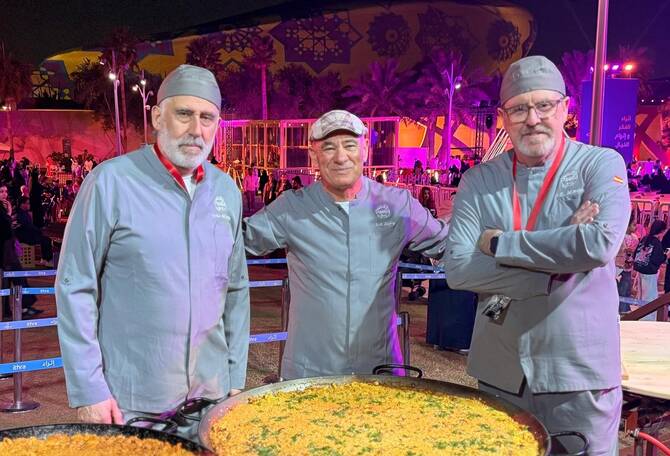
Chef serves up a taste of Spain at Ithra Cultural Days in Saudi Arabia
DHAHRAN: Among the attractions of the Ithra Cultural Days: Spain at the King Abdulaziz Center for World Culture (Ithra), visitors can try a tantalizing selection of Spanish foods — none more renowned than its famous paella.
Arab News spoke with chef Jose Zafra at the event, which runs until Jan. 31, who flew in from Spain to offer a taste of his homeland to the people of Saudi Arabia.
A “master rice cook, paella researcher and promoter,” according to his business card, his logo is even designed around the recognizable cooking pan and the phrase “Pasion por la paella,” or “Passion for paella.”
“That's why the pan is round because people get around and eat all together — to share culture and passion and life,” Zafra told Arab News as foodies lined up behind him, eager to try a plateful.

“It’s not just a food. It’s a link, a connection. Paella is the symbol of unity and sharing. And people now are going to try it — authentic Spanish paella in Saudi Arabia.”
The word “paella” comes from the Latin “patella,” meaning pan.
In Spanish, it refers both to the rice dish itself and the pan in which it is cooked.
Paella was introduced to Spain during Moorish rule. It originated in Valencia, on the country’s eastern coast, as a rural peasant dish that was cooked by farm workers over open fires using local ingredients. Over time, the dish’s popularity spread and other versions evolved, for example featuring seafood and meat.
It is different to Saudi Arabia’s kabsa, a communal dish which similarly uses rice and meat. Kabsa is cooked in a deep pot to ensure the rice stays soft and aromatic from the meaty broth, whereas paella uses a wide, shallow pan to fully absorb flavors evenly, often creating a prized crispy layer at the bottom.
Visitors to Ithra’s Culture Days can enjoy the flavors of Spain made with a sprinkling of local love — true to the origins of the dish.
Find the scoops of Spanish joy near the food truck area and try chicken paella, seafood paella —or both! You will see the signs offering a plate, at SR35 ($9) for chicken and SR40 for seafood, or let your nose lead you there.
Zafra concluded: “The chicken is from here, the seafood is from here — and the passion, well, that is from Spain.”


