

UK-Rwanda refugee deal faces first legal challenge

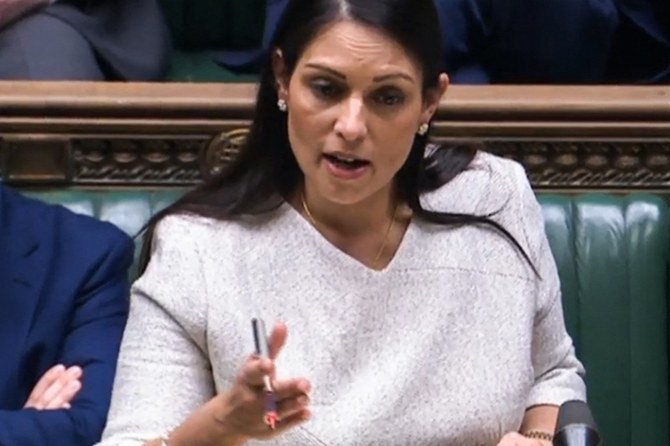
Instalaw will issue judicial review proceedings challenging the legality of the deal that Home Secretary Priti Patel signed with Rwanda this month. (File/AFP)
Short Url
Updated 29 April 2022
Follow

UK-Rwanda refugee deal faces first legal challenge

  • Iranian, Eritrean men believe they will be among first extradited under plan
  • Lawyer: ‘Interesting that PM can enter ‘world-first’ agreement without there being any debate, vote in parliament’

LONDON: Two refugees in the UK have instructed their lawyers to challenge British plans to send asylum seekers to Rwanda, marking the first legal test of the policy.

The two — an Eritrean man who arrived in February, and an Iranian who came in March — both entered on the back of a lorry and believe, with their asylum claims yet to receive a response from the Home Office, that they will be among the first extradited under the plans.

Instalaw will issue judicial review proceedings challenging the legality of the deal that Home Secretary Priti Patel signed with Rwanda this month.

The Times reported that the firm will use the argument that anti-Brexit campaigner Gina Miller made to block former Prime Minister Theresa May from triggering Article 50, and therefore Brexit, without first putting it to a parliamentary vote.

Stuart Luke, a partner at the firm who was also involved in Miller’s case, will argue that ministers do not have powers to agree an international deal without first seeking parliamentary approval.

The deal was enabled through changes to second legislation brought through in January that adjudged anyone who arrived illegally via another “safe” country, such as France, “inadmissible” to the UK asylum system.

This allowed Patel to sign the deal in Rwanda just hours after consulting the Cabinet and without any legislation, debates or votes in Parliament.

“It’s very interesting that a prime minister can enter into a ‘world-first’ agreement without there being any debate and vote on the details and specifics of the deal in parliament,” Luke told The Times.

He and his team will also argue that the deal fails the Geneva Convention’s rules that asylum seekers are entitled to have their asylum status determined in the country in which they claim it.

Neither man has yet been screened by Home Office officials, a process that usually occurs within days of claiming asylum, after which they are asked where they are from, how they got to the UK, and what the basis of their claim for asylum is.

A further challenge will test the policy’s compliance with data protection laws, questioning how sharing personal data with Rwanda is compliant with GDPR rules. A Home Office source said: “We welcome the challenge and it was always to be expected.”


Poland slow to counter Russia’s ‘existential threat’: general

Updated 4 sec ago
Follow

Poland slow to counter Russia’s ‘existential threat’: general

  • The general highlighted a low “pace of technical modernization,” compared to increases in the army’s size
  • Kukula said the Polish army should reach 500,000 soldiers by 2039

WARSAW: Russia poses an “existential threat” to Poland and its military is lagging, the country’s armed forces chief warned senior officials on Wednesday.
Poland, the largest country on NATO’s eastern flank and a neighbor of Russia, Belarus, and Ukraine, is the western alliance’s largest spender in relative terms.
This year, the country is allocating 4.8 percent of its GDP to defense, just shy of the alliance’s five percent target to be met by 2035.
However, that record defense spending was not enough to “make up for nearly three decades of chronic underfunding of the armed forces,” General Wieslaw Kukula, chief of the general staff, argued at the meeting, which included top officers, the defense minister and Poland’s president.
The general highlighted a low “pace of technical modernization,” compared to increases in the army’s size.
Kukula said the Polish army should reach 500,000 soldiers by 2039, compared with around 210,000 at present.
As a result of a lack of updates, some new Polish units “are not achieving combat readiness,” due to insufficient equipment, rather than a personnel shortage, the general argued.
Meanwhile, he added, “the Russian Federation remains an existential threat to Poland.”
Russia “is constantly reorganizing its forces, drawing on the lessons from its aggression in Ukraine, and building up the capacity for a conventional conflict with NATO countries,” he stressed.
Poland is to receive 43.7 billion euros ($51,5 billion) in loans under the European Union’s Security Action For Europe (SAFE) scheme, designed to strengthen Europe’s defensive capabilities.
Warsaw plans to use these funds to boost domestic arms production.
The Polish government claims that Poland will be able to access SAFE finance even if President Karol Nawrocki — backed by Poland’s conservative-nationalist opposition — vetos a law setting out domestic arrangements for its implementation.
Law and Justice (PiS) — the main opposition party — argues that SAFE could become a new tool for Brussels to place undue pressure on Poland, thanks to a planned mechanism for monitoring the funds, which they claim risks undermining Polish sovereignty.