



DUBAI: As the war between Russia and Ukraine continues, many around the world, and even in Ukraine, are experiencing it on the front lines of social media.
The use of the internet during this conflict has been unprecedented, from the Ukrainians who are using it to reveal the truth to the world and who depend on it for accurate information and even basic necessities such as food and shelter, to the Russians using it to spread propaganda and fake news.
“The internet has indeed become another battlefield between the warring countries, full of misinformation, fakes, deepfakes, cyberattacks taking place on both sides, online censorship, the disruptions to the internet in Ukrainian territories where missiles fall, and many more,” Vira Slyvinska, head of global business development at AIR Media-Tech, told Arab News.
On the other hand, she added, “social networks have become the fastest way to receive necessary information or help, even from unknown people, be it food deliveries for aged people who stay in their homes, finding transportation for evacuation from hot spots, finding shelters for refugees, collecting requests from hospitals, or crowdfunding the acquisition of drones and thermal imagers for the Ukrainian army, and so on.”
Moreover, Slyvinska said, the Ukrainian government and official organizations are making effective use of social media to keep the population informed about the latest developments, such as air raid alerts and curfew hours.
Ukrainian president Volodymyr Zelensky has overtaken British band Coldplay in terms of popularity on Instagram, racking up more than 16.5 million followers. His use of social media has brought him closer not only to his own citizens but people around the world.
On Instagram, the hashtags #zelensky and #zelenskyyy can be found on more than 100,000 posts. On TikTok, posts featuring the hashtags #zelensky and #zelenskiy have more than 1.6 billion and 1 billion views respectively.
Other Ukrainian political figures, including Oleksiy Arestovych, a presidential adviser, and Vitaly Kim, the governor of Mykolaiv regional administration, have also come to prominence on social media as they use it to keep their citizens informed and motivated.
Arestovych, for instance, has more than 1 million followers on Instagram. Kim’s personal channel on instant messaging service Telegram has more than 879,000 subscribers and his speeches have garnered more than 50 million mentions on TikTok, said Slyvinska.
Most city administrations and official organizations in Ukraine use social media to distribute critical information and have even created dedicated channels on Telegram. Mykhailo Fedorov, the country’s minister of digital transformation, keeps citizens updated on Ukrainian victories through his Telegram channel, for example. The country’s armed forces also use Telegram to share updates on the situations in various parts of the country.
Closer to home, technology and social media have played a significant role in times of peril in the Middle East. During the Arab Spring, for instance, much of the traditional media in many countries was controlled by dictatorships that traditionally restrict access to information.
Platforms such as Twitter, YouTube and Facebook allow “people in these Arab countries to circumvent these dictatorships and their traditional means of controlling information,” said CNN journalist Ivan Watson, now a senior international correspondent, at an SXSW conference in 2012.
In Ukraine, it is not only the government and official organizations that are using social media to distribute the latest information about the war; citizens are joining in, too. Many have taken to platforms such as Instagram and TikTok to post videos of windowless bomb shelters or cities rocked by explosions — in stark contrast to the usual upbeat content of those platforms.
For example, this young girl from Mariupol posted a seven-minute video recording her “two weeks of hell.”
“Civilian journalism is important, because receiving first-hand information on the situation from ordinary people helps to create sympathy for the plight of Ukrainians among people throughout the world,” said Slyvinska.
“On the other hand, such activities can pose a threat if the extra information goes public because the enemy can receive information about the location of the Ukrainian army and equipment, adjust their fire, and much more,” she cautioned.
Last month, a Ukrainian TikTok user was arrested after posting a video of military vehicles parked near a shopping mall, which was subsequently bombed by the Russians. The day after the attack, in which eight people were killed, the Security Service of Ukraine posted a video of the man apologizing.
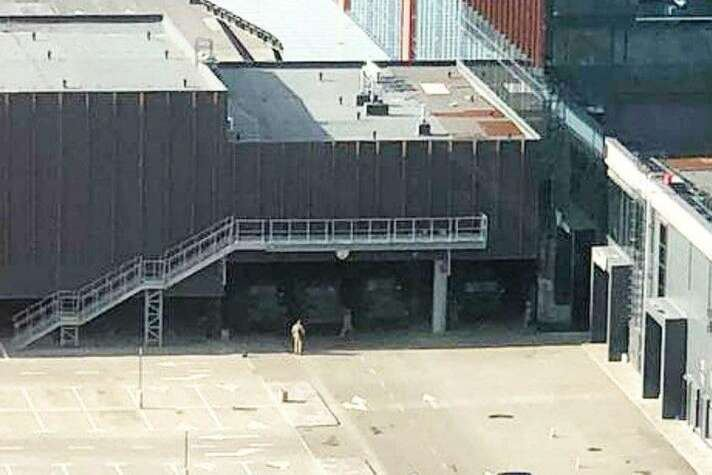
Retroville Mall before the Russian attack, military vehicles appear to be parked.
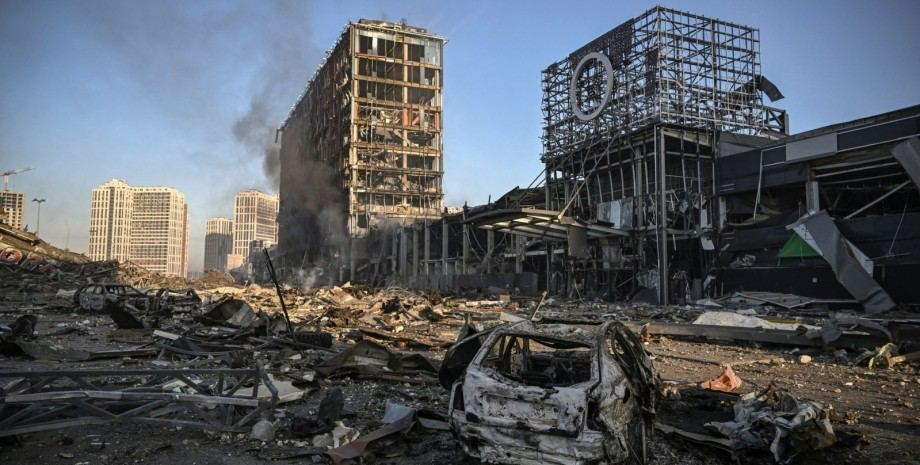
Following the incident, Kyiv Mayor Vitali Klitschko urged residents not to share footage “of the movement of military equipment, checkpoints, strategic objects.”
“Therefore, in Ukraine, filming and publication of the movements of the military, weapons and equipment has been banned, causing criminal liability if violated,” said Slyvinska.
Meanwhile, social media influencers in the country have switched from posting their usual fashion and travel advice to uploading bleak images of themselves wrapped in blankets as they huddle in underground bunkers, and of army tanks trundling down residential streets, Reuters reported. Some have asked their followers to pray for Ukraine, donate to efforts to support the Ukrainian military, and called on Russian fans to join in anti-war protests.
AIR Media-Tech, which has offices around the world including one in Kyiv, has launched a campaign called #YellowForPeace in partnership with Instagram and TikTok influencers, local influencer marketing agencies and Ukraine’s Ministry of Digital Transformation.
“Targeted at Russian citizens, the goal (of the campaign) is to shed light on the actual situation in Ukraine and to call on Russians to participate in anti-war meetings in their cities,” said Slyvinska.
In the early days of the war, AIR Media-Tech created internal groups on Telegram to coordinate the company’s efforts in relation to the conflict. Evacuation was the top priority and so the company created a chat group in which requests for help could be posted.
“Social media channels, predominantly Facebook, Instagram and dedicated groups on Telegram, became the space where we could find actual information from people about safe routes for evacuation from Kyiv and other hot spots, possibilities of sharing transport, information about petrol availability at gas stations, available shelters on the way,” among other things, said Slyvinska.
“Social media is a place to ask for help and also offer our free resources to others when we have it,” she added.
The company also launched email and social media campaigns to inform partner creators about the situation in Ukraine and call on influencers to spread the word and raise funds. A group of employees created a humanitarian hub in Kyiv called Over Help that relies on social media to collect requests for help, find partners and raise donations.
Another company, Epom, which specializes in ad servers, has collected the stories of more than 100 Ukrainians as it builds a confidential database at www.uabrave.org, where journalists can read about people’s experiences and request interviews from them.
Lina Lugova, Epom’s chief marketing officer, said that on the “first day of the full-scale Russian invasion,” PR managers and journalists were searching for eyewitness accounts from people across Ukraine.
Epom’s efforts have helped to amplify the truth and share it with the world, she said, with eyewitnesses giving more than 500 interviews to international media outlets.
“Ukrainians in the bombed cities of Kharkiv, Chernigiv, Mariupol and others who shared their living conditions on Instagram quickly became famous as their sincere stories gave a real understanding of Russian aggression against civilians,” Lugova added.
Konstantin Vasuk, executive director of the IT Ukraine Association, said that social media has been the silver lining in an otherwise desperate situation. He describes it as “a well-known case of how social media makes the impossible possible.”
In February, for example, digital transformation minister Fedorov Tweeted a request asking Tesla CEO Elon Musk, now also the new owner of Twitter, to launch his satellite internet system, Starlink, in Ukraine.
“We ask you to provide Ukraine with Starlink stations and to address sane Russians to stand.”
Within 24 hours, Musk responded: “Starlink service is now active in Ukraine. More terminals en route.
The power of Twitter was also evident during the 2011 revolution in Egypt, which resulted in President Hosni Mubarak being overthrown after just over two weeks of protests.
Killian Clarke, an assistant professor at the Edmund A. Walsh School of Foreign Service at Georgetown University, which is affiliated with the university’s Center for Contemporary Arab Studies, and Korhan Kocak, an assistant professor of political science at NYU Abu Dhabi, published a paper analyzing the role of Facebook and Twitter in the Egyptian uprising.
They found that Facebook had been crucial in organizing the protest and mobilizing demonstrators, while Twitter was used on the day of the protests to share updates about where the protesters were going and which areas to avoid. Such updates facilitated the spontaneous convergence of marches across Cairo on Tahrir Square, which was not part of the original plan.
“Overall, then, social media seems to be as helpful for organizing protests today as it was in Egypt eight years ago,” Clarke and Kocak wrote in a 2019 article for the Washington Post.
“The development of technologies and the internet opens many opportunities for people but can also be a threat when used for destructive purposes,” said Slyvinska.
“All Russian propaganda messages, facts, statistics and expert opinions are blatant lies but they are so well orchestrated in all possible media that not only Russian citizens, but also some people in other countries can believe them.”
Last month, for example, a deepfake video that claimed to show President Zelensky went viral online. TV news channel Ukraine 24 confirmed that the hackers responsible for it succeeded in getting the fake footage featured on some live TV broadcasts and, briefly, on the channel’s website.
More recently, a NewsGuard study found that within 40 minutes of joining TikTok, new users could receive recommendations that included articles containing false information about Ukraine.
Another study, by the Institute for Strategic Dialogue, found that 27.5 percent of the Facebook posts it analyzed “cast doubt on the legitimacy of images from Bucha used by Western mainstream media,” and, even more importantly, gained “significantly more traction online than those that did not question the mainstream narrative.”
Slyvinska said: “Misinformation from Russia is distributed through every possible tool on the internet, from local Russian platforms such as VKontakte and Yandex to global platforms such as YouTube, Facebook, Instagram, TikTok, and even Google Maps, where Russians put fake marks to intimidate Ukrainian citizens.
“They (Russians) also launch dedicated campaigns via influencers who repeat the same text, word-by-word, written by propaganda technologists.”
And yet she pointed out that during wars fought in the pre-internet days, “enemies could spread misinformation through leaflets without fear of being exposed.” She added that this is in contrast to current times, “when internet users have instant access to necessary information, and those who want to can find plenty of guides to determine fakes and get reliable information from trusted officials.”
Moreover, she said, despite Russia’s use of the internet to spread propaganda, it is not dependent on it.
“TV remains a very powerful media channel in Russia, with the majority of channels under state control where they can build whatever surrealistic reality perception for their population,” Slyvinska said.
Despite all the fake news, misinformation and propaganda that spreads rapidly on social media, it nevertheless provides a powerful, and sometimes safe, space for people in war-ravaged nations.
“(Thanks to) the internet, crimes committed by Russia and its soldiers against the civilian population in Ukraine cannot be hidden,” said Slyvinska. “For Ukraine, in its current situation, the internet adds more power.”


