LebElon? After Musk’s Twitter takeover, Lebanese plead with him to buy their country

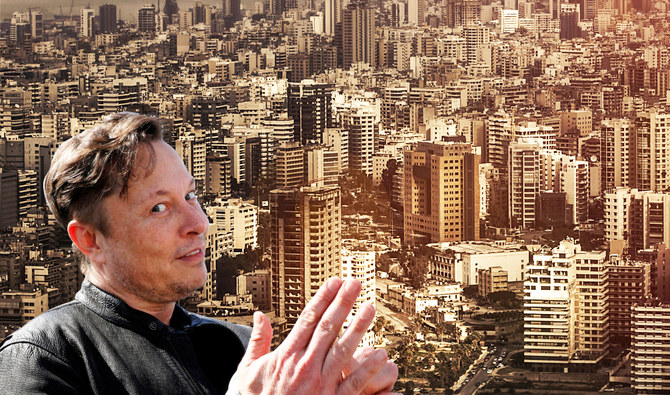
(Reuters/Shutterstock)
Short Url
Updated 28 April 2022
Follow

LebElon? After Musk’s Twitter takeover, Lebanese plead with him to buy their country

  • For better or for worse, the people of Lebanon are asking the billionaire to consider purchasing their nation

DUBAI: Eccentric entrepreneur, random tweeter and Tesla CEO Elon Musk this week bought his favorite social media platform, Twitter, for $44 billion — an amount approximately the equivalent of the gross domestic product of Jordan.

Musk’s ambition to “save” Twitter and, as he sees it, free speech, has given hope to some Lebanese people who are asking Musk to now consider buying their country.


If Musk can revolutionize the electric-car industry and attempt to shake up social media, he’s surely capable of saving Lebanon, they argue. Even if he cannot and utterly fails in the attempt, as some commentators predict will be the case with Twitter, many in Lebanon query whether the situation in their country could get any worse.

Some critics suggest that Musk is impulsive and brash and bought Twitter on a whim. That is simply not true; the move was very much premeditated. In fact, he had been contemplating it to some degree for more than four years.

In December 2017, he took to Twitter to share his love for the platform and when a user suggested he buy it, he asked how much it would cost. This month, Musk decided to make his move with little concern about whether the platform was for sale or not.

In February, Ukraine’s minister of digital transformation posted a message on Twitter asking Musk to make his satellite internet system, Starlink, available in Ukraine. Musk replied within 24 hours: “Starlink service is now active in Ukraine. More terminals en route.”

It remains to be seen whether and how he will respond to the requests from some Lebanese people that he buy their country.


Tunisian police clash with youths in Kairouan after man’s death

Rights groups accuse Saied of using the judiciary and police to stifle criticism, something that Saied denies. (AFP file photo)
Updated 15 December 2025
Follow

Tunisian police clash with youths in Kairouan after man’s death

  • Tunisia President Kais Saied shut down parliament and began ruling by decree in 2021 in what he called a move to root out rampant corruption and mismanagement, but which the opposition called a coup

TUNIS: Clashes erupted for a second night on Saturday between police and youths in the central Tunisian city of Kairouan after a man died following a police chase, according to his family, fueling authorities’ fears that protests could spread across the country. As Tunisia prepares to mark the January anniversary of the 2011 revolution, which sparked the Arab Spring uprising, tensions have risen amid protests, and a powerful UGTT union call for a nationwide strike next month. Thousands have been protesting for weeks in the southern city of Gabes, demanding the closure of a chemical plant on environmental grounds.
Witnesses said demonstrators in Kairouan threw stones, petrol bombs and flares, and blocked streets by burning tires, prompting police to disperse crowds with tear gas.
The family said the man, riding a motorcycle without a license, was chased by police, beaten, and taken to a hospital. He later fled and died on Friday from a head injury.
The government was not immediately available to comment. Relatives of the deceased said they will not remain silent and will spark major protests if those responsible are not held accountable.
In a bid to defuse tensions, Kairouan’s governor visited the family on Saturday evening and pledged to open an investigation to determine the circumstances of the death and establish accountability, witnesses said.
Tunisia President Kais Saied shut down parliament and began ruling by decree in 2021 in what he called a move to root out rampant corruption and mismanagement, but which the opposition called a coup.
Rights groups accuse Saied of using the judiciary and police to stifle criticism, something that Saied denies.