Cinnamon rolls are a sweet pastry that is popular as a breakfast food but can be enjoyed at any time of the day.
It is said that the birthplace of cinnamon rolls is Sweden and was first called “kanelbulle” which translates to cinnamon bun.
The Swedish are so serious about this pastry that they even celebrate National Cinnamon Bun Day or “Kanelbullens Dag” on Oct. 4.
Cinnamon rolls are made with slight alterations in different parts of the world.
The American cinnamon rolls are heavier and are baked together in a tray. In Sweden, however, they are lighter and contain spices like cardamom.
These days people are getting more creative with their fillings, with recipes including different berries and fruits instead of the classic cinnamon and brown sugar mixture.
There are also other variations like red velvet cinnamon buns and carrot cake-inspired rolls, and the list goes on.
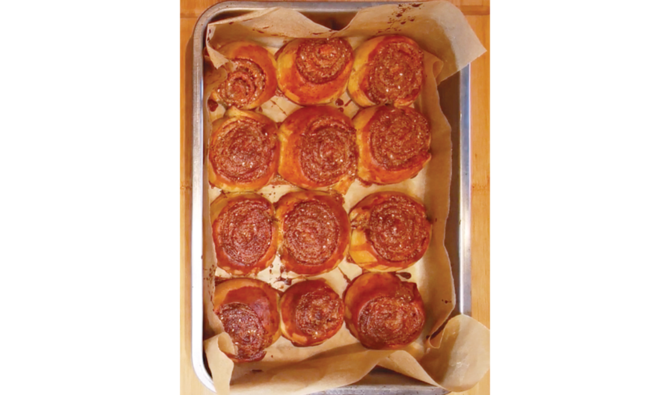
Today’s recipe, cinnamon and sesame swirls, is another spin on the classic cinnamon buns — but with an Arab twist.
For the dough of the rolls, you will need 300 grams of flour, 150 milliliters of milk, 5 tablespoons of clarified butter, 2 tablespoons of water, 1 egg, 2 teaspoons of yeast, and 1 teaspoon of sugar.
Mix all the wet ingredients in a large bowl and set aside for 10 minutes allowing the yeast to activate. Add the flour and salt to the activated yeast mixture and knead the dough until well incorporated and soft. Cover the dough with a tea towel and set aside to proof for an hour.
For the filling mix 125 grams of tahini, 150 grams of caster sugar, 1.5 tablespoons of sesame seeds, 1 tablespoon of cinnamon, and a quarter teaspoon of salt in a bowl and mix thoroughly.
Here the classic ingredient to hold the mixture together would be butter but tahini brings a unique taste to it.
After the dough is proofed, roll it out on a clean and well-floured surface. During this step make sure that the dough is being rolled in a rectangular shape until it is 1 centimeter in thickness. Spread the filling evenly.
Start rolling the dough with the help of your fingers. Once it is turned into a log, cut it into 2.5-centimeter sections with a string of floss or a knife. Place your buns in a buttered tray and cover again to proof for 20 to 30 minutes.
Brush the tops of the rolls with an egg and sugar glaze and place it in the oven for 25 minutes at 160 degrees Celsius. Serve warm and enjoy!

Ramadan Recipes: Cinnamon and Sesame Swirls
https://arab.news/ze879
Ramadan Recipes: Cinnamon and Sesame Swirls
- There are other variations like red velvet cinnamon buns and carrot cake-inspired rolls, and the list goes on
Recipes for Success: Chef Yasmina Hayek offers advice and a mushroom moghrabiye recipe
DUBAI: Yasmina Hayek grew up around professional kitchens. As a kid in a family of restaurateurs, food was part of everyday life — not just at the table, but in the routines and responsibilities that came with running a restaurant. Those early experiences shaped her understanding of cooking as something practical and constant, rather than performative, she says.
Her career led her to fine-dining kitchens in Europe before she returned to work in the family business. Today, Hayek is the executive chef of Em Sherif, which consists of four different chains — Em Sherif Restaurant, Em Sherif Cafe, Em Sherif Sea Cafe and Em Sherif Deli — with locations across the Middle East, including Saudi Arabia, and in Europe.
When you started out as a professional, what was the most common mistake you made?
Early on, the instinct is often to do too much. With time, I understood that the real challenge, and talent, is knowing when to stop and let the ingredients and the intention behind the dishes come through.
What is your top tip for amateur chefs?
Taste constantly and don’t be afraid to adjust. Recipes are guides, not rules — your palate and intuition matter most. And beyond technique, remember that cooking at home is about sharing. Eating around a table with family or friends, even something simple, is one of the greatest pleasures there is. That connection is what really makes a meal special.
What one ingredient can instantly improve any dish?
Good extra virgin olive oil. It brings depth, warmth, and continuity to a dish, especially in Lebanese cuisine.
When you go out to eat, do you find yourself critiquing the food?
I genuinely try to eat as a guest, not as a chef. I travel a lot, so eating out is often what makes me feel grounded or at home wherever I am. There are so many restaurants and chefs I admire, and my list of places to try is always growing.
What is the most common mistake you notice in other restaurants?
When something feels off, it’s usually a question of balance. But I’m very aware of how demanding this industry is, so I tend to approach other restaurants with that in mind.
What is your favorite cuisine or dish to order?
When I’m traveling, I enjoy eating at local restaurants where tradition and local flavors are central. At the moment, I’m really interested in the changes that have happened in the culinary scene in London. I’m a big fan of Ruthie Rogers and everything she has achieved at the River Café. Dorian in Notting Hill and Café Cecilia in Hackney are also building new approaches to dining, which really excites me.
What is your go-to dish when you need to cook something quickly at home?
I love folded eggs with avocado and a crispy piece of sourdough bread, drizzled with some good extra virgin olive oil. We serve this at Deli for breakfast and it’s my go-to whether I’m at Deli or at home. It’s quick, nourishing, and relies entirely on a fun technique and great ingredients rather than complexity.
What customer request or behavior annoys you the most?
When they ask for dishes to be heavily modified without understanding the intention of the dishes. A menu is carefully thought through — it has a certain rhythm and a point of view. Changing it too much, unless there’s a serious dietary restriction, can disrupt what the kitchen team is trying to express.
What is your favorite dish to cook?
It really depends on my mood. When it comes to seafood, I’d say our seafood moghrabiyeh. If I’m in Deli mode, it’s definitely the kibbeh naye sandwich. I love sandwiches. Oh! And desserts! I think there’ssomething so creative about reimagining family favorites into sandwiches. We actually have so much fun creating a new one every month.
What is the most difficult dish for you to get right?
Djej w batata, which is baked chicken and potatoes. It’s one of those comfort dishes that sounds easy but isn’t easy to get perfectly right. At Em Sherif au Musée in Beirut’s iconic Sursock Museum, it’s one of the specials that I wanted to nail the most.
As a head chef, what are you like?
I’m very present in the kitchen, and I believe leadership comes from consistency above all else. My mother has a strong presence and sets the standard for all of us every day in the kitchen. Our teams know exactly what is expected, but they also know I’m there to support them, guide them, and protect what we put out as a team. I care deeply about teamwork, love for the craft, for the product, and for one another. When all that is in place, everything else always follows.
Chef Yasmina’s wild mushroom moghrabiye
Preparation: 30 minutes
Cooking time: 45 minutes
Portions: 4 people
Ingredients:
500 g dry moghrabieh
1.5 l chicken stock
500 ml cooking cream
Pinch of caraway
Pinch of cinnamon
Pinch of black pepper
Method:
Finely chop the shallots and sweat them in olive oil and butter. Once translucent, add the garlic and sauté.
Wash the mushrooms and add 1/4 of the quantity to the garlic and shallot mixture. Brown them and add spices and salt.
Add the moghrabieh and moisten with the chicken stock and cream. Cook for around ten minutes, until the pearls are slightly melted.
Prepare the mushrooms by sautéing in butter and olive oil with a sprig of thyme. Season with salt until golden brown.
Serve the moghrabieh in a dish, sprinkle with the sautéed mushrooms and garnish with snipped chives. Drizzle with extra-virgin olive oil.


