

Ramadan spending in Saudi Arabia up 14% so far this year; 1 in 2 people plan to spend more

One in two people in Saudi is planning to spend more during the current month of Ramadan, according to a new survey
Short Url
Updated 27 April 2022
Follow

Ramadan spending in Saudi Arabia up 14% so far this year; 1 in 2 people plan to spend more

Consumer spending in Saudi Arabia during Ramadan 2022 is on course to exceed last year as the Kingdom bounces back from the COVID-19 pandemic, new data shows.

Saudi central bank data analysed by Arab News, shows that, including the Shaaban peak week and the following two weeks, Saudi consumers spent SR33.7 billion this year, up 13.7 percent when compared to the same period last year.

Research carried out by consumer sentiment firm Toluna also revealed that one in two people in Saudi planned to spend more during Ramadan compared to the same month last year.

Spending performance during Ramadan 2022

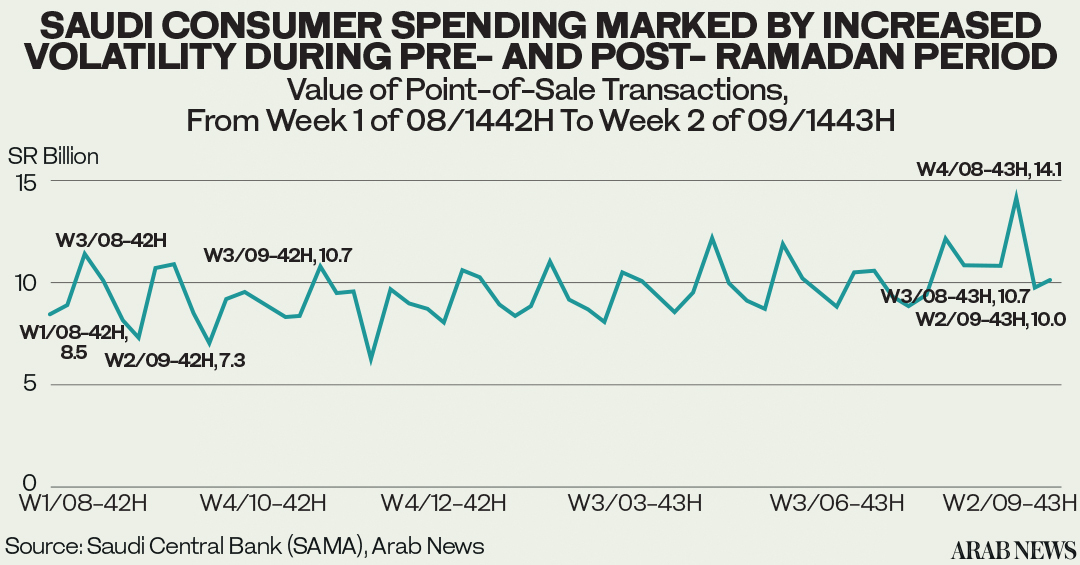
Looking at data for the last Hijri year 1442, spending activity peaked during the third week of Shaaban - the week ending April  42021, that is two weeks before the start of the fasting.  Spending during the week grew 29 percent week-on-week to hit SR11.4 billion ($3.04 billion), the highest weekly level on record at the time. 

Consumer spending then was seen falling over the next three weeks in a row to hit the month of Ramadan’s lowest point during the second week.

Growth resumed by an almost 47-percent week-on-week spike during the third week of the month.

The value of spending however remained below the peak of Shaaban, and remained muted for the next few months, with weekly values averaging at SR9 billion, clearly below the peak of Shaaban. 
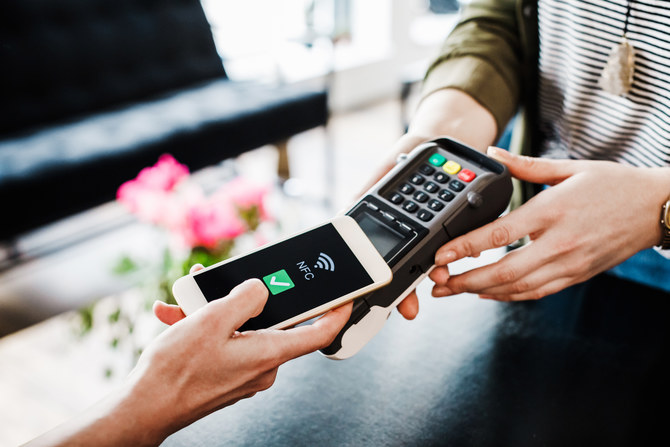

Arab News has analyzed point-of-sale transaction data from the Saudi Central Bank (Getty)

Arab News has analyzed point-of-sale transaction data from the Saudi Central Bank (Getty) 

This year, 1443, the value of consumer spending hit a new all-time high of SR14.1 billion during the fourth week of Shaaban (week ending 2 April 2022), having surged 31.7 percent, compared to the previous week.

It then plunged 31.4 percent in the next week — that is the first week of Ramadan — to SR9.6 billion, but managed to bounce back to SR10.0 billion already during the second week of Ramadan (week ending 9 April 2022).

It remains to be seen whether the pattern of Saudi consumer spending of last year will also be seen this year.

Data on spending for the third week of Ramadan (week ending April 23) from the central bank is scheduled for the release this Tuesday, April 25.

Interestingly, Saudi consumer spending goes up and down in waves during months of the Hijri year, as evidenced by the weekly data from SAMA.

Spending usually peaks during the second or — which is less often — the third week of the month, while the first and the last week of the month is usually marked with muted activity and declines in spending.

Saudi consumer spending consumer activity is marked by higher volatility during pre-Ramadan and Ramadan periods. 


Read more: The fashion brands giving back this Ramadan 


Ramadan spending expectations: Survey

One in two people in Saudi is planning to spend more during the current month of Ramadan, compared to the same month last year, according to a study conducted by consumer sentiment firm Toluna.

The results of its poll reveal that 46 percent of respondents in Saudi Arabia intend to spend more this Ramadan, when compared to Ramadan 2021.

Nevertheless, 29 percent of the respondents intend to have the same spending habits as last year’s Ramadan.

Out of those in the 46-percent group who indicated plans for more Ramadan spending this year, 35 percent said they would be spending somewhat more than the last year, while the remaining 11 percent said "a lot more."

Spending expectations by category:

  • 41 percent of respondents are planning to spend more this year on entertainment.
  • 39 percent of respondents will spend more this year than last year on ordering food.
  • 90 percent plan to buy Eid gifts for their families and friends.

Among the most popular gift options are sweets, money, toys, games, and perfumes.

When it comes to consumer spending habits on Eid gifts, the study revealed that 57 percent of respondents are planning to spend more this year on gifts, when compared to last year.

People are more willing to spend more on gifts this year, as life goes back to normal after two years of the pandemic, social distancing, and disruptions in traditional social gatherings.

Moreover, the study indicates that one in two individuals – an estimated 53 percent - intend to travel domestically during Eid Al-Fitr, with the most popular destinations being Jeddah and Mekkah, the results of the study disclosed.
Some 35 percent of respondents plan on travelling abroad to foreign destinations including the UAE and Egypt. 

At the same time, while 37 percent of the respondents said they will spend more on travelling this year during the festive period than last year, 29 percent indicated their spending will remain the same, and the other 20 percent said they will spend less. 


Read more: Four health tips to practice beyond Ramadan


Shopping channels

While fashion-related shopping is shifting towards e-commerce, shopping for categories like groceries, chocolates, and sweets is expected to be done more offline during Ramadan, when compared to other periods of the year. 

The shopping channel for most of the remaining categories is projected to remain the same during Ramadan and the rest of the year.


Building bridges: Saudi Arabia leads Gulf-Asia tech leap

Updated 01 January 2026
Follow

Building bridges: Saudi Arabia leads Gulf-Asia tech leap

ALKHOBAR: Saudi Arabia is forging new academic connections with Asia as the Kingdom’s Vision 2030 accelerates reforms in education and innovation.

Two academics — Prof. Eman AbuKhousa, a data science professor at the University of Europe for Applied Sciences in Dubai, and Prof. Hui Kai-Lung, acting dean of the HKUST Business School in Hong Kong —emphasize that the Kingdom’s transformation is reshaping the development of artificial intelligence and fintech talent across the region.

For AbuKhousa, responsible AI is not just about technology; it is fundamentally about intention. “It is about aligning technology with human values: ensuring fairness, transparency, and accountability in every system we build.”

She highlighted that the Middle East’s heritage of trust and ethics gives the region a competitive advantage. “Institutions should embed ethics and cultural context into AI education and create multidisciplinary labs where engineers collaborate with social scientists and ethicists,” she said.

At the University of Europe for Applied Sciences in Dubai, AbuKhousa trains students to question data, identify bias, and integrate integrity into innovation. 

Asian universities like HKUST play a growing role in cross-border education partnerships with Saudi institutions.

“Educators must model responsible use by explaining how data is sourced and decisions are made,” she explained. “Ultimately, responsible AI is less about algorithms than about intention; teaching future innovators to ask not only ‘Can we?’ but ‘Should we?’”

She further noted:“Saudi Arabia’s Vision 2030 has turned digital education into a national movement placing technology and innovation at the heart of human development.”

AbuKhousa emphasized the transformative opportunities for women in the Kingdom: “Today, Saudi female students are designing models, leading AI startups, and redefining what digital leadership looks like.”

Prof. Hui views this transformation through the lens of fintech. “Fintech is deeply embedded in Vision 2030, serving as a key enabler of its three pillars: a vibrant society, a thriving economy, and an ambitious nation,” he said.

Hui stressed that Saudi Arabia’s investment capacity and modern regulatory framework “create a conducive environment for innovation.” Having collaborated with Aramco, The Financial Academy, and Prince Mohammed Bin Salman College of Business and Entrepreneurship, he highlighted the strategic potential of the Kingdom’s young population. “The Kingdom has one of the youngest populations in the world, with a median age below 30,” he said. 

Opinion

This section contains relevant reference points, placed in (Opinion field)

“This demographic presents a tremendous opportunity for higher education to shape future leaders, and our collaborations in Saudi Arabia are highly targeted to support this goal.”

AbuKhousa argued that universities must lead innovation rather than follow it. “Universities must evolve from teaching institutions into innovation ecosystems,” she said. “The real bridge between research and industry lies in applied collaboration: joint labs, shared data projects, and co-supervised capstones where students solve live industry challenges.”

“At UE Dubai, we’ve introduced an Honorary Senate of Business Leaders to strengthen that bridge, bringing decision-makers directly into the learning process,” she added.

DID YOU KNOW?

Vision 2030 has made digital education central to Saudi Arabia’s development strategy.

Women in Saudi Arabia are now designing AI models and leading startups.

Universities are transforming into innovation ecosystems bridging research and industry.

Cross-border collaborations with Hong Kong and Dubai are accelerating fintech and AI growth.

Hui noted that cross-border cooperation between Hong Kong and Saudi Arabia is growing rapidly. “Saudi Arabia’s scale, strategic location, and leadership in the Arab world offer Hong Kong an ideal partner,” he said. “Hong Kong’s academic and regulatory experience can help the Kingdom fast-track its digital transformation.”

He highlighted lessons from Hong Kong’s fintech journey. “Hong Kong’s fintech journey offers critical lessons for Saudi Arabia, particularly in creating a balanced ecosystem for innovation,” he said. “Education and regulation are both important. We need education at all levels and beyond schools to expose people to these ideas; having diverse and rich experiences also helps, as the education needs to be supplemented by real-life implementation and usage experience. That is what Hong Kong can offer.”

AbuKhousa emphasized that women’s participation in technology must extend beyond access to influence. “Empowering women in technology begins with reimagining representation: from inclusion to influence,” she said. “We need more women not only learning tech, but leading teams, designing systems, and shaping AI policy. Institutions must normalize women’s presence in decision-making spaces and provide visible mentorship networks to counter imposter syndrome.”

Both experts agreed that innovation must remain human-centered and accountable. “As AI becomes integral to financial systems, governments must strike a careful balance between innovation, data ethics, and compliance,” Hui said. “Establishing clear regulatory frameworks and transparency standards is crucial.”

AbuKhousa concurred, emphasizing the role of education in AI adoption: “Educators must position generative AI as a thinking partner, not a shortcut. The goal is to teach students how to use AI critically, not merely that they can.”

Hui predicts that “AI, blockchain, and cybersecurity will be transformative forces in the region’s financial sector.” AbuKhousa sees a similar momentum in education: “The Gulf is entering a defining phase where AI becomes the backbone of education and workforce development.”

The experts concluded that the Kingdom’s digital transformation, anchored in Vision 2030, is connecting classrooms, industries, and continents through human-centered innovation.