

Handwritten newspaper brings world to remote Bangladeshi south

This photo taken in November 2021 shows Mohammed Hasan Parvez working on an issue of Andharmanik, a handwritten newspaper he publishes in West Sonatala, southern Bangladesh. (Photo courtesy: Mohammed Hasan Parvez)
Short Url
Updated 23 April 2022
Follow

Handwritten newspaper brings world to remote Bangladeshi south

  • Published by a brick kiln laborer, Andharmanik has about 1,000 readers
  • Journalists are volunteers — farmers, fishermen and laborers — who report community news

DHAKA: While most of the world takes access to information for granted, for one community in Bangladesh’s remote south it is a blessing that comes in an unlikely form: a handwritten newspaper.

Andharmanik, named after a local river, is a bimonthly publication launched by Mohammed Hasan Parvez in West Sonatala village, in southern Bangladeshi's Patuakhali District, where national dailies rarely reach and most residents do not have the Internet.

Parvez, a brick kiln laborer, started the newspaper in May 2019 to tell the stories of success and failure of his community.

The 42-year-old hardly makes the ends meet, but that has not deterred him.

“Publishing a newspaper with modern printing technology, camera, computer, smartphones and other set-ups was an impossible task for me. At this moment, I thought to use my hands as I could write with a pen,” he told Arab News.

“I want to inspire people with good news that happened in their communities. (From the stories) people can also learn from the mistakes of their neighbors and save themselves from doing the same.” 
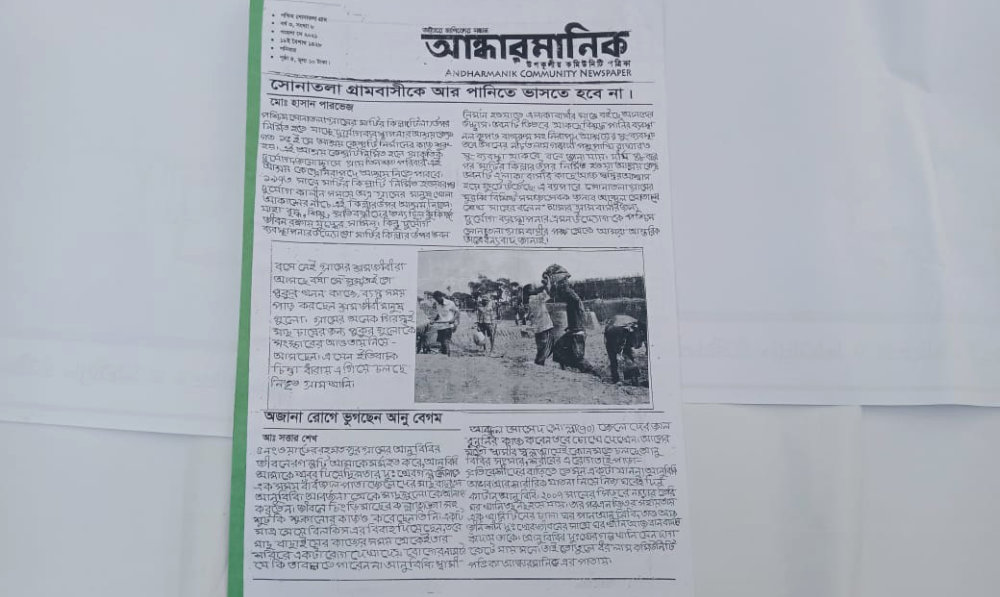


A copy of the May 2021 issue of Andharmanik, a handwritten newspaper he published in West Sonatala, southern Bangladesh. (Photo courtesy: Mohammed Hasan Parvez)

Parvez goes around the village and surrounding areas to gather local news. He has a team of 15 volunteer reporters — farmers, fishermen and laborers — who keep him updated on what happens in their communities.

“I sit together with the team once a month and collect the news they have gathered,” he said. “I can’t pay anything for their services, but they are still very enthusiastic to be part of my handwritten newspaper.”

Each edition of Andharmanik has four pages.

Parvez starts with headlines, which he prints out in big fonts at a computer shop in a nearby market.

He then pastes the headlines on to A3-size sheets, fills in the content with a pen and make 300 copies on a Xerox machine.

He has so far published 11 issues, selling each copy for 12 US cents.

Parves estimates that each edition of Andharmanik is read by about 1,000 people in the village — a third of its population.

For the readers, the newspaper is a source of pride and joy.

“Andharmanik is a unique creation and pride of our village,” Saleh Uddin, a 33-year-old resident, told Arab News. “The newspaper speaks for all of us.”

Kabir Hossain, 42, who is a regular reader, said Parvez’s initiative has brought the community closer.

“Here people have very limited access to information as we don’t get national dailies regularly,” he said. “The handwritten newspaper made the bond among villagers even stronger, as they receive news about each other.”

Despite financial and technical limitations, the editor hopes one day he would get his newspaper officially registered.

“I dream for Andharmanik to continue forever, even when I’m no longer on Earth,” Parvez said. “It will continue serving mankind.”


Disinformation the new enemy in disaster zones, says Red Cross

Updated 05 March 2026
Follow

Disinformation the new enemy in disaster zones, says Red Cross

  • “Harmful information and dehumanizing narratives” undermines humanitarian aid and putting lives of aid workers at risk
  • Between 2020 and 2024, disasters affected nearly 700 million people, displaced over 105 million, and killed more than 270,000 — doubling the number in need of humanitarian aid

GENEVA: The rise of disinformation is undermining humanitarian aid and putting lives at risk, while disasters are affecting ever more people, the Red Cross warned Thursday.
“Between 2020 and 2024, disasters affected nearly 700 million people, caused more than 105 million displacements, and claimed over 270,000 lives,” the International Federation of Red Cross and Red Crescent Societies said.
The number of people needing humanitarian assistance more than doubled in the same timeframe, the IFRC said in its World Disasters Report 2026.
But the world’s largest humanitarian network said that “harmful information and dehumanizing narratives” were increasingly undermining trust, putting the lives of aid workers at risk.
“In polarized and politically-charged contexts, humanitarian principles such as neutrality and impartiality are increasingly misunderstood, misrepresented or deliberately attacked online,” it said.
The IFRC has more than 17 million volunteers across more than 191 countries.
“In every crisis I have witnessed, information is as essential as food, water and shelter,” said the Geneva-based federation’s secretary general Jagan Chapagain.
“But when information is false, misleading or deliberately manipulated, it can deepen fear, obstruct humanitarian access and cost lives.”
He said harmful information was not a new phenomenon, but it was now moving “with unprecedented speed and reach.”
Chapagain said digital platforms were proving “fertile ground for lies.”
The IFRC report said the challenge nowadays was no longer about the availability of information but its reliability, noting that the production and spread of disinformation was easily amplified by artificial intelligence.

- ‘Life and death’ -

The report cited numerous recent examples of harmful information hampering crisis response.
During the 2024 floods in Valencia, false narratives online accused the Spanish Red Cross of diverting aid to migrants, which in turn fueled “xenophobic attacks on volunteers,” the IFRC said.
In South Sudan, rumors that humanitarian agencies were distributing poisoned food “caused people to avoid life-saving aid” and led to threats against Red Cross staff.
In Lebanon, false claims that volunteers were spreading Covid-19, favoring certain groups with aid and providing unsafe cholera vaccines eroded trust and endangered vulnerable communities, the IFRC said.
And in Bangladesh, during political unrest, volunteers faced “widespread accusations of inaction and political alignment,” leading to harassment and reputational damage, it added.
Similar events were registered by the IFRC in Sudan, Myanmar, Peru, the United States, New Zealand, Canada, Kenya and Bulgaria.
The report underlined that around 94 percent of disasters were handled by national authorities and local communities, without international interventions.
“However, while volunteers, local leaders and community media are often the most trusted messengers, they operate in increasingly hostile and polarized information environments,” the IFRC said.
The federation called on governments, tech firms, humanitarian agencies and local actors to recognize that reliable information “is a matter of life and death.”
“Without trust, people are less likely to prepare, seek help or follow life-saving guidance; with it, communities act together, absorb shocks and recover more effectively,” said Chapagain.
The organization urged technology platforms to prioritize authoritative information from trusted sources in crisis contexts, and transparently moderate harmful content.
And it said humanitarian agencies needed to make preparing to deal with disinformation “a core function” of their operations, with trained teams and analytics.