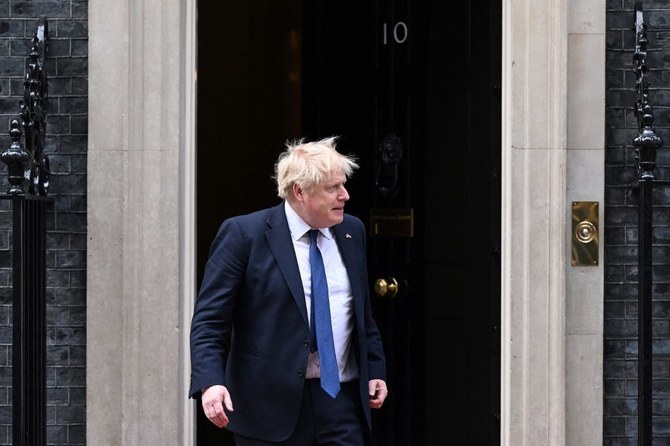
LONDON: British lawmakers on Thursday ordered a parliamentary investigation into Prime Minister Boris Johnson for allegedly lying about whether he broke coronavirus restrictions by attending illegal gatherings during the pandemic.
The move, approved by cries of “aye” and without a formal vote in the House of Commons, means Parliament’s Committee of Privileges will investigate whether Johnson knowingly misled Parliament — historically a resigning offense if proven.
The probe piles more pressure on a Conservative prime minister whose grip on power has been shaken by claims he flouted the pandemic rules he imposed on the country, then repeatedly failed to own up to it.
The move was instigated by the opposition Labour Party and passed after the government abandoned efforts to get Conservative lawmakers to block it. Johnson’s Conservatives have a substantial majority in Parliament, but many lawmakers were uneasy with the prime minister’s behavior.
Labour leader Keir Starmer said the move sought to uphold “the simple principle that honesty, integrity and telling the truth matter in our politics.”
“It is a British principle ... guiding members from every political party in this House,” Starmer said. “But it is a principle under attack.”
Johnson was not present for the decision on a scandal that has rocked his leadership of the country and the Conservative Party. He was more than 4,000 miles (6,400 kilometers) away in India, insisting he wanted to “get on with the job” of leading the country.
Johnson was fined 50 pounds ($66) by police last week for attending his own birthday party in his office in June 2020, when people in Britain were barred from meeting up with friends and family, or even visiting dying relatives. Johnson is the first British prime minister ever found to have broken the law while in office.
He has apologized, but denied he knowingly broke the rules. Johnson’s shifting defense — initially saying there were no illegal gatherings, then claiming it “did not occur to me” that the birthday event was a party — has drawn derision and outrage from opponents, who have called for him to quit.
“The truth is simple and it’s this – he lied to avoid getting caught, and once he got caught, he lied again," Scottish National Party lawmaker Ian Blackford said in the House of Commons.
Usually lawmakers are forbidden from accusing one another of lying, but Blackford was not reprimanded by the Speaker.
A growing number of Conservatives are uncomfortable about defending a leader who broke rules he imposed on the country. A few have called openly for Johnson to go, and the number is growing. Others are waiting to see whether public anger translates into Conservative losses at local elections on May 5.
“It is utterly depressing to be asked to defend the indefensible,” said Conservative legislator William Wragg. "Each time part of us withers.”
Lawmaker Steve Baker, until now a prominent supporter, said that Johnson “should be long gone” for violating the “letter and spirit” of the rules.”
“I’ll certainly vote for this motion,” he said. “But really, the prime minister should just know the gig’s up.”
The Committee of Privileges probe will not start until twin police and civil-service investigations into “partygate” have concluded.
Senior civil servant Sue Gray is investigating 16 events, including “bring your own booze” office parties and “wine time Fridays” in Johnson’s 10 Downing St. office and other government buildings. Police are probing a dozen of the events and so far have handed out at least 50 fines, including ones to Johnson, his wife Carrie and Treasury chief Rishi Sunak. Johnson could still face more police fines.
Johnson and his allies argue that it would be reckless for the country to change leaders now amid the war in Ukraine and a cost-of-living squeeze sparked by soaring prices for energy and food.
As he flew to India for a two-day visit focused on boosting economic ties, Johnson again denied knowingly misleading Parliament and insisted he would lead the Conservatives into the next national election, due by 2024.
“I have absolutely nothing, frankly, to hide,” Johnson told Sky News during his visit to the western Indian state of Gujarat. “I want to get on with the job that I was elected to do.”


![]()

UK lawmakers approve probe into PM Boris Johnson’s alleged lies
Short Url
https://arab.news/68p2m
UK lawmakers approve probe into PM Boris Johnson’s alleged lies
- Opposition parties accuse prime minister of lying to the House of Commons over lockdown parties in Downing Street
- Johnson was not present for the decision on a scandal that has rocked his leadership of the country and the Conservative Party


Latest updates




© 2026 SAUDI RESEARCH & PUBLISHING COMPANY, All Rights Reserved And subject to Terms of Use Agreement.