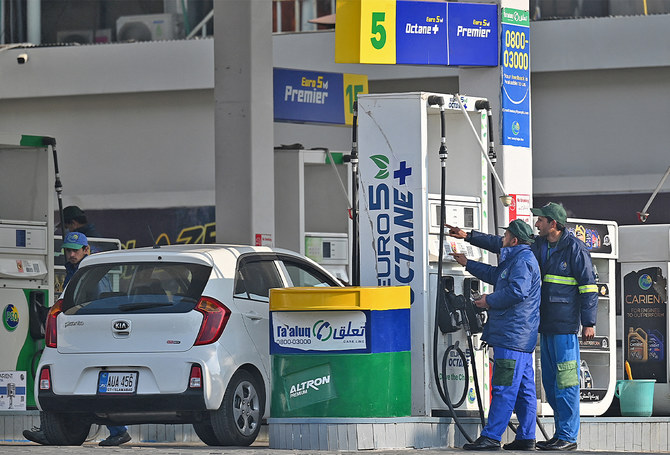
KARACHI: The Pakistan Business Council (PBC), a representative body of leading corporate and business groups, has urged Prime Minister Shehbaz Sharif’s administration in a letter to withdraw general subsidy on fuel and avoid populist measures that further increase inflationary pressure in the economy.
The PBC, whose member companies contribute 11 percent to Pakistan’s domestic economy and 40 percent to its exports, assured its full support to the new government that is facing several economic challenges.
It also shared its recommendations with the government to restore fiscal prudence in the country while suggesting measures to decrease pressure on foreign exchange reserves and revive the International Monetary Fund’s loan program.
“Withdraw the general subsidy on fuel,” Ehsan A. Malik, the council’s chief executive officer, said in the letter shared with the media on Tuesday. “Replace with targeted assistance through BISP [Benazir Income Support Program].”
“Avoid further populist measures that also result in increasing the inflation,” he continued while recommending to raise regulatory duty (RD) on import of non-essential goods to decrease pressure on forex reserves by cutting down on imports.
“As RD is impractical on fuel imports, limit import through conservation measures: work from home; early closure of commercial centers and wedding halls; rationing of fuel for private vehicles,” he suggested, adding: “Don’t allow the country to experience the kind of challenges confronting Sri Lanka.”
As Pakistan and the IMF resume talks over the stalled seventh review of a $6 billion loan program, the PBC strongly advocated the revival of the financial facility to “secure bilateral and multilateral funding.”
The council also recommended a competitive exchange rate by keeping it between Rs95 and Rs105 to “avoid egoistic/unsustainable measures to prop up Pak Rupee.”
Pakistan’s national currency has once again come under pressure amid higher imports and declining foreign exchange rate.
The Pak rupee lost its value by 1.03 percent on Tuesday to close at Rs184.44 against the US dollar. The currency has gained its value by more than three percent since the ouster of former prime minister Imran Khan in a no-confidence vote on April 11.
The council also called for equitable taxation regime in the country while recommending reforms in the Federal Bureau of Revenue (FBR) to spare the current tax payers further burden.
“Accelerate FBR reforms to broaden the tax base, pending which, increase the advance and withholding tax rates on non-filers,” the letter said. “Don’t burden existing tax payers further. Avoid knee-jerk revenue seeking measures that impact the long-term health of the economy.”
The council also called for stable and competitive energy supplies for industry and suggested the government to “liberate industry from legacies of past energy contracts, cross subsidies, system inefficiencies and theft” and “fast forward [work on] the additional LNG [liquefied natural gas] terminals.”


![]()

Pakistan’s industrialists suggest removal of fuel subsidy, call for avoiding populist measures
Short Url
https://arab.news/mad8b
Pakistan’s industrialists suggest removal of fuel subsidy, call for avoiding populist measures
- Pakistan Business Council asks the new administration to raise duty on non-essential imports
- The PBC seeks revival $6 billion IMF program to secure further bilateral and multilateral funding
Latest updates



© 2026 SAUDI RESEARCH & PUBLISHING COMPANY, All Rights Reserved And subject to Terms of Use Agreement.