

Pakistan’s new federal cabinet takes oath after issuance of list of ministers

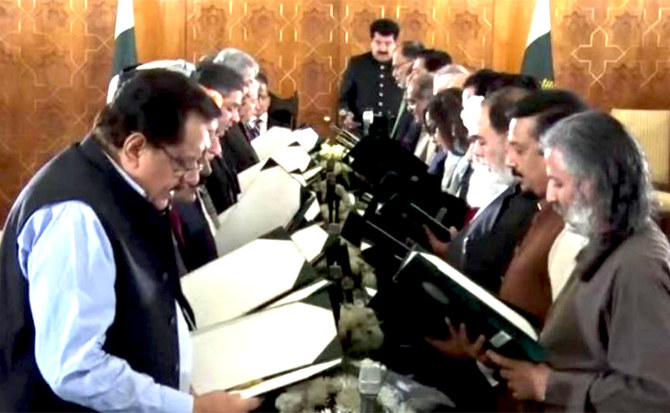
In this photo, Pakistan’s new federal cabinet taking oath in Islamabad on April 19, 2022. (Screengrab from APP)
Short Url
Updated 19 April 2022
Follow

Pakistan’s new federal cabinet takes oath after issuance of list of ministers

  • The list mentions the names of 30 federal ministers, four ministers of state and three advisers
  • Legal experts say all policy actions by the prime minister remain ‘illegal’ in the absence of the cabinet

ISLAMABAD: Pakistan’s new federal cabinet on Tuesday took oath after the cabinet division issued a list of 30 federal ministers, four ministers of state and three advisers to the prime minister.
Prime Minister Shehbaz Sharif, the younger brother of three-time former prime minister Nawaz Sharif, was elected to the top political office of the country on April 11 after the ouster of Imran Khan through a no-trust vote in Pakistan’s parliament.
However, he could not unveil his cabinet earlier even about a week after his election, with a legal expert saying it rendered all policy actions and decisions by the prime minister “illegal” and “unconstitutional.”

The oath was administered to the cabinet members by Senate Chairman Sadiq Sanjrani while the PM sat right next to him. 

Sharif is now leading a coalition government of over eight parliamentary parties, while Khan’s Pakistan Tehreek-e-Insaf (PTI) party has tendered resignations en masse from the National Assembly, citing an alleged US conspiracy to topple his government.
The new prime minister was said to be struggling with the distribution of ministries among coalition partners as per their strength in the National Assembly until recently.
“The consultation [for the cabinet] is complete and I will be announcing the details shortly,” Marriyum Aurangzeb, who speaks for Sharif’s Pakistan Muslim League-Nawaz (PML-N) party, told reporters Monday afternoon.
Khawaja Muddassir, a foreign media coordinator of Jamiat-e-Ulema-e-Islam-Fazl (JUI-F) that is one of the key coalition partners of the government, said cabinet members would be taking oath on Tuesday.
“Our four lawmakers will be part of the federal cabinet,” he told Arab News, dismissing reports of a deadlock on the distribution of portfolios.
“The portfolios of our ministers are also decided and will be announced after the oath-taking ceremony,” Muddassir said.
The JUI-F lawmakers, expected to be the part of the cabinet, include Maulana Asad Mehmood, Senator Talha Mehmood, Abdul Wasay and Abdul Shakoor.
Bilawal Bhutto Zardari, chairman of the Pakistan Peoples Party (PPP), is also said to have been shortlisted for the post of the foreign minister, though his name is not included in the list issued by the cabinet division.
Legal experts say the prime minister’s policy actions and decisions would remain “illegal” and “unconstitutional” in the absence of the cabinet.
“The constitution clearly says the government means a federal cabinet,” Barrister Ahmed Pansota told Arab News. “So, all government decisions must be endorsed and approved by the cabinet.”
He said the Supreme Court had also made it clear through a judgment that a prime minister alone could not take policy decisions as the government would remain incomplete without the cabinet.
“The prime minister is required under the law and constitution to unveil his cabinet at the earliest to run all state functions smoothly,” Pansota added.


Back from Iran, Pakistani students say they heard gunshots while confined to campus

Updated 8 sec ago
Follow

Back from Iran, Pakistani students say they heard gunshots while confined to campus

  • Students say they were confined to dormitories and unable to leave campuses amid unrest
  • Pakistani students stayed in touch with families through the embassy amid Internet blackout

ISLAMABAD: Pakistani students returning from Iran on Thursday said they heard gunshots and stories of rioting and violence while being confined to campus and not allowed out of their dormitories in the evening.

Iran’s leadership is trying to quell the worst domestic unrest since its 1979 revolution, with a rights group putting the death toll over 2,600.

As the protests swell, Tehran is seeking to deter US President Donald Trump’s repeated threats to intervene on behalf of anti-government protesters.

“During ‌nighttime, we would ‌sit inside and we would hear gunshots,” Shahanshah ‌Abbas, ⁠a fourth-year ‌student at Isfahan University of Medical Sciences, said at the Islamabad airport.

“The situation down there is that riots have been happening everywhere. People are dying. Force is being used.”

Abbas said students at the university were not allowed to leave campus and told to stay in their dormitories after 4 p.m.

“There was nothing happening on campus,” Abbas said, but in his interactions with Iranians, he ⁠heard stories of violence and chaos.

“The surrounding areas, like banks, mosques, they were damaged, set on fire ... ‌so things were really bad.”

Trump has repeatedly ‍threatened to intervene in support of protesters ‍in Iran but adopted a wait-and-see posture on Thursday after protests appeared ‍to have abated. Information flows have been hampered by an Internet blackout for a week.

“We were not allowed to go out of the university,” said Arslan Haider, a student in his final year. “The riots would mostly start later in the day.”

Haider said he was unable to contact his family due to the blackout but “now that they opened international calls, the students are ⁠getting back because their parents were concerned.”

A Pakistani diplomat in Tehran said the embassy was getting calls from many of the 3,500 students in Iran to send messages to their families back home.

“Since they don’t have Internet connections to make WhatsApp and other social network calls, what they do is they contact the embassy from local phone numbers and tell us to inform their families.”

Rimsha Akbar, who was in the middle of her final year exams at Isfahan, said international students were kept safe.

“Iranians would tell us if we are talking on Snapchat or if we were riding in a cab ... ‌that shelling had happened, tear gas had happened, and that a lot of people were killed.”