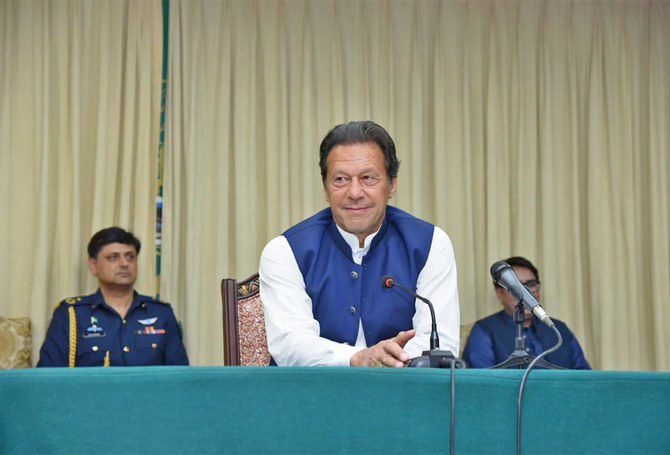
ISLAMABAD: Former prime minister Imran Khan on Monday responded to the Toshakana controversy, saying the gifts he received during his time in office were his and so was it his choice what to do of them.
Khan has been embroiled in the Toshakhana (a repository of gifts received by a head of state from their foreign counterparts) controversy since last week, when PM Shehbaz Sharif said his predecessor had sold state gifts worth Rs140 million ($770,000) in Dubai.
PM Sharif’s statement was endorsed by former information minister Chaudhry Fawad Hussain, who said in a statement that “selling one’s own assets (after purchasing them from Toshakhana) is not a crime.”
According to local media reports, Khan received 58 gifts worth over Rs140 million from world leaders during his three-and-a-half-year stint and retained all of them either by paying a negligible amount or even without any payment.
“Mera tohfa, meri marzi (my gift, my choice),” Geo News channel quoted Khan, who became the first Pakistani prime minister to be ousted through a no-trust vote on April 10, as telling reporters during an informal conversation on Monday.
“I deposited a gift sent by a president at my residence. Whatever I took from Toshakana is on record. I purchased the gifts after paying 50 percent of the cost.”
The former prime minister said his government changed the policy and increased the cost of retaining them from 15 percent to 50 percent.
The items, presented to Khan by rulers of foreign countries, reportedly included a wristwatch from the crown prince of Saudi Arabia, a gold-plated Kalashnikov, cufflinks and bracelets. According to the law, precious gifts received from foreign dignitaries are to be deposited with the Toshakhana.
Khan’s Pakistan Tehreek-i-Insaf (PTI) party had been avoiding disclosure of details of gifts he received from foreign heads of state and deposited with the Toshakhana.
The Islamabad High Court (IHC) has been hearing a petition filed by a citizen seven months ago, seeking details of these gifts, the Dawn newspaper reported.
Last year, the court questioned the then PTI government’s reluctance to disclose details of gifts presented to Khan since August 2018, when he assumed the office.
Earlier, Khan’s close aides, including Dr. Shahbaz Gill, claimed the former premier had not sold any gifts, but deposited them all with the Toshakhana, according to the Dawn report.
However, former information minister Hussain on Friday said those gifts were purchased by Khan and he could sell his assets. “So there is nothing wrong with it,” he added.


![]()

'My gift, my choice,' ex-PM Khan says on Toshakhana controversy
Short Url
https://arab.news/6kr4t
'My gift, my choice,' ex-PM Khan says on Toshakhana controversy
- Khan has been embroiled in the controversy for reportedly selling state gifts worth $770,000
- Ousted via a no-trust vote, Khan says he purchased the gifts after paying 50 percent of the cost
Latest updates


© 2026 SAUDI RESEARCH & PUBLISHING COMPANY, All Rights Reserved And subject to Terms of Use Agreement.