ISLAMABAD: Pakistan’s political leaders and foreign office on Friday condemned Israeli attacks on Al-Aqsa mosque and demanded immediate action by the United Nations Security Council (UNSC).
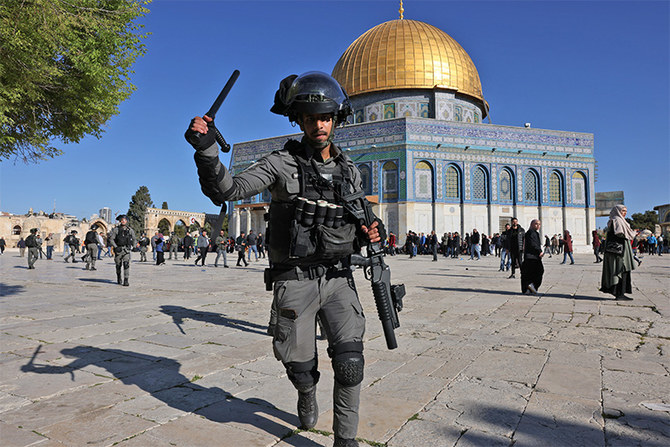
Israeli security forces on Friday raided the Al-Aqsa mosque, when thousands of Palestinians were gathered for prayers during the holy month of Ramadan. Over 150 Palestinians were injured and more than 300 were arrested in clashes set off by the raid.
“Reports of Israeli forces’ raid on Al-Aqsa Mosque, today, indicate 152 injured and more than 300 Palestinians detained,” the Pakistani foreign office said in a statement.
“This highly condemnable assault on worshippers, especially during the holy month of Ramadan, is an egregious violation of all humanitarian norms and human rights laws.”
The clashes come at a particularly sensitive time, when Ramadan this year coincides with Passover, a major weeklong Jewish holiday beginning Friday at sundown, and Christian holy week, which culminates on Easter Sunday. The holidays are expected to bring tens of thousands of faithful into Jerusalem’s Old City, home to major sites sacred to all three religions.
In recent weeks, Israeli forces have killed dozens and injured countless Palestinians in the occupied East Jerusalem and other areas.
Pakistani political leaders condemned Israeli attacks on worshippers and demanded immediate action from the UNSC.
Noorul Haq Qadri, former religious affairs minister and a member of Pakistan Tehreek-e-Insaf (PTI), termed Israeli attacks on innocent Palestinians an “absolutely shameful act.”
“The manner in which Al-Aqsa mosque has been desecrated and religious freedom of Palestinian Muslims has been taken away is very shameful and unprecedented in the whole world,” Qadri told Arab News.
He said the last ten days of brutalities by Israeli forces were “even bigger than Hitler’s and the Nazis’.”
“Until the people of Palestine and Kashmir are not given their right to self-determination, this will remain a challenge to world peace,” Qadri said.
“The Al-Aqsa mosque imam contacted me and I assured him Pakistan’s full support and to take his message to the Pakistani government. I will ask Pakistani government to firmly stand up with Palestinians.”
Raja Zafar ul Haq, a member of the ruling Pakistan Muslim League-Nawaz (PML-N) party, condemned continued brutalities by Israeli forces on innocent worshippers.
“Israel is killing Palestinians with impunity and without any justification,” he told Arab News, regretting neither the UN nor International Criminal Court took notice of these human rights violations.
“We should collectively raise this issue at these forums.”
Senator Taj Haider from the Pakistan Peoples Party (PPP) said the Palestinians became victims of extreme cruelty for merely praying at the mosque.
“Pakistan should protest this with full force,” he told Arab News. “The government should call a conference to gather and unite the Muslim world just like former prime minister Zulfiqar Ali Bhutto did in 1974.”
Liaquat Baloch, a member of Jamaat-e-Islami Pakistan, said the Israeli attacks were “a clear violation of the UN charter and an attempt to fuel hatred between different religions.” He said it had been going on for the past several years that Israel attacked worshippers in the holy month of Ramadan.
“The UN Security Council must take notice of this and also the countries with veto power must rethink of their support to Israel,” Baloch said.


![]()

Pakistani political leaders condemn Israeli raid on Al-Aqsa mosque, demand UN action
Short Url
https://arab.news/52enq
Pakistani political leaders condemn Israeli raid on Al-Aqsa mosque, demand UN action
- The raid set off clashes that injured over 150 Palestinians, resulted in arrest of 300 others
- Islamabad calls the raid an ‘egregious violation’ of humanitarian norms and human rights laws
Latest updates


© 2026 SAUDI RESEARCH & PUBLISHING COMPANY, All Rights Reserved And subject to Terms of Use Agreement.