Award-winning Saudi speech disorder treatment primed to go global

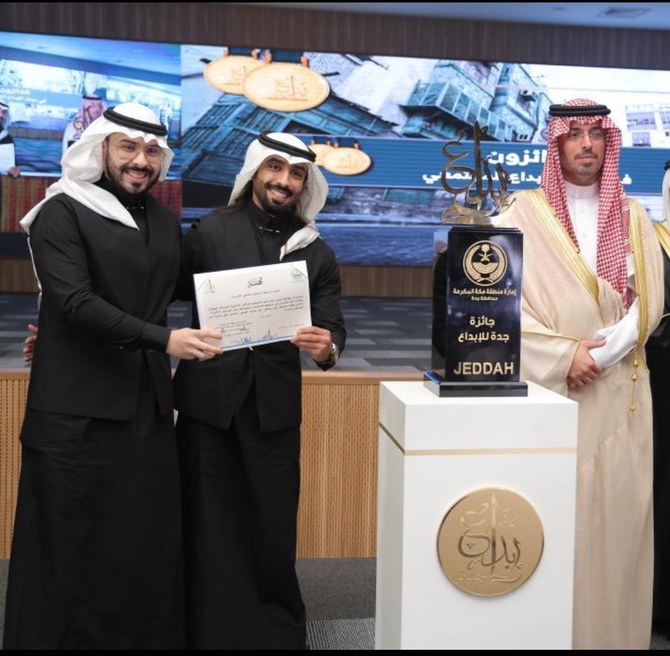
Prince Saud bin Abdullah bin Jalawi, Jeddah's acting governor (Right) in a photo with Dr. Abdullah Kreshan, supervisor of SSC project (Left) and Ahmed Al-Muhanna, project manager, after handing a creativity award to SSC. (Supplied)
Short Url
Updated 14 April 2022
Follow

Award-winning Saudi speech disorder treatment primed to go global

  • The SSC was recently presented with the Jeddah Prize for Community Creativity

JEDDAH: Officials behind an award-winning Saudi health project to help stutterers overcome the debilitating speech disorder are aiming to offer the treatment globally.

As part of the Smart Stuttering Community scheme, more than 400 people in the Kingdom have successfully completed five-day therapy sessions designed to bring their disfluency conditions under control.

And with an estimated 80 million sufferers around the world, SSC organizers are aiming to link up with Saudi, Middle East, and international health bodies to promote the drug-free treatment.

The SSC was recently presented with the Jeddah Prize for Community Creativity during a ceremony on the sidelines of the fifth edition of the Makkah “How to Set an Example” initiative, an event held under the patronage of Makkah Deputy Gov. Prince Badr bin Sultan bin Abdulaziz.

Dr. Abdullah Kreshan, general supervisor of the SSC project, said the organization hoped the accolade would pave the way for more regional and international awards and recognition.

He pointed out that the scheme was the first of its kind in Saudi Arabia and the Middle East, positively changing the lives of stutterers by helping them to speak more fluently and coherently within days, adding that an estimated 350,000 people in the Kingdom had the disorder.

“We offer specialized workshops with a number of experts who work on the main cause of the problem, breathing. Stuttering is caused by a disturbance in the human respiratory system,” Kreshan said.

“When academicians from King Abdulaziz University, the University of Jeddah, and Effat University looked into our research they, along with KAU President Dr. Abdulrahman Al-Youbi, showed great interest in our project and suggested a higher coordination with the Ministry of Education once our academic research was over,” he added.

He noted that a KAU research team had been assigned to monitor the project and that when the treatment methodology had been officially registered their research could be published globally. The SSC was also working alongside a scientific team from the same university on a scholarly work.

Kreshan said video-recorded interviews had been carried out with the 400 people in Saudi Arabia who had already been helped to overcome the speech disorder.

“We interviewed these people before and after receiving the therapy, as we want those joining our programs to help us spread awareness through the videos. We also have certificates from guardians, proving we have succeeded in assisting their relatives to become normal speakers.”

Stuttering, he added, was a physiological disorder of the respiratory system that could be caused by either a genetic factor or the shock of a traumatic experience, such as being chased by a dog.

Kreshan pointed out that a normally functioning respiratory system was important to forming words and sounds.

“It starts between the ages of one and six. We all learn to speak when we are young, and this is called the sub-conscience mindset. During these early years, we usually do not teach our children in a conscious way,” he said.

But in later life, experiences such as parental divorce, a car accident, strict teacher, or being trapped in an elevator, could disrupt breathing and trigger a stutter.

“After that, another problem arises. The brain begins to get used to the new way of speaking, and as there is no other alternative in communicating with people, stuttering becomes a habit,” he added.

“We host stutterers in five-star hotels and subject them to a five-day training camp in which they receive intensive scientific, psychological programs to help them get rid of producing unnecessary repetitive sounds,” Kreshan said.

The SSC was now only admitting applicants aged 15 or over. “As for stutterers aged from seven to 14, no institute or organization in the world is dealing with their cases,” he added.

He noted that around 70 to 80 percent of stutterers in the world were male, and that the condition usually developed in people aged between five and 20. With help, it often disappeared over time, and in rare cases went of its own accord, he said.


‘I feel seen,’ says Saudi storyteller Noura Alashwali

Saudi visual storyteller Noura Alashwali’s debut graphic novel began as a way to process grief in private. (Supplied)
Updated 6 sec ago
Follow

‘I feel seen,’ says Saudi storyteller Noura Alashwali

  • Ministry of Culture-backed incubator helped Jeddah local create her first graphic novel

JEDDAH: Visual storyteller Noura Alashwali is one of a generation of Saudi artists whose personal journeys mirror the Kingdom’s cultural transformation, meaning their creative impulses are increasingly backed by public institutions and have an audience ready to listen.

“Creative expression was never just a hobby for me; it was a need,” Alashwali, 37, told Arab News. “From a young age, whether through writing or drawing, creativity felt like a part of who I was. And it still is.”

It was her education at Dar Al-Hekma University, where she obtained a degree in graphic design, that gave structure and language to an instinct she had carried since childhood. 

Saudi visual storyteller Noura Alashwali’s debut graphic novel began as a way to process grief in private. (Supplied)

“My earliest memory of drawing with pen and paper is when I was four years old, and I still have those drawings,” she said. Like many artists, she experimented with various mediums as she grew older. Eventually, she found her way to a Saudi art center that she described as “a very popular and wonderful place to learn art.”

At university, Alashwali’s work turned digital. “When I learned about the major, I immediately felt that I belonged. Graphic design is about visual communication. It’s not just about creating art, but about communicating ideas, thoughts, and stories.”

Those ideas would take on a personal weight in 2023 with “Deema and the Old Letters,” her debut graphic novel.

When an idea comes to me (now), I take it more seriously. I honor it and commit to it. I say, ‘Thank you for choosing me. I’m going do my best to manifest you.’

Noura Alashwali, Saudi storyteller

“It was a way for me to process my grief after my mother passed away in 2023,” Alashwali explained. “I was simply writing and drawing while processing very heavy emotions.” 

Noura Alashwali's creativity was supported by the Literature, Publishing and Translation Commission's Authors’ Incubator Program in 2024. (Supplied)

What transformed that intimate archive into a published work was institutional support. In early 2024, Alashwali came across an open call from the Ministry of Culture’s Literature, Publishing and Translation Commission for its Authors’ Incubator program. 

The inclusion of graphic novels and comics among the supported genres caught her attention. She assembled her materials into a PDF, applied, and was accepted.

For the six-month Riyadh-based program she was paired with a mentor, Dr. Hanan Al-Ghadi from Princess Nourah University, and supported logistically. By November 2024, she had signed with Rashm, a publishing house collaborating with the commission.

Alashwali contrasts the protagonist’s depression with the warmth of Jeddahwi landscapes. (Supplied)

Beyond the mentorship and funding, the experience reshaped her sense of self.

“It felt like a dream. Because of institutional support from the Ministry of Culture, I feel validated. I feel seen,” she said. “It encouraged me to take my practice seriously — not just as self-expression, but as something that contributes to the Saudi cultural scene.”

Initiatives such as the incubator program do not merely teach skills; they signal that deeply personal stories of grief, love and memory have a place in the public cultural sphere.

Alashwali contrasts the protagonist’s depression with the warmth of Jeddahwi landscapes. (Supplied)

While Alashwali hopes her work will be translated into English, publishing in Arabic for Saudi readers was the natural choice. “It’s great to contribute to the local scene with an Arabic graphic novel,” she said.

“Deema and the Old Letters” traces a young woman’s journey through pain and grief, using moonlit symbolism and visual poetry to explore art as a means of self-discovery and healing.

“I wanted it to feel intimate and personal. So ‘Deema’ is also designed like a journal,” Alashwali noted.

The protagonist’s depression is juxtaposed with the warmth of Jeddahwi landscapes. 

“Jeddah is home. And when you are home, you’re being your most authentic self,” Alashwali said. “It’s a very kind and happy city; very welcoming and down-to-earth.”

The literature commission’s incubator also expanded Alashwali’s creative world, connecting her to artists from across the Kingdom, including Riyadh, Baha, and the Eastern Province. 

“We have lots of beautiful cultures and stories in Saudi Arabia,” she said. “I have developed close friendships which contributed to my creative practice and personal growth.”

This sense of cross-regional exchange reflects a shift: Artists who once worked in silos are now being given room to meet, collaborate and be heard. 

“What I enjoy most about being a storyteller in Saudi Arabia is that the scene is still fresh. People notice new work and genuinely connect with it,” Alashwali said. “It doesn’t feel overcrowded and overwhelming.”

Besides the literature commission, she has worked with the Visual Arts Commission and the Heritage Commission, including a workshop on creating eyeglass frames using Saudi craft techniques, created in collaboration with Italian gallery Moi Aussi and the Saudi Artisanal Company. 

At Hayy Jameel in December, as part of the three-day “Soul of Palestine” program, Alashwali led a visual storytelling workshop where participants created digital illustrations to celebrate Palestinian heritage and culture.

Earlier in 2025, she participated in the Jeddah Book Fair and the Riyadh International Book Fair. In Jeddah, she worked with younger audiences on transforming emotions into short comics. In Riyadh, the focus shifted to books and artistic practice. 

Across these settings, her metric for success remains emotional rather than technical. “It’s when I feel the participants have opened their hearts and try to transform their emotions into a comic, regardless of the drawing skills,” she explained.

Alashwali’s next project is inspired by conversations with her five-year-old daughter. “One day, after smelling a vanilla perfume she loves, she told me: ‘Mama, I think this is the smell of my heart.’ She believed it completely,” she said. “That idea stayed with me — the thought that the world might be kinder if we could smell hearts. So, the project will take the form of a directory of heart scents.”

Her plans for 2026 are modest. “I hope to dedicate more time and energy to my art,” she said. “If that doesn’t happen, publishing my next book will be enough.”

Underpinning it all is a philosophy she returns to — one espoused in one of her favorite books, “Big Magic,” in which Elizabeth Gilbert writes about ideas as living entities searching for someone to bring them into the world.

“As a Muslim, I believe these ideas are created by God,” said Alashwali. “When an idea comes to me now, I take it more seriously. I honor it and commit to it. I say, ‘Thank you for choosing me. I’m going do my best to manifest you.’”