

Over 2,000 Indian Sikhs in Pakistan for Vaisakhi harvest festival starting today

Sikh pilgrims wave from a bus before leaving to Pakistan for 'Baisakhi', a spring harvest festival for Sikhs and Hindus, in Amritsar on April 12, 2022. (AFP)
Short Url
Updated 13 April 2022
Follow

Over 2,000 Indian Sikhs in Pakistan for Vaisakhi harvest festival starting today

  • Main ceremony for critical day in Sikh religion to be held at Gurdawara Panja Sahib in Hasan Abdal tomorrow
  • Around 400 Railways policemen deployed for security of pilgrims, special commandos and snipers on duty

ISLAMABAD: Over 2,000 Sikh pilgrims entered Pakistan on Tuesday from the Wagah border crossing to attend the annual Vaisakhi harvest festival starting today, Wednesday.
The main ceremony of Vaisakhi, a New Year’s celebration as well as a critical day in the formation of the Sikh religion, will be held at the Gurdawara Panja Sahib shrine in the town of Hasan Abdal outside Islamabad tomorrow, Thursday, in which thousands of Sikhs will perform the cleansing ritual of ashnan, or bathing.
The shrine is one of Sikhism’s holiest sites and it is believed that the handprint of the founder of the religion, Guru Nanak, is imprinted on a boulder there. Vaisakhi is also meant to mark the day when Gobind Singh, the 10th and final prophet, established the discipline of Khalsa, through which the faithful can aspire to the ultimate state of purity.

Sikhs are a small minority in Muslim-majority Pakistan, but many Sikh holy sites ended up in the country after the 1947 partition from India following independence from Britain.


Sikh pilgrims shout slogans before leaving to Pakistan for 'Baisakhi', a spring harvest festival for Sikhs and Hindus, in Amritsar on April 12, 2022. (AFP)

Many Sikhs also see Pakistan as the place where their religion began: the founder of Sikhism, Guru Nanak, was born in 1469 in a small village near the eastern Pakistani city of Lahore.
“Whenever we come to Pakistan, the land of our gurus, we feel very happy and relaxed ... this time too, we have come here with a lot of love for the people of Pakistan,” Sardar Arvinder Singh, the leader of a Sikh group that arrived in Pakistan, told media at the Wagah border crossing, adding that he was thankful to the Pakistan government for issuing visas in such large numbers.
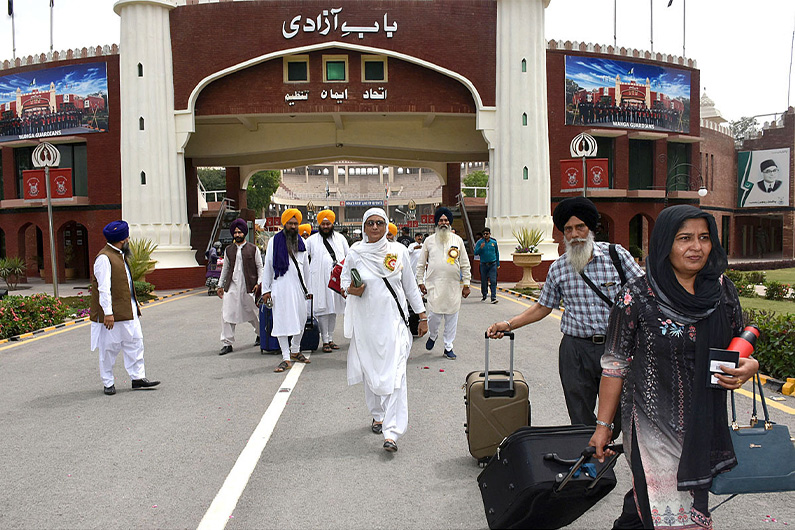


Sikh pilgrims arrive in Lahore, Pakistan for 'Baisakhi', a spring harvest festival for Sikhs and Hindus on April 13, 2022. (APP)

Delhi Gurdwara Management Committee chief Sardar Sukhbeer Singh said Pakistan and India shared the “same culture” and Sikhs always “felt comfortable” in Pakistan.



Sikh pilgrims queue to board a bus before leaving to Pakistan for 'Baisakhi', a spring harvest festival for Sikhs and Hindus, in Amritsar on April 12, 2022. (AFP)

“The arrangements made by the Pakistan government for us are impressive,” he added.
The Pakistan High Commission in New Delhi this year issued visas to 2,200 pilgrims out of whom 2,044, including women, crossed into Pakistan via Wagah to attend the festival on Tuesday. After having food at Wagah, the pilgrims left for Hasan Abdal on special buses and trains with escorts from the Railways Police, district police and other law enforcement agencies. They reached the town by 8pm.


Sikh pilgrims queue to board a bus before leaving to Pakistan for 'Baisakhi', a spring harvest festival for Sikhs and Hindus, in Amritsar on April 12, 2022. (AFP)

“Due to security issues, the pilgrims were not allowed to get off the trains on their way to Hasanabdal,” a spokesperson for Railways told media on Tuesday. “Similarly, they wouldn’t be allowed to get off the trains or other transport whenever they are traveling in Pakistan during their trip.”
Around 400 Railways policemen have been deployed for the security of the pilgrims.
“Special commandos and snipers have also been deployed at each railway station, especially Wagah, Lahore, Hasanabdal and Nankana Sahib,” Pakistan’s Dawn newspaper reported.


US sees 18 percent rise in Pakistani students despite UGRAD pause, opens new USEFP headquarters

Updated 9 sec ago
Follow

US sees 18 percent rise in Pakistani students despite UGRAD pause, opens new USEFP headquarters

  • USEFP inaugurates purpose-built campus in Islamabad as Fulbright program marks 75 years in Pakistan
  • Undergraduate UGRAD program remains suspended but graduate scholarships and visas continue, US officials say

ISLAMABAD: The United States inaugurated a new purpose-built headquarters for the United States Educational Foundation in Pakistan (USEFP) this week, as American officials reported an 18 percent rise in Pakistani students studying in the US, despite the suspension of a major undergraduate exchange scheme earlier this year.

The launch comes as the Fulbright program completes 75 years in Pakistan, the world’s largest US-funded scholarship portfolio for master’s and PhD study. Officials said growing student mobility and stable visa issuance reflect continued academic engagement between the two countries, even after the UGRAD exchange program was paused in April.

USEFP Executive Director Peter Moran told Arab News that Pakistani students are still securing visas without unusual difficulty and enrollment levels remain strong.

“We are not finding that Pakistani students are facing undue difficulties getting their visas when they want to go and study on their own. The number of Pakistani students who are studying in the United States, actually based on data from the year before last, because you know there’s always a lag, it’s up 18 percent,” Moran said, citing 2023 figures.

He said nearly 10,000 Pakistanis are currently enrolled in US institutions, including self-funded students. While UGRAD, which previously sent 100–130 undergraduates per year, remains paused under US budget adjustments, Moran said there is hope it will return.

“So, the UGRAD program for now is on pause ... the UGRAD program sent undergraduate, actually high school students. That program ended in April. We don’t know when that will come back, but we sure hope that it will.”

USEFP clarified that no reductions have been applied to graduate programs.

“There is no cut on Fulbright… and we don’t anticipate there being any,” Moran added.

Around 65 Pakistani scholars left for the US through Fulbright this year, another 10–12 departed under the Humphrey Fellowship, and USEFP expects next year’s Fulbright cohort to rise to 75–80.

The inauguration of the new headquarters brought together US officials, scholarship alumni and education leaders.

US Embassy Minister Counselor for Public Diplomacy Andy Halus said the new facility reflects the depth of the bilateral academic partnership.

“We have over 9,000 students in Pakistan that have had experience in the United States on the Fulbright programs that started 70 years ago. Our commitment to sending more and more students to the United States on the Fulbright program is strong and it’s going to continue.”

Among attendees was Fulbright alumnus Aftab Haider, the CEO of Pakistan Single Window, the government-backed digital trade clearance platform. He credited the scholarship with shaping his career:

“I am a very proud Fulbrighter from 2008. I think it is one of the most transformational programs that can be offered to young Pakistanis to have the opportunity to be educated abroad, come back to Pakistan and contribute in public service delivery as well as in enhancement of the private sector.”