

RSF urges new UN special rapporteur to act quickly to protect Afghan journalists

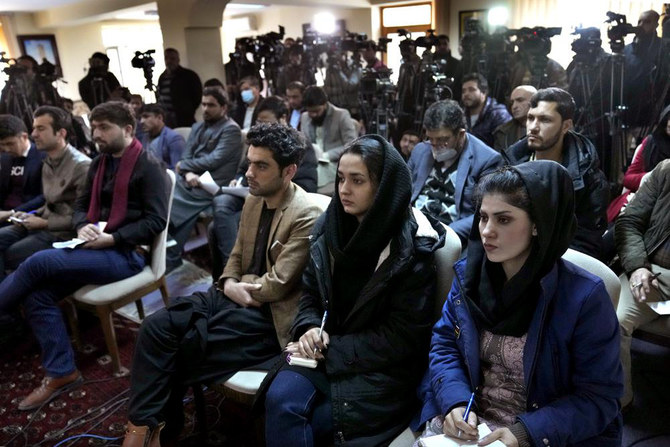
Afghan Journalists attend a press conference of a former president Hamid Karzai in Kabul, Afghanistan, on Feb. 13, 2022. (AP)
Short Url
Updated 12 April 2022
Follow

RSF urges new UN special rapporteur to act quickly to protect Afghan journalists

  • Since the Taliban takeover of Afghanistan in mid-August last year, Afghan journalists and media reporters have lived in increasing fear amid regular reports of arbitrary detentions, arrests and raids of journalists’ homes

LONDON: Reporters Without Borders wrote on Monday to the UN’s new special rapporteur on the human rights situation in Afghanistan, Richard Bennett, urging him to act quickly to defend journalists and press freedom in the country.

“As the regime continues to arrest journalists and step up pressure on the media, the press freedom situation in Afghanistan must not pass under the radar of the international community’s attention,” said RSF Advocacy and Assistance Director Antoine Bernard.

“From the new UN special rapporteur on Afghanistan, Richard Bennett, we expect the maximum possible involvement in support of free, pluralist and independent journalism.”

Bennett, an academic with UK and New Zealand dual nationality, was appointed to the position by the UN Human Rights Council on March 27.

RSF’s letter warns Bennett that press freedom has dramatically worsened in Afghanistan, and that journalists are being arbitrarily arrested and placed under media restrictions.

The new regulations in Afghanistan include a law banning privately owned TV channels from retransmitting news programs provided by international broadcasters, including BBC, Voice of America and Deutsche Welle, in local languages such as Dari, Pashto and Uzbek.

When contacted by RSF, a ministry spokesman blamed the ban on “the problem of the attire worn by these media’s women presenters, after several warnings.”

Since the Taliban takeover of Afghanistan in mid-August last year, Afghan journalists and media reporters have lived in increasing fear amid regular reports of arbitrary detentions, arrests and raids of journalists’ homes.

At least 50 media workers have been arrested by the Afghan police and intelligence services since, and more than 300 media organizations have shut down, with many employees fleeing the country.

Reporters Without Borders ranked Afghanistan 122nd out of 180 countries in the 2021 World Press Freedom Index.


Meta to charge Arab advertisers extra fee for reaching European audiences

Updated 11 March 2026
Follow

Meta to charge Arab advertisers extra fee for reaching European audiences

  • US tech giant told advertisers it will add fees ranging from 2 to 5 percent on image and video ads delivered on its platforms to offset digital service taxes
  • Charges are determined by where the audience is located, not where the advertiser is based

LONDON: Meta will from July 1 impose location-based surcharges on advertisers targeting audiences in six European countries, a move that will directly affect Arab businesses that run campaigns across the continent.

The US tech giant announced it will add fees ranging from 2 to 5 percent on image and video ads delivered on its platforms, including Facebook, Instagram and WhatsApp, to offset digital service taxes imposed by individual governments.

Crucially, the charges are determined by where the audience is located, not where the advertiser is based.

That means Saudi, Emirati, Egyptian or other Arab companies paying to reach consumers in the UK, France or Italy will face the additional costs regardless of their own country’s tax arrangements with Meta.

Fees will apply at 2 percent for ads reaching UK audiences, 3 percent for France, Italy and Spain, and 5 percent for Austria and Turkiye.

“If you deliver $100 in ads to Italy, where there is a 3% location fee, you will be charged $100 (ad delivery), plus $3 (location fee), for $103 total,” the company wrote in an email to an advertiser initially reported by Bloomberg. “Note that any applicable VAT will be calculated on top of the total amount.”

The taxes have been introduced at different points, starting with France in 2019, though not the EU as a bloc.

Many tech companies report substantial sales in Europe and millions of users but pay minimal tax on profits. The goal is to claw back locally derived economic value, Bloomberg reported.

The move follows similar decisions by Google and Amazon, which have also begun passing European digital tax costs on to advertisers.

For Arab brands with growing European footprints, particularly in fashion, travel, hospitality and media, the new fees add another layer of cost to campaigns already subject to currency and targeting complexities.

Digital services taxes, levied as a percentage of revenues earned by major tech platforms in individual countries, have drawn criticism from Washington, which argues they unfairly target US companies.

Meta has been reached for comments.